
Hookdeck
Hookdeck provides infrastructure for receiving, managing, and delivering webhooks and other external events.
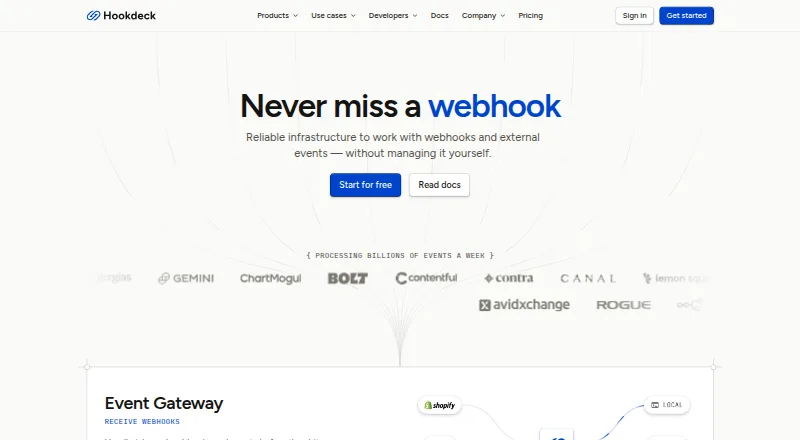
What Hookdeck is
Hookdeck provides infrastructure for receiving, managing, and delivering webhooks and other external events. Its Event Gateway ingests and queues incoming events, then can transform and deliver them with controls for signature verification, conditional filtering and routing, retries, logs, alerts, tracing, and replay. Outpost adds event delivery to APIs, SaaS, and PaaS products, with managed and self-hosted options. Listed destinations include webhooks, Amazon SQS, RabbitMQ, Google Pub/Sub, AWS EventBridge, Apache Kafka, and the Event Gateway. The CLI can forward webhook events to a local web server and replay or inspect the forwarded data. The free Developer plan includes up to 10,000 events and three-day retention; after the limit is exceeded, the dashboard locks until upgrade or the next billing period. A 14-day trial for inviting team members is listed, subject to Developer usage limits. Developer support is through community Slack, while Enterprise lists Slack Connect with premium support.
Good
- Event controls include retries, tracing, and replay
- Outpost offers managed and self-hosted options
- CLI can forward, replay, and inspect webhook events
- Free Developer plan includes up to 10,000 events
Watch out
- Developer retention is three days
- Dashboard locks after exceeding 10,000 events
Who it suits
Hookdeck suits developers and teams building event-driven systems that receive events from external providers and deliver them to their own systems. Its self-hosted option may suit teams seeking to run event delivery themselves.
Verdict
Hookdeck offers a focused set of tools for event ingestion, delivery, and operational visibility. The free Developer plan has a firm event limit and short retention period, so teams should consider their usage needs.
Plans and prices
From Hookdeck's own pricing page, checked 15 Oct 2026.
| Plan | Price | What it gives you |
|---|---|---|
| Developer | Free | 10,000 events · 3-day retention · 1 user · SOC 2 compliance · Always $0 /month |
| Self-hosted | Free | Open source · Apache 2.0 licensed · community support · Always free |
| Self-hosted Outpost | Free | Apache 2.0 licensed · any cloud · minimal dependencies · community support · Always free |
| Starter | Free | Uncapped throughput · unlimited seats · 7-day retention · $10 per million events · Pay-as-you-go; first 50k events free |
| Starter Outpost | $10 a month | First 50,000 events free · uncapped throughput · unlimited seats · 7-day retention · SOC 2 · OpenTelemetry · Pay-as-you-go $10 per million events |
| Team | $39 a month | 10,000 included events · pay-as-you-go · 7-day retention · unlimited users · Slack, Discord, Microsoft Teams, PagerDuty, Better Stack Uptime, incident.io and Sentry integrations · Starts at $39 /month |
| Growth Outpost | $499 a month | 50,000 included events · 30-day retention · 99.99% uptime SLA · SSO/SAML/SCIM · HIPAA · multi-region · Starts at $499 + $10 per million events |
| Growth | $499 a month | 30-day retention · uptime and latency SLAs · Datadog, New Relic and Prometheus export · read-only role · SSO/SAML/SCIM · HIPAA · Starts at $499 /month |
| Enterprise | Priced on request | Premium support · support manager · Slack Connect · custom security compliance · custom SLAs · custom contracts · Inquire for plans |
| Enterprise Outpost | Priced on request | 99.999% uptime SLA · custom retention · premium support · custom security and compliance · custom contracts · Inquire for plans |
The facts
Each one read from Hookdeck's own pages, with the date it was checked.
What it does
- AI workflows
- Documentation describes connecting OpenAI, Claude and ElevenLabs workflows with delivery timeouts up to 15 minutes and concurrency caps.checked 15 Oct 2026
- API and infrastructure as code
- Hookdeck exposes an API for configuring connections and retrieving events and provides a Terraform provider.checked 15 Oct 2026
- Audience
- Hookdeck describes its Event Gateway as infrastructure for event-driven systems that need to receive events from external providers and deliver them to their systems.checked 28 Sep 2026
- Changelog news
- The changelog records Node.js transforms on October 12, 2026, two-way Sentry integration on October 5, and EventBridge, Cloudflare Queues and destination proxies on October 2.checked 15 Oct 2026
- Developer tools
- CLI forwards webhooks to localhost, Console provides a test capture URL, and Radar alerts on third-party webhook latency.checked 15 Oct 2026
- Documentation depth
- The documentation includes product concepts, quickstarts, guides, API reference, CLI reference, MCP resources and configuration references.checked 15 Oct 2026
- Event Gateway
- The Event Gateway ingests, queues, transforms, and delivers inbound webhooks and events with operational control and observability.checked 28 Sep 2026
- Event handling
- The Event Gateway supports signature verification, conditional filtering and routing, configurable retries, event queues, logs, alerts, tracing, and replay.checked 28 Sep 2026
- Funding
- Crunchbase identifies Hookdeck Technologies Inc. as a Montreal seed-stage company and lists 11 investors, including Chris Nguyen and Brian Vallelunga; the funding amount is not publicly shown there.checked 15 Oct 2026
- Inbound gateway
- Event Gateway sits between webhook providers and applications, providing durable queues, filtering, transformations, retries and delivery control.checked 15 Oct 2026
- Independent API assessment
- Anchor Terminal reports a public OpenAPI 3.0.1 specification with 135 operations, a 240-requests-per-minute API-key limit and a beta MCP server that defaults to read-only tools.checked 15 Oct 2026
- Integrations
- Team integrations include Slack, Discord, Microsoft Teams, PagerDuty, Better Stack Uptime, incident.io and Sentry; Growth exports metrics to Datadog, New Relic and Prometheus.checked 15 Oct 2026
- Licence
- Outpost is distributed under Apache License 2.0, while Hookdeck's hosted Event Gateway is delivered as a service.checked 15 Oct 2026
- Limit: CLI and integrations
- G2 reviewers mention troublesome multi-instance CLI setup, a desire for n8n integration and missing loop-prevention safeguards.checked 15 Oct 2026
- Limit: pricing
- Several G2 reviewers describe throughput or overall pricing as high, steep or less suitable for small workloads.checked 15 Oct 2026
- Limit: static IPs
- A G2 reviewer reports that rotating cloud IPs prevent client IP allowlisting unless the customer self-hosts, reducing the convenience of the managed service.checked 15 Oct 2026
- Observability
- The platform records requests, events and attempts and provides metrics for latency, throughput, errors and backpressure.checked 15 Oct 2026
- Open-source repository
- The public Outpost repository describes a Go and Docker-distributed, Apache-2.0 system with at-least-once delivery, tenant isolation, retries, fan-out, OpenTelemetry and webhook signature rotation.checked 15 Oct 2026
- Outbound delivery
- Outpost adds outbound webhook and event delivery for SaaS or platform products and can be managed by Hookdeck or self-hosted.checked 15 Oct 2026
The company
- Company
- The company page identifies Alex Bouchard as co-founder and CEO and Maurice Kherlakian as co-founder and CTO.checked 28 Sep 2026
- Company identity
- The legal company name shown on Hookdeck's company page is Hookdeck Technologies Inc.; founders listed are Alex Bouchard and Maurice Kherlakian.checked 15 Oct 2026
- Company profile
- LinkedIn lists Hookdeck as privately held software-development company headquartered in Montreal, with 11–50 employees and a 2020 founding year.checked 15 Oct 2026
Money
- Plan limits
- The Developer plan includes up to 10,000 events and 3-day retention; the pricing FAQ says the dashboard locks after exceeding 10,000 events until upgrade or the next billing period.checked 28 Sep 2026
Where it runs
- Platforms
- The CLI installation guide lists macOS, Windows, Linux, and Docker installation options.checked 28 Sep 2026
The full review of Hookdeck
Hookdeck is event infrastructure for software that receives webhooks from external providers and needs to route them reliably into its own systems. It suits developers and teams operating event-driven services; its strongest case is the combination of delivery controls and operational visibility, while the free tier’s hard cap makes it a poor fit for sustained higher-volume use.
Overview
Hookdeck’s Event Gateway handles inbound events from ingestion through queuing, transformation, and delivery. Signature checks, conditional routing, retries, logs, alerts, tracing, and replay give teams tools to manage failures and inspect event flows rather than treating webhooks as fire-and-forget requests.
Outpost adds outbound event delivery for APIs, SaaS, and PaaS products, with managed and self-hosted options. The Hookdeck CLI forwards webhook events to a local web server and supports inspection and replay, useful when developing against event-driven integrations. This is specialized infrastructure, not a general-purpose app; its value depends on whether external event flows are central to the system.
Hookdeck is in Webhook Management Software.
Key features
- Inbound event controls: Queues, signature verification, conditional filters and routes, configurable retries, and replay address common delivery and troubleshooting needs. Logs, alerts, and tracing add operational visibility.
- Outbound delivery: Outpost supports delivery to APIs, SaaS, and PaaS products. Destinations include webhooks, Amazon SQS, RabbitMQ, Google Pub/Sub, AWS EventBridge, Apache Kafka, and Hookdeck’s Event Gateway, giving teams several established event systems to target.
- Local development: The CLI forwards events to a local web server and lets developers inspect or replay the forwarded data, helping work on integrations without limiting event handling to deployed services.
- Security and deployment: The Event Gateway displays SOC 2 Type II, SCIM, RBAC, SSO, HIPAA, GDPR, CCPA, and PIPEDA badges. Hookdeck offers managed and self-hosted deployment; the self-hosted plan is open source under Apache 2.0.
Pricing
Hookdeck has a free Developer plan, pay-as-you-go Starter pricing, paid Team and Growth plans, and custom-priced Enterprise. A 14-day trial allows inviting team members, but Developer usage limits continue to apply during it.
- Developer — $0 /month, always: Includes up to 10,000 events, 3-day retention, one user, and 100,000 included discarded requests. The dashboard locks after 10,000 events until upgrading or the next billing period, so this is best for evaluation or small workloads, not a service that must keep running through a quota overrun.
- Self-hosted — always free: Provides the Apache 2.0-licensed open-source software with community support. It avoids a hosted-plan price but is the choice for teams prepared to self-host.
- Starter — first 50k events free; $10 per million events: Pay-as-you-go pricing includes uncapped throughput, unlimited seats, and 7-day retention. It suits variable traffic or teams wanting room to scale without a fixed monthly tier; beyond the first 50k events, usage is metered.
- Team — starts at $39 /month: Includes 10,000 monthly events, 7-day retention, unlimited users, and metered additional events. It provides more retention and collaboration than Developer, but the included event allowance is the same, so higher volume adds cost.
- Growth — starts at $499 /month: Includes 10,000 monthly events, 30-day retention, unlimited users, with additional events metered. It is aimed at teams that need longer history; the higher starting price does not raise the included monthly event count.
- Enterprise — custom pricing: Offers custom usage and retention, a 99.999% uptime SLA, premium support, and custom security and compliance. This fits organizations needing tailored terms and an explicit uptime commitment.
Developer, Team, and Growth include community Slack support; Enterprise includes Slack Connect with premium support. The sharpest trade-off is between the free plan’s predictable zero cost and its short retention and dashboard lock, versus paid plans that add retention and seats but meter usage above their included event allowance.
Platforms
Hookdeck supports API, Linux, macOS, web, and Windows, as well as self-hosted deployment. That range accommodates both hosted workflows and teams operating their own installation.
Who it's for
Hookdeck is a strong fit for developers and teams that receive events from outside providers and need to route, retry, inspect, and replay them as part of event-driven systems. Outpost also suits API, SaaS, and PaaS products adding outbound event delivery. It is less compelling for low-volume users who need little operational control, or workloads that cannot tolerate the Developer plan’s lock after its event cap.
Pros and cons
- Pro: Inbound controls span signature verification, routing, retries, and replay, alongside logs, alerts, and tracing, reducing the need to treat delivery failures as opaque.
- Pro: The CLI supports local forwarding, inspection, and replay, while Outpost covers outbound delivery and multiple event destinations.
- Pro: Starter offers uncapped throughput and unlimited seats with usage-based pricing, and self-hosting is available under Apache 2.0.
- Con: Developer is limited to 10,000 events, one user, and 3-day retention; exceeding the event limit locks the dashboard until upgrade or the next billing period.
- Con: Team and Growth each include only 10,000 monthly events, with additional events metered, so their monthly starting prices do not remove volume-based cost growth.
- Con: Starter’s 7-day retention is shorter than Growth’s 30 days, and self-hosting trades managed deployment for operating the software yourself.
Alternatives
Pick Dispatch if its Free plan’s 10,000 events per month, 3-day history, and two members suit a small team; it drops over-limit events at ingress, while Hookdeck locks the dashboard after its Developer cap.
Webhook Relay is another freemium option for readers comparing webhook-management tools.
Choose Convoy if its free Community plan’s one-user, one-organisation allowance and incoming and outgoing webhooks with automatic retries and message-broker support match your needs.
Hook0 is another freemium option for readers comparing webhook-management tools.
Consider Repost if a free plan with a 50K events-per-month hard cap, one seat, three buckets, and 30-day history better fits the workload; its Starter plan is $32.00 per month.
Svix is another freemium option for readers comparing webhook-management tools.
RelayHQ and Hookbridge are also freemium alternatives.
Verdict
Choose Hookdeck when webhook and external-event delivery is core infrastructure and your team needs routing, retries, replay, and operational visibility in one system. Its event controls and deployment flexibility are the draw; look elsewhere if the Developer cap and lock are too restrictive, or if you need longer retention without paying for a higher tier.
Getting started
- Visit https://hookdeck.com/.
- Choose a plan: Developer, Self-hosted, Starter, Team, Growth, or Enterprise.
- Use the 14-day trial for inviting team members, subject to Developer usage limits.
- Use the Hookdeck CLI to forward webhook events to a local web server.
Limits worth knowing
The free Developer plan includes up to 10,000 events, three-day retention, one user, and 100,000 included discarded requests. Its dashboard locks after the event limit is exceeded until upgrade or the next billing period. The free Self-hosted plan is Apache 2.0 licensed and includes community support.
Questions
Is Hookdeck free?
Yes. The Developer plan is billed at $0 per month and includes up to 10,000 events. A separate self-hosted plan is also listed as always free.
What do paid plans cost?
Starter is pay-as-you-go, with the first 50,000 events free and $10 per million events.
Is there a free trial?
Yes. Hookdeck lists a 14-day trial for inviting team members, while Developer plan usage limits still apply.
What platforms does Hookdeck support?
Its listed platforms are API, Linux, macOS, self-hosted, web, and Windows.
Is Hookdeck open source?
The Self-hosted plan is open source and Apache 2.0 licensed.
Which event destinations does Outpost list?
Outpost lists webhooks, Amazon SQS, RabbitMQ, Google Pub/Sub, AWS EventBridge, Apache Kafka, and the Hookdeck Event Gateway.
Alternatives to Hookdeck
- 1
Kiosk
Free planOpen sourceAndroidiOSWebExtension8.0Free plan - 2
WebhookX
Free planOpen sourceWebAPILinuxmacOS8.0From $39 a month - 3
Svix
Free planOpen sourceWebAPILinuxSelf-hosted7.8From $20 a month - 4
RelayHQ
Free planWebAPILinuxmacOS7.7From $29 a month - 5
Dispatch
Free planWebAPILinuxmacOS7.6From $39 a month - 6

Convoy
Free planWebAPILinuxSelf-hosted7.4From $999 a month