Dispatch
Dispatch is a cloud service that receives webhooks, processes events, and sends them to Discord, Slack, Telegram, or custom HTTP endpoints.
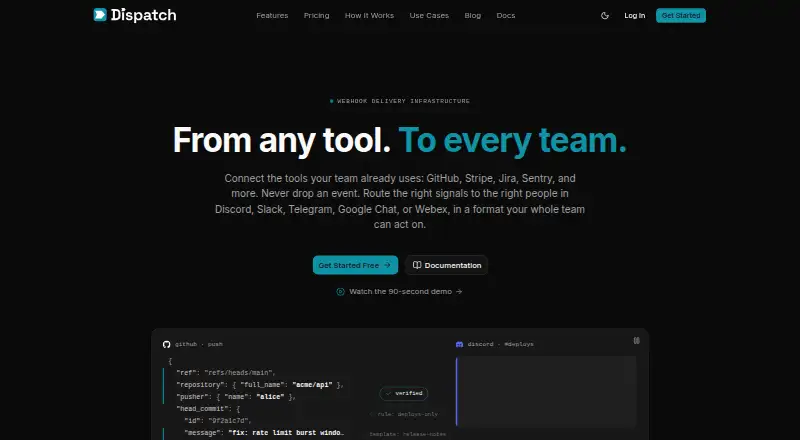
What Dispatch is
Dispatch is a cloud service that receives webhooks, processes events, and sends them to Discord, Slack, Telegram, or custom HTTP endpoints. It verifies incoming requests before storage, applies filters, formats payloads, and routes events to linked destinations. Filters can use header or body fields, and JSONata expressions can transform event data. Templates support Discord embeds, Slack Block Kit, and Telegram HTML with platform-specific variants. Failed deliveries can be retried with configurable exponential backoff, up to seven attempts by default. Documented sources include GitHub, GitLab, Bitbucket, Jira, Linear, OpenAI, Shopify, Stripe, and other services; destinations also include Google Chat and Webex. Its CLI can forward events through a secure tunnel to a local development server, with binaries for Linux, macOS, and Windows. Project-scoped API keys provide programmatic access. The Free plan allows 10,000 events per month and three days of history, but drops over-limit events at ingress. Free costs nothing; Team is $39 a month and Growth is $399 a month.
Good
- Verifies webhook signatures before storing events.
- Filters by header or body fields.
- Retries failed deliveries up to seven times by default.
- Encrypts destination URLs and tokens at rest.
- CLI binaries are available for Linux, macOS, and Windows.
Watch out
- Free plan is limited to 10,000 events per month.
- Free plan keeps history for three days.
- Over-limit Free events are dropped at ingress.
- Cloud deployment only.
Who it suits
Dispatch is intended for developers and teams managing webhook routing, event inspection, delivery to multiple destinations, and integration setup. It may fit teams that need filtering and retry controls for event delivery.
Verdict
Dispatch provides configurable webhook processing and routing, with free and paid monthly tiers. Its Free event cap and history window are important limits for teams choosing a plan.
Plans and prices
From Dispatch's own pricing page, checked 15 Oct 2026.
| Plan | Price | What it gives you |
|---|---|---|
| Free | Free | 10,000 events/mo · 3-day history · 2 members · over-limit events dropped at ingress · public projects only · community support · No time limit |
| Team | $39 a month | 50,000 events/mo · 7-day history · 5 members · $0.03/1K overage · 80% alert · private projects · priority support · monthly |
| Growth | $399 a month | 500,000 events/mo · 30-day history · 25 members · $0.03/1K overage · 80% alert · private projects · dedicated support · advanced analytics · monthly |
The facts
Each one read from Dispatch's own pages, with the date it was checked.
What it does
- API access
- Dispatch provides programmatic access through project-scoped API keys using the dsp_ prefix.checked 30 Sep 2026
- API authentication
- Webhook ingress supports HMAC signatures and project keys prefixed dsp_, while management endpoints use session JWTs.checked 15 Oct 2026
- Authentication and access control
- Dispatch supports TOTP multi-factor authentication, organization roles for owner, admin, developer, and viewer, and row-level security policies.checked 30 Sep 2026
- CLI tunnel
- The dispatch listen command forwards live webhook traffic to a local development server without requiring a public URL.checked 15 Oct 2026
- Delivery reliability
- Dispatch supports automatic retries with configurable exponential backoff and up to seven attempts by default.checked 30 Sep 2026
- Destinations
- Documented destinations include Discord, Slack, Telegram, Google Chat, Webex, and generic HTTP webhooks.checked 15 Oct 2026
- Documentation depth
- The documentation includes quickstart, AI setup, CLI, MCP, concepts, API reference, integrations, dashboard guidance, and generated llms.txt files.checked 15 Oct 2026
- Encryption
- Destination webhook URLs, bot tokens, and OAuth access tokens are encrypted with AES-256-GCM at rest, while client and delivery traffic uses TLS 1.2 or higher.checked 30 Sep 2026
- Event pipeline
- Dispatch verifies requests, stores events, evaluates filters, fans events out to linked destinations, formats payloads, and retries failed deliveries with exponential backoff.checked 30 Sep 2026
- Fan-out
- A single event can be routed to multiple destinations with separate templates and transforms.checked 15 Oct 2026
- Filtering
- Events can be filtered using header or body-field conditions before delivery.checked 15 Oct 2026
- Filtering and transforms
- Events can be filtered by header or body fields and transformed with JSONata expressions before formatting.checked 30 Sep 2026
- Independent architecture disclosure
- A Reddit launch post describes a Go/Fiber backend, Postgres and Redis workers, Next.js and React frontend, Supabase Auth, and an npm-distributed Go CLI.checked 15 Oct 2026
- Independent feature description
- The Reddit post says Dispatch supports provider signatures, JSONata transforms, per-platform templates, routing fan-out, exponential retries, a dead-letter queue, and local tunneling.checked 15 Oct 2026
- Independent product description
- Beta Bots describes Dispatch as one endpoint that routes provider webhooks to Discord, Slack, Telegram, or HTTP endpoints with verification, transforms, retries, and replay.checked 15 Oct 2026
- Infrastructure and disclosure
- Dispatch runs on SOC 2 compliant cloud infrastructure and aims to respond to vulnerability reports within 48 hours.checked 30 Sep 2026
- Integrations
- Documented sources include GitHub, GitLab, Bitbucket, Slack, Jira, Linear, OpenAI, Shopify, Stripe, Vercel, PayPal, Sentry, Supabase, PostHog, Salesforce, Patreon, Twitch, and YouTube.checked 15 Oct 2026
- Intended users
- Dispatch was built for developers and teams managing webhook routing, payload inspection, multi-destination delivery, and integration setup.checked 30 Sep 2026
- Limit: review evidence
- G2 says its field-service Dispatch listing has too few reviews to provide buying insight, and no matching dispatch.tech review profile was identified there.checked 15 Oct 2026
The company
- Company ownership
- LinkedIn classifies Beta Bots LLC as self-employed rather than a public company or subsidiary.checked 15 Oct 2026
- Company size
- LinkedIn lists Beta Bots LLC as having 2–10 employees.checked 15 Oct 2026
- Founded
- LinkedIn lists Beta Bots LLC as founded in 2023.checked 15 Oct 2026
Money
- Limit: free tier overage
- Free-plan events beyond 10,000 per month are dropped at ingress rather than billed or retained.checked 15 Oct 2026
- Limit: free tier privacy
- Free projects are public only; private projects begin on the $39-per-month Team plan.checked 15 Oct 2026
The full review of Dispatch
Overview
Dispatch is a cloud webhook router for developers and teams that need to process incoming events and deliver them to several destinations. It combines verification, filtering, message formatting, and retry handling; its clearest trade-off is that the free tier is limited to public projects and drops events that exceed its cap.
Rather than treating each integration as a separate forwarding path, Dispatch lets teams shape an event and fan it out to linked services. Event inspection and replay add useful oversight, while the short free-plan history makes it a better fit for evaluation or modest workloads than for retaining a long operational record.
Key features
- Verified event pipeline: Provider-specific signatures are checked before events are stored, and failed requests are rejected. That is a sound first gate for teams handling inbound integrations, though it does not remove the need to secure the systems receiving deliveries.
- Filtering and transformation: Rules can use header or body fields, and JSONata expressions can reshape events before formatting. This is useful when a source payload needs adapting for different downstream services without building a separate route for every variation.
- Platform-aware templates: A single template can render Discord embeds, Slack Block Kit messages, and Telegram HTML with variants for each platform. That keeps multi-channel notifications manageable, but the documented destination set also includes Google Chat, Webex, and generic webhooks.
- Retries and recovery: Failed deliveries are retried with configurable exponential backoff, up to seven attempts by default. Inspection and replay provide a path to investigate and resend events; teams with stricter delivery requirements should still account for what happens after those attempts are exhausted.
- Integration and development tools: Documented sources include GitHub, GitLab, Jira, Linear, Stripe, Shopify, and many others. The CLI securely tunnels webhook events to a local development server, with precompiled binaries for Linux, macOS, and Windows; project-scoped API keys support programmatic access.
- Security controls: Destination URLs, bot tokens, and OAuth access tokens are encrypted at rest with AES-256-GCM, and traffic uses TLS 1.2 or higher. TOTP multi-factor authentication, organization roles, and row-level security provide additional access controls. Dispatch runs on SOC 2 compliant cloud infrastructure and aims to respond to vulnerability reports within 48 hours.
Pricing
The Free plan costs nothing and allows 10,000 events/mo, 3 days of history, and 2 members. It is limited to public projects, and over-limit events are dropped at ingress, so it is a poor fit for a production flow where exceeding quota must not silently lose events. Community support is included.
Team costs $39 a month, billed monthly. Its 50,000 events/mo, 7 days of history, 5 members, private projects, and priority support make it the practical starting point for small teams that need private routing. Overage is $0.03/1K, with an 80% alert; the allowance is higher, but teams should still plan around quota and overage costs.
Growth costs $399 a month, billed monthly, for 500,000 events/mo, 30 days of history, 25 members, private projects, and dedicated support. It suits larger teams that need substantially more volume and retention than Team provides, though its price is a significant step up. Overage is also $0.03/1K, with an 80% alert.
All three plans are monthly or free rather than annual commitments in the stated terms. The short retention on Free and Team matters for investigations that happen after the event, while Growth's 30-day window gives more room to review history.
Platforms
Dispatch is a cloud service with API access and support across web, Linux, macOS, and Windows. The local-development tunnel has precompiled Linux, macOS, and Windows binaries; the service itself is not described as self-hosted.
Who it's for
Dispatch is best suited to developers and teams centralizing webhook routing, inspecting payloads, and formatting one event for multiple destinations. It is particularly compelling when signature verification, configurable retries, and platform-specific notification templates belong in the same workflow. Teams needing private projects must choose a paid plan, and those that cannot tolerate dropped events should not rely on the Free cap.
Pros and cons
- Pro: Verification happens before storage, helping reject invalid provider-signed requests at the entrance to the pipeline.
- Pro: Filters, JSONata transforms, and platform variants support useful customization without reducing the product to basic forwarding.
- Pro: Retry controls, event inspection, and replay offer multiple ways to handle and investigate delivery failures.
- Con: Free projects are public, and events above the 10,000 events/mo cap are dropped at ingress, limiting the free tier for dependable production use.
- Con: Free history lasts only 3 days and Team history 7 days, which can constrain later investigation; the 30-day window requires the much pricier Growth plan.
- Con: Team and Growth charge overage at $0.03/1K, so growing traffic can raise the bill beyond the monthly plan price.
Alternatives
For a wider comparison, see Webhook Management Software.
- Hookdeck is worth comparing if its Developer plan's 10,000-event allowance and 3-day retention suit your needs; its free tier also includes 100,000 discarded requests and one user.
- Webhook Relay may suit a smaller, simpler setup: its Free Starter plan allows 150 webhooks/month, up to 2 destinations, and 1 input.
- Convoy is an option for teams seeking incoming and outgoing webhooks, automatic retries, and message broker support on a free Community plan.
- Hook0 may fit a tightly capped, single-developer setup: its free Developer plan allows 1 application, 10 event types, 10 subscriptions, and 100 events/day, with extra events blocked.
- Repost is worth considering if a 50K events/mo hard cap and 30-day history on a free plan matter more than Dispatch's free-tier member allowance.
- Svix offers a Basic plan at $20 a month with 30-day payload retention and 50k free messages/month, a different fit for teams prioritizing longer retention at a lower stated paid price.
- Webhook Management has a Starter plan with 10,000 API requests/month and 7-day log retention for teams comparing a request-based allowance.
- Webhook.site offers a paid Basic plan at $9 a month with one URL, unlimited requests, and 1,000-request history; consider it if that single-URL model fits better than Dispatch's routing workflow.
Verdict
Choose Dispatch if your team needs configurable webhook processing, multi-destination formatting, and retry handling in a cloud service, and the paid quotas match your traffic. The Free plan is useful for modest or public-project workflows, but its ingress drops and brief history are real operational limits; look elsewhere if private access, longer retention, or a different quota model is central to your choice.
Getting started
- Visit https://dispatch.tech/.
- Start with the Free plan for up to 10,000 events per month and public projects.
- Set up source integrations and link destinations such as Discord, Slack, Telegram, or generic webhooks.
- Configure filters, optional JSONata transforms, and message templates for destinations.
- Use a project-scoped API key for programmatic access.
- Install the CLI using a precompiled binary for Linux, macOS, or Windows to tunnel events to a local development server.
- Choose Team at $39 a month or Growth at $399 a month for higher event allowances and private projects.
Limits worth knowing
Free allows 10,000 events per month, three days of history, two members, and public projects only; over-limit events are dropped at ingress. Team includes 50,000 events per month, seven days of history, and five members, while Growth includes 500,000 events per month, 30 days of history, and 25 members.
Questions
Is Dispatch free?
Yes. Free includes 10,000 events per month, three days of history, two members, and public projects only.
What does Dispatch cost?
Team costs $39 a month. Growth costs $399 a month.
Which platforms does Dispatch support?
The listed platforms are API, Linux, macOS, web, and Windows. Precompiled CLI binaries are available for Linux, macOS, and Windows.
Which webhook sources and destinations are documented?
Sources include GitHub, GitLab, Bitbucket, Jira, Linear, Shopify, Stripe, and others. Destinations include Discord, Slack, Telegram, Google Chat, Webex, and generic webhooks.
How does Dispatch handle failed deliveries?
It supports automatic retries with configurable exponential backoff and up to seven attempts by default.
Does Dispatch provide API access and security controls?
It provides project-scoped API keys and supports TOTP multi-factor authentication, organization roles, and row-level security policies.
Alternatives to Dispatch
- 1
Kiosk
Free planOpen sourceAndroidiOSWebExtension8.0Free plan - 2
WebhookX
Free planOpen sourceWebAPILinuxmacOS8.0From $39 a month - 3
Svix
Free planOpen sourceWebAPILinuxSelf-hosted7.8From $20 a month - 4

Hookdeck
Free planWebAPILinuxmacOS7.7From $39 a month - 5
RelayHQ
Free planWebAPILinuxmacOS7.7From $29 a month - 6

Convoy
Free planWebAPILinuxSelf-hosted7.4From $999 a month