Webhook Relay
Webhook Relay receives webhooks, transforms them, and delivers events to public URLs, private servers, localhost, or cloud services such as AWS and GCP.
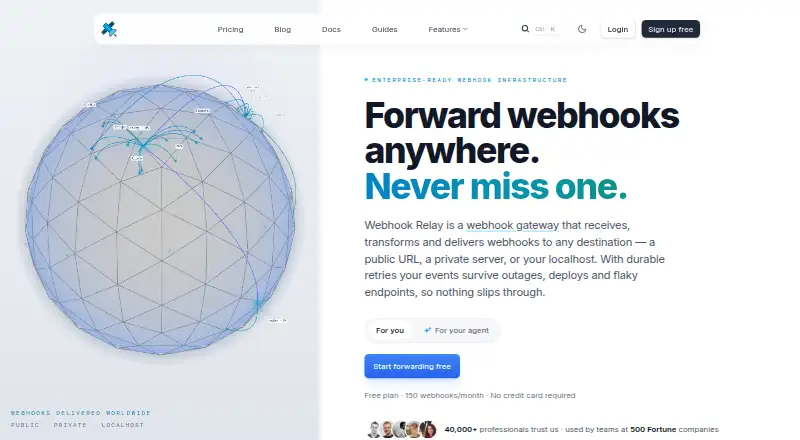
What Webhook Relay is
Webhook Relay receives webhooks, transforms them, and delivers events to public URLs, private servers, localhost, or cloud services such as AWS and GCP. It stores incoming events and retries delivery with exponential backoff for up to 30 days. Payloads can be filtered, routed, and transformed using JavaScript or Lua functions. Its tunnels expose local servers through encrypted connections described as available in multiple regions and non-expiring. The service lists integrations and use cases involving Stripe, GitHub, Shopify, Jenkins, Bitbucket, AWS, GCP, and Azure. Webhook Relay can run on customer infrastructure, with agents available as Linux, Windows, and macOS executables or as a Docker container. The company says it has SOC 2 Type II certification and describes authenticated agents and encrypted tunnels for access to internal services. The free plan includes 150 webhooks per month, up to two destinations, and one input; its pricing FAQ says free-plan buckets are temporarily suspended from receiving webhooks when the monthly quota is reached. Basic costs $8.99 per month and includes 5,000 webhooks per month, 10 destinations, and eight bidirectional tunnels.
Good
- Retries delivery for up to 30 days.
- Payloads can be transformed with JavaScript or Lua.
- Supports public, internal, local, and cloud destinations.
- Can run on customer infrastructure.
- Agents are available for Linux, Windows, macOS, and Docker.
Watch out
- Free plan allows 150 webhooks per month.
- Free plan limits destinations to two and inputs to one.
- Free-plan buckets pause receiving webhooks at quota.
- Basic costs $8.99 per month.
Who it suits
Webhook Relay suits teams that need to route and transform webhook events across public endpoints, internal services, or cloud services. It may also suit users who need local-server tunnels or a self-hosted deployment option.
Verdict
Webhook Relay combines webhook delivery and transformation with retry handling and local tunnels. Review the free-plan quota and destination limits, or consider the listed Basic plan at $8.99 per month.
Plans and prices
From Webhook Relay's own pricing page, checked 30 Sep 2026.
| Plan | Price | What it gives you |
|---|---|---|
| Free Starter | Free | 150 webhooks/month · up to 2 destinations · 1 input · 0 bidirectional tunnels · $0.00/month; $0.00 per year |
| Basic | $8.99 a month | 5,000 webhooks/month · 10 destinations · 8 bidirectional tunnels · extra webhooks $5/1k · $8.99/month; $107.88 per year |
| Business | $71.99 a month | 60,000 webhooks/month · 50 destinations · 20 bidirectional tunnels · large webhooks (40MB) · extra webhooks $10/10k · $71.99/month; $863.88 per year |
| Pro | $224.99 a month | 1M webhooks/month · 200 destinations · 50 bidirectional tunnels · large webhooks (40MB) · extra webhooks $100/1M · $224.99/month; $2,699.88 per year |
| Enterprise | Priced on request | Custom enterprise plans · SAML SSO · SOC2 report · 24×7×365 premium enterprise support · uptime SLAs · Contact Us |
The facts
Each one read from Webhook Relay's own pages, with the date it was checked.
The company
- Company
- The site identifies the company as AppScension Ltd.checked 30 Sep 2026
What it does
- Deployment
- The company says Webhook Relay can be run on the customer's own infrastructure.checked 30 Sep 2026
- Destinations
- It can forward events to public URLs, internal services, localhost, and cloud services including AWS and GCP.checked 30 Sep 2026
- Durable delivery
- The service stores incoming events and retries delivery with exponential backoff for up to 30 days.checked 30 Sep 2026
- Integrations
- The site describes use with providers and tools including Stripe, GitHub, Shopify, Jenkins, Bitbucket, AWS, GCP, and Azure.checked 30 Sep 2026
- Local tunnels
- Its tunnels expose local servers and are described as encrypted, available in multiple regions, and non-expiring.checked 30 Sep 2026
- Product
- Webhook Relay receives, transforms, and delivers webhooks to public URLs, private servers, or localhost.checked 30 Sep 2026
- Security
- Webhook Relay says it has SOC 2 Type II certification and describes authenticated agents and encrypted tunnels for reaching internal services.checked 30 Sep 2026
- Support
- Customers can contact support through the site chat or by email, while the pricing page lists priority support for Business and dedicated support for Pro.checked 30 Sep 2026
- Transformations
- Webhook payloads can be filtered, routed, and transformed using JavaScript or Lua functions.checked 30 Sep 2026
Money
- Free plan limit
- The pricing FAQ says free-plan buckets are temporarily suspended from receiving webhooks when the monthly quota is reached.checked 30 Sep 2026
Where it runs
- Platform support
- The agent is available as Linux, Windows, and macOS executables, and as a Docker container.checked 30 Sep 2026
The full review of Webhook Relay
Webhook Relay is a webhook delivery and tunneling service for developers connecting cloud events to private systems or local servers. Its combination of durable retries, payload transformations, and self-hosting options makes it a strong fit for integration work; the free plan’s small quota and hard pause at its cap call for care.
Overview
Webhook Relay accepts incoming webhooks, adapts their payloads, and forwards them to public endpoints, internal services, localhost, or cloud destinations. It pairs that flexibility with stored events and exponential-backoff retries for up to 30 days, which is more useful for keeping integrations moving than a simple best-effort forwarder.
Event inspection, replay, signature verification, and routing rules round out its event controls. Teams can use the hosted service or deploy it on their own infrastructure. For category-wide comparisons, see Webhook Management Software.
Key features
Delivery and transformation
JavaScript and Lua functions can filter, route, and transform payloads before delivery, letting teams reshape events to suit downstream services. The 30-day retry window and replay capability help recover from delivery problems, while inspection gives teams a way to examine events. These controls are valuable for consequential integrations, but they do not remove the need to size a plan for monthly traffic.
Tunnels, integrations, and security
Encrypted tunnels expose local servers and are described as available in multiple regions without expiring. Authenticated agents support access to internal services. Webhook Relay says it holds SOC 2 Type II certification. Its agent runs as Linux, Windows, and macOS executables or a Docker container, and the service is described for use with Stripe, GitHub, Shopify, Jenkins, Bitbucket, AWS, GCP, and Azure.
Pricing
The freemium structure starts with Free Starter at $0.00/month: 150 webhooks per month, up to two destinations, one input, and no bidirectional tunnels. That is suitable for light evaluation or low-volume use, but the pricing FAQ says free-plan buckets are temporarily suspended from receiving webhooks once the monthly quota is reached.
Basic costs $8.99 per month ($107.88 per year) and includes 5,000 webhooks monthly, 10 destinations, and eight bidirectional tunnels. Extra webhooks cost $5/1k. It is the practical entry point for modest production workloads, though the quota and destination count constrain larger integrations.
Business is $71.99 per month ($863.88 per year) for 60,000 webhooks monthly, 50 destinations, 20 bidirectional tunnels, and large webhooks up to 40MB; extra webhooks cost $10/10k. Priority support is included, making it a better fit for teams with broader event flows and support needs.
Pro costs $224.99 per month ($2,699.88 per year) and raises the allowance to 1 million webhooks, 200 destinations, and 50 bidirectional tunnels. It also supports large webhooks up to 40MB; extra webhooks cost $100/1M. This suits high-volume operations that can justify the higher recurring cost.
Enterprise has custom pricing and includes custom enterprise plans, SAML SSO, a SOC2 report, 24×7×365 premium enterprise support, and uptime SLAs. It is aimed at organizations needing those controls and commitments. There is no free trial. Support is available through site chat or email, with dedicated support for Pro.
Platforms
Webhook Relay supports API and web access, Linux, macOS, and Windows, as well as self-hosted deployment. The executable and Docker agent options make it relevant to teams operating across desktop and server environments.
Who it's for
Webhook Relay is best for developers and teams that need dependable webhook delivery, code-based payload handling, or tunnels between cloud services and private or local systems. Self-hosting adds deployment flexibility. It is less suitable for workloads that cannot tolerate free-tier intake stopping at the quota or that need a larger allowance without moving to a paid plan.
Pros and cons
Pros
- Durable delivery: Stored events, exponential-backoff retries, and a 30-day retry window address transient destination failures.
- Flexible event handling: JavaScript or Lua transformations, routing, inspection, replay, and signature verification give developers meaningful control over event flows.
- Private and local connectivity: Encrypted, non-expiring tunnels and self-hosted deployment suit integrations that reach beyond public endpoints.
- Clear scaling steps: Paid tiers specify monthly event, destination, and tunnel allowances, with extra-webhook pricing on Basic, Business, and Pro.
Cons
- Free tier is narrow: Its 150-webhook monthly allowance, two-destination ceiling, and zero bidirectional tunnels limit sustained or multi-service use.
- Quota exhaustion interrupts intake: Free-plan buckets pause receiving webhooks when the monthly quota is reached.
- Higher volumes cost substantially more: Business and Pro raise capacity considerably, but their monthly prices are $71.99 and $224.99 respectively.
Alternatives
Choose Dispatch if its free allowance of 10,000 events per month and three-day history better suit your volume; its free plan has two members and public projects only, and drops over-limit events at ingress.
Hookdeck is another freemium option for webhook management.
FastHook is a free web-based option for receiving traffic, routing to destinations, inspecting requests and attempts, and retrying and replaying.
Hook0 offers a free Developer plan capped at 100 events per day, with extra events blocked.
Repost may suit readers who prefer a 50K-events-per-month free cap, 30-day history, and one seat; its free plan also limits users to three buckets.
Svix is an alternative for readers prioritizing a 99.9% uptime SLA, 200 messages per second, and 30-day payload retention on its Basic plan.
Convoy is another freemium webhook platform, with a free Community plan that supports incoming and outgoing webhooks, automatic retries, and message broker support.
Axel is another freemium option.
Verdict
Choose Webhook Relay if your integrations need retries that persist, programmable payload transformations, and secure routes to private or local systems. Its strongest case is the combination of delivery controls and tunnel flexibility; look elsewhere if the free-tier intake pause is unacceptable or if your event volume makes the higher paid tiers hard to justify.
Alternatives to Webhook Relay
- 1
Kiosk
Free planOpen sourceAndroidiOSWebExtension8.0Free plan - 2
WebhookX
Free planOpen sourceWebAPILinuxmacOS8.0From $39 a month - 3
Svix
Free planOpen sourceWebAPILinuxSelf-hosted7.8From $20 a month - 4

Hookdeck
Free planWebAPILinuxmacOS7.7From $39 a month - 5
RelayHQ
Free planWebAPILinuxmacOS7.7From $29 a month - 6
Dispatch
Free planWebAPILinuxmacOS7.6From $39 a month