
Hookbridge
Hookbridge is a cloud service for software teams that need to send webhooks to customer endpoints, accept events from third-party services, or hold incoming …
What Hookbridge is
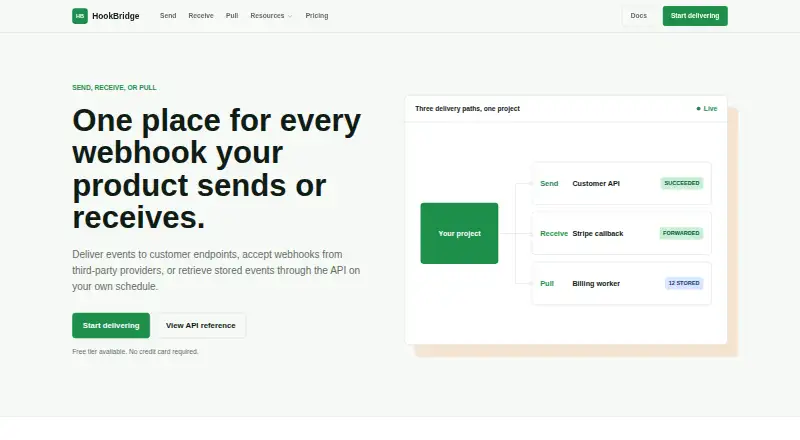
Hookbridge is a cloud service for software teams that need to send webhooks to customer endpoints, accept events from third-party services, or hold incoming events for workers to fetch through an API. Its send API queues each message and returns a message ID, so delivery can proceed separately from the application’s request path. For outbound delivery, retryable failures follow a configured schedule using exponential backoff and jitter. Retained messages can be replayed from the console or API whether delivery succeeded or failed.
Security features include outbound HMAC-SHA256 signing and inbound verification through configured HMAC signatures, static tokens, or IP allowlists. Hookbridge says it encrypts data in transit and uses access controls and monitoring; it acts as a processor for customer payloads and delivery logs. Retention and automatic purging depend on the plan and customer settings.
Developers can use the HTTP API or SDK examples for Node.js, Python, Go, Ruby, and PHP. Additional tools include a CLI tunnel for receiving webhooks on localhost, a GitHub Action for testing handlers in CI, and a browser request inspector that needs no account. The GitHub Action runs on Linux GitHub Actions runners and requires a Hookbridge account and API key.
Good
- Queues outbound messages outside the application request path.
- Retries retryable failures with exponential backoff and jitter.
- Replays retained messages after successful or failed delivery.
- Offers outbound signing and several inbound verification methods.
- SDK examples cover Node.js, Python, Go, Ruby, and PHP.
- Browser request inspector requires no account.
Watch out
- Free plan is limited to 1,000 messages.
- GitHub Action requires an account and API key.
- Payload and log retention varies by plan and customer settings.
Who it suits
Hookbridge suits software teams that need managed webhook delivery, inbound event handling, or an API-based way for workers to retrieve events. It is also relevant to developers who want event replay, delivery retries, signature checks, or tools for local webhook reception and CI handler tests.
Verdict
Choose Hookbridge if your team needs queued webhook delivery with configurable retries and replay, or needs to receive third-party events through an API. The free tier covers 1,000 messages; teams needing more can start with the $10-per-month Starter plan. The GitHub Action is less convenient for users without a Hookbridge account and API key.
Plans and prices
From Hookbridge's own pricing page, checked 7 Oct 2026.
| Plan | Price | What it gives you |
|---|---|---|
| Free | Free | 1,000 messages |
| Starter | $10 a month | 5,000 messages |
| Pro | $20 a month | 50,000 messages |
| Business | $100 a month | 250,000 messages |
The facts
Each one read from Hookbridge's own pages, with the date it was checked.
What it does
- CI limit
- The GitHub Action runs on Linux GitHub Actions runners and requires a Hookbridge account and API key.checked 7 Oct 2026
- Delivery
- The send API stores and queues a message, then returns a message ID while delivery continues outside the application's request path.checked 7 Oct 2026
- Developer tools
- Hookbridge offers a CLI secure tunnel for receiving webhooks on localhost, a GitHub Action for testing handlers in CI, and a browser request inspector that requires no account.checked 7 Oct 2026
- Integrations
- The inbound webhook page names Stripe, GitHub, and Shopify as example providers.checked 7 Oct 2026
- Privacy
- The privacy policy says Hookbridge encrypts data in transit, uses access controls and monitoring, does not sell personal data, and acts as a processor for customer webhook payloads and delivery logs.checked 7 Oct 2026
- Product
- Hookbridge lets software teams send webhooks to customer endpoints, receive third-party webhooks, or store incoming events for workers to retrieve through an API.checked 7 Oct 2026
- Replay
- Retained messages can be replayed from the console or API after successful or failed delivery.checked 7 Oct 2026
- Retention
- Webhook payload and delivery log retention depends on the plan and customer settings, with automatic purging after the configured retention window.checked 7 Oct 2026
- Retries
- Outbound delivery retries use exponential backoff and jitter, and retryable failures follow a configured schedule.checked 7 Oct 2026
- SDKs
- The site lists SDK examples for Node.js, Python, Go, Ruby, and PHP, alongside an HTTP API.checked 7 Oct 2026
- Security
- The service supports outbound HMAC-SHA256 signatures and inbound verification using configured HMAC signatures, static tokens, or IP allowlists.checked 7 Oct 2026
- Support
- The site lists [email protected] as a contact address for inquiries and requests.checked 7 Oct 2026
The full review of Hookbridge
Hookbridge is a cloud service for software teams that send webhooks, accept provider events, or queue incoming events for workers to fetch through an API. It fits developers who need delivery, recovery, and authentication handled outside an application’s request path. The central trade-off is straightforward: robust delivery controls are paired with message quotas and retention that should determine which plan you choose.
Overview
A send request stores and queues a message, returns its message ID, and lets delivery continue independently. That design prevents a slow customer endpoint from holding up the calling application. Hookbridge can also receive third-party webhooks or retain incoming events for later worker retrieval through its API. It is a cloud deployment, not a self-hosted option.
Retention of payloads and delivery logs follows the selected plan and customer settings, with automatic purging after the configured window. That makes retention useful for recovery without implying indefinite storage. The privacy policy describes encryption in transit, access controls, monitoring, and processor handling for webhook payloads and delivery logs; Hookbridge says it does not sell personal data.
Key features
Queued delivery and recovery
Outbound delivery uses exponential backoff and jitter, and retryable failures follow a configured schedule. In practice, temporary endpoint outages can be handled without making the original request wait or requiring every application to build its own retry loop. Retained messages can be replayed from the console or API after successful or failed delivery, giving teams a deliberate way to reprocess an event or recover from a failed attempt. Replay is bounded by the retention window, so teams with longer incident-recovery needs must check whether their plan and settings preserve events long enough.
Verification and inspection
Hookbridge signs outbound requests with HMAC-SHA256. For inbound traffic, teams can configure HMAC signatures, static tokens, or IP allowlists. Those choices cover common provider and customer-endpoint authentication patterns, while event inspection helps developers examine activity when diagnosing delivery behavior.
Developer workflow
HTTP access is accompanied by SDK examples for Node.js, Python, Go, Ruby, and PHP. The CLI provides a secure tunnel for receiving webhooks on localhost, and a browser request inspector works without an account, making quick payload inspection accessible. A GitHub Action supports handler testing on Linux GitHub Actions runners, but it requires a Hookbridge account and API key, so it is less convenient for teams seeking a zero-account CI utility. Stripe, GitHub, and Shopify are named examples of inbound providers.
Pricing
| Plan | Price | Included messages | Best fit |
|---|---|---|---|
| Free | free | 1,000 | Small projects and evaluation |
| Starter | $10 a month | 5,000 | Low-volume production teams |
| Pro | $20 a month | 50,000 | Growing integrations |
| Business | $100 a month | 250,000 | Higher-volume operations |
The free tier is a useful starting point for up to 1,000 messages, but it leaves little headroom for busy production traffic. Starter raises capacity to 5,000 messages for $10 a month and is the sensible entry point when a small team needs a paid allowance. Pro’s 50,000-message quota at $20 a month is a substantial step up for teams with many endpoints or providers. Business supplies 250,000 messages at $100 a month for larger workloads. Quotas, retention settings, and automatic purging make usage forecasting important; choose by expected message volume and recovery requirements rather than price alone.
Platforms
Hookbridge is delivered as a cloud service and exposes an API. It supports Linux, macOS, and Windows clients alongside web access. SDK examples and the CLI suit developers working across those environments, while the GitHub Action targets Linux-based GitHub Actions runners.
Who it's for
Choose Hookbridge for a software product that must deliver webhooks asynchronously, retry transient failures, replay retained events, or accept provider webhooks with configurable verification. It is particularly suitable when workers need to pull stored events through an API and when a cloud-managed service is preferred. It is a weaker fit for teams that require self-hosting, need quotas far above 250,000 messages, or want account-free CI webhook testing.
Pros and cons
Pros
- Queued, asynchronous delivery: calling applications receive a message ID without waiting for endpoint delivery.
- Practical recovery controls: exponential-backoff retries and console/API replay address temporary failures and deliberate reprocessing.
- Flexible verification: outbound HMAC-SHA256 plus inbound HMAC, token, and IP-allowlist options cover common trust models.
- Useful developer coverage: five SDK examples, a localhost tunnel, event inspection, and a browser inspector support implementation and diagnosis.
Cons
- Quota-based plans: the free tier stops at 1,000 messages, and the largest published tier at 250,000 may not suit very high volume.
- Retention is bounded: automatic purging after plan- and setting-dependent windows limits long-term replay.
- CI setup has a dependency: the GitHub Action requires both a Hookbridge account and API key.
- Cloud only: teams needing self-hosted deployment must look elsewhere.
Alternatives
Hookdeck is worth choosing when a free plan with up to 10,000 events, three-day retention, one user, and included discarded requests better matches a small development workflow, or when self-hosting is required.
Kiosk is a free, open-source PDF reader for readers whose need is document reading rather than webhook operations.
Dispatch suits teams wanting a free allowance of 10,000 events per month and two members, accepting three-day history and public-project limits.
RelayHQ is an alternative for very small endpoint setups where three endpoints, 500 requests per month, 24-hour logs, and no automatic retry are acceptable.
Webhook Relay fits teams wanting a free starter allowance of 150 webhooks per month with up to two destinations and one input.
Webhooker is a choice for a free 10,000-event monthly plan with three sources, nine destinations, and 14-day retention.
WebhookX is suited to teams seeking a self-hosted deployment and a free community edition.
Hookdeck Outpost is the alternative for an Apache-2.0, Go-based, self-hosted binary or Docker deployment.
Browse the Webhook Management Software category for more options.
Verdict
Hookbridge is a strong choice for teams that want queued webhook delivery with configurable retries, replay, and multiple verification methods in a managed cloud service. Its main reason to look elsewhere is equally clear: message quotas, retention-based purging, and the lack of self-hosting can constrain larger or infrastructure-controlled deployments.
Getting started
- Open the Hookbridge website.
- Choose the free plan or a paid plan based on message volume.
- Use the HTTP API or an SDK example for your language.
- Configure outbound delivery or inbound event verification.
- For local reception, use the CLI secure tunnel; for CI tests, use the GitHub Action with an account and API key.
Limits worth knowing
The free plan includes 1,000 messages. Starter is $10 per month for 5,000 messages; retention depends on plan and customer settings.
Questions
Is Hookbridge free?
Yes. The Free plan costs nothing and includes 1,000 messages.
What do paid plans cost?
Starter costs $10 per month for 5,000 messages, Pro costs $20 per month for 50,000, and Business costs $100 per month for 250,000.
What platforms does Hookbridge support?
Its listed platforms are API, Linux, macOS, web, and Windows.
Which developer languages have SDK examples?
The site lists Node.js, Python, Go, Ruby, and PHP examples, alongside an HTTP API.
Can I replay webhook messages?
Yes. Retained messages can be replayed through the console or API after successful or failed delivery.
Which third-party services are named as inbound examples?
The inbound webhook page names Stripe, GitHub, and Shopify.
Alternatives to Hookbridge
- 1
Kiosk
Free planOpen sourceAndroidiOSWebExtension8.0Free plan - 2
WebhookX
Free planOpen sourceWebAPILinuxmacOS8.0From $39 a month - 3
Svix
Free planOpen sourceWebAPILinuxSelf-hosted7.8From $20 a month - 4

Hookdeck
Free planWebAPILinuxmacOS7.7From $39 a month - 5
RelayHQ
Free planWebAPILinuxmacOS7.7From $29 a month - 6
Dispatch
Free planWebAPILinuxmacOS7.6From $39 a month