Hangfire
Hangfire runs background processing in .NET and .NET Core applications without requiring a Windows Service or separate process.
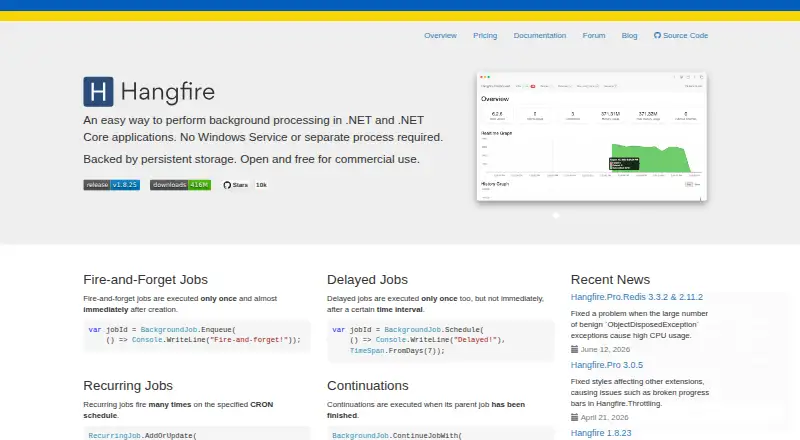
What Hangfire is
Hangfire runs background processing in .NET and .NET Core applications without requiring a Windows Service or separate process. It supports fire-and-forget, delayed and recurring jobs, along with continuations, and stores jobs persistently. SQL Server and Redis are officially supported storage options; community-driven implementations are also available. A web dashboard shows processing activity and the state of each job. Hangfire describes its processing as at-least-once, with automatic retries after unhandled exceptions or application termination. It can run across multiple machines and coordinate their work automatically. Documented integrations include ASP.NET, ASP.NET Core, console applications, Windows Services, WCF, Nancy and ServiceStack. Hangfire Core is open source under LGPLv3 and free for commercial use. Pro adds batches and batch continuations, while Ace adds throttling for concurrency and rate limits. The dashboard allows local requests by default; remote access requires authorization configuration.
Good
- Supports fire-and-forget, delayed and recurring jobs.
- Persists jobs using SQL Server or Redis.
- Retries jobs after exceptions or application termination.
- Coordinates processing across multiple machines.
- Core is free for commercial use.
Watch out
- Remote dashboard access requires authorization configuration.
- Throttling support is limited to specified storage options.
- No free trial for Hangfire Pro.
Who it suits
Hangfire suits developers adding scheduled or background jobs to .NET applications. It is relevant for teams that need persistent jobs, retries or processing across multiple machines.
Verdict
Hangfire provides several job types, persistent storage and a dashboard for .NET background processing. The free Core plan is available, while paid plans add features and different support options.
Plans and prices
From Hangfire's own pricing page, checked 15 Oct 2026.
| Plan | Price | What it gives you |
|---|---|---|
| Open | Free | Hangfire Core LGPL 3.0 · commercial use · SQL Server 2008 R2+ or In-Memory · community support · Always and forever |
| Startup | $500 a year | Core LGPL plus Pro EULA · SQL Server, Redis 2.6.12+, or In-Memory · perpetual license · private NuGet feed · no dedicated support · per organization / year |
| Business | $1,500 a year | Core, Pro and Ace under EULA · SQL Server, Redis or In-Memory · source access · email/helpdesk and technical support · per organization / year |
| Enterprise | $4,500 a year | Core, Pro and Ace · royalty-free EULA · custom terms · source access · priority support · invoice or purchase order · per organization / year |
The facts
Each one read from Hangfire's own pages, with the date it was checked.
What it does
- API
- The public API includes BackgroundJobClient, IBackgroundJobClient, JobStorage and extension methods for creating and changing jobs.checked 15 Oct 2026
- At-least-once processing
- The product promises at-least-once processing and retries interrupted jobs after process termination.checked 15 Oct 2026
- Automatic retries
- Transient failures are retried automatically and retry counts can be controlled with AutomaticRetryAttribute.checked 15 Oct 2026
- Batches
- Hangfire Pro adds atomic batches of jobs and batch continuations.checked 15 Oct 2026
- Cancellation
- Jobs can receive cancellation tokens so application shutdowns can be handled gracefully.checked 15 Oct 2026
- Community extensions
- The extension directory lists community storage and IoC projects but disclaims official support, quality and security responsibility for them.checked 15 Oct 2026
- Continuations
- A continuation can run after its parent job finishes.checked 15 Oct 2026
- Dashboard
- A built-in web dashboard shows job states and processing activity.checked 15 Oct 2026
- Dashboard security
- Dashboard access is local-only by default and authorization must be configured before allowing remote requests because job arguments and method names are exposed.checked 15 Oct 2026
- Delayed jobs
- Jobs can be persisted and scheduled to run after a specified time interval.checked 15 Oct 2026
- Distributed processing
- Multiple Hangfire servers can run on the same or different machines with automatic synchronization and distributed locking.checked 15 Oct 2026
- Documentation depth
- The documentation includes getting-started guides, installation, ASP.NET Core setup, dashboard authorization, storage configuration and deployment guidance.checked 15 Oct 2026
- Extensibility
- Developers can replace storage, states, job creation, job performance, state changes and job activation components.checked 15 Oct 2026
- Fire-and-forget jobs
- Jobs can be queued for execution once and almost immediately after creation.checked 15 Oct 2026
- GitHub activity
- The public repository showed about 10.2k stars, 1.8k forks and 891 issues when opened.checked 15 Oct 2026
- Integrations
- The documentation lists integrations with ASP.NET, ASP.NET Core, console applications, Windows Services, WCF, Nancy, and ServiceStack.checked 4 Oct 2026
- IoC integration
- Dependency injection is supported through job activators and packages such as Hangfire.Ninject and Hangfire.Autofac.checked 15 Oct 2026
- Job types
- Its job types include fire-and-forget, delayed, and recurring jobs, plus continuations.checked 4 Oct 2026
- Licence
- Hangfire Core is open source under LGPLv3, with commercial licensing available for private forks and modifications.checked 15 Oct 2026
- License
- Hangfire Core is open source under LGPLv3 and free for commercial use.checked 4 Oct 2026
The company
- Company legal facts
- The Estonian Business Register lists Hangfire OÜ as a private limited company registered March 1, 2022, with €10,000 capital and an Ahtri 12, Tallinn address.checked 15 Oct 2026
- Company ownership
- A company announcement says Hangfire became owned by Estonian private company Hangfire OÜ from March 8, 2022 and remained owned by Sergey Odinokov.checked 15 Oct 2026
- Company size
- The Estonian registry data reports three employees for Hangfire OÜ in its 2025 annual-report figures.checked 15 Oct 2026
- Headquarters
- Ahtri 12, Tallinn, Harju County 15551, Estoniachecked 28 Sep 2026
The full review of Hangfire
Hangfire is a background-job processor for .NET and .NET Core applications, aimed at developers who want queued and scheduled work to run within their application stack. Its strongest case is persistent, retrying job processing with a built-in dashboard; teams needing batches or throttling should expect to pay for extensions.
Overview
Hangfire handles fire-and-forget, delayed and recurring jobs, along with continuations. Jobs persist in storage rather than depending on one running process: SQL Server and Redis are officially supported, and community-driven storage implementations are also available. That is useful when work must survive application interruptions, but choosing and operating the storage backend remains part of the deployment.
Hangfire describes its processing as at-least-once and retries jobs after unhandled exceptions or application termination. Those safeguards reduce the chance that interrupted work is simply lost, but repeated execution is possible, so job logic should tolerate retries. Processing can span multiple machines, with synchronization handled automatically.
The built-in web dashboard shows processing activity and job states. By default, it accepts only local requests; remote access requires authorization configuration. This gives teams a safer default, while making dashboard access control their responsibility if they need remote visibility.
Key features
- Multiple job patterns: Fire-and-forget, delayed, recurring jobs and continuations cover immediate work and scheduled workflows without limiting Hangfire to a single queueing pattern.
- Persistent storage: Official SQL Server and Redis support gives teams established backend choices; community storage implementations broaden the options, but are not the officially supported choices.
- Retries and distributed processing: At-least-once handling and automatic retries support resilience, while multi-machine processing can suit workloads that need to run across machines. Applications still need to account for jobs being executed again.
- Integrations: Documentation covers ASP.NET, ASP.NET Core, console applications, Windows Services, WCF, Nancy and ServiceStack, making Hangfire relevant beyond a single .NET hosting style.
- Paid extensions: Pro adds batches and batch continuations; Ace adds concurrency and rate-limit throttling. Hangfire.Throttling is officially supported only with Hangfire.SqlServer, Hangfire.Pro.Redis and Hangfire.InMemory storage, so teams should check that compatibility before buying for throttling.
- Dashboard access: The dashboard gives a view of background processing and job state, but remote access is not ready by default: authorization must be configured.
Pricing
Hangfire uses a freemium model. Core is open source under LGPLv3 and free for commercial use, so teams can begin without a license fee. There is no free trial for Pro, but purchases have a 30-day refund period.
| Plan | Price and terms | What it includes | Best fit |
|---|---|---|---|
| Open | free (billed Always and Forever) | Hangfire Core under LGPL 3.0, commercial use, SQL Server 2008 R2+ and In-Memory storage, community support. | Teams that can work with Core's job processing and community support, and use one of the included storage options. |
| Startup | $500 a year (billed per organization / year) | Core under LGPL 3.0 and Pro under EULA, perpetual license, private NuGet feed, SQL Server, Redis and In-Memory storage; no dedicated support. | Organizations wanting Pro features and broader storage options without dedicated support. |
| Business | $1,500 a year (billed per organization / year) | Core, Pro and Ace under EULA, perpetual license, private NuGet feed, source code access, email/helpdesk and technical support. | Organizations needing Ace throttling, source access and technical support. |
| Enterprise | $4,500 a year (billed per organization / year) | Core, Pro and Ace, royalty-free EULA, perpetual license, custom license terms, private NuGet feed, source code access and priority support. | Organizations that need custom license terms and priority support. |
The lower-cost paid tier adds Pro but stops short of dedicated support and Ace. Business adds Ace and support; Enterprise costs more for priority support and custom terms. Paid plans are priced per organization per year, not per seat, and carry perpetual licenses. The free plan's stated storage choices are narrower than Startup's. No trial means Pro must be purchased to evaluate under its license, though the 30-day refund period offers an exit.
Platforms
Hangfire supports API, Linux, self-hosted, web and Windows environments. It is a self-hosted deployment rather than a managed service, and its purpose is specifically background processing in .NET and .NET Core applications without requiring a Windows Service or separate process.
Who it's for
Hangfire is a strong fit for .NET teams that need persistent background work, recurring schedules, automatic retries and visibility into job state, particularly when they want to distribute processing across machines. The free Core license makes it accessible for commercial projects. Teams that need batches, batch continuations or throttling should budget for the appropriate paid tier; teams unwilling to manage storage or configure remote dashboard authorization may prefer a different approach.
Pros and cons
Pros
- Free commercial Core: Teams can use the open-source Core without a license fee, including in commercial applications.
- Useful job coverage: Fire-and-forget, delayed and recurring jobs plus continuations serve several common background-work patterns.
- Resilience and scale: Persistent storage, automatic retries and multi-machine processing help jobs outlive process interruptions and support distributed work.
- Visible job state: The built-in dashboard provides a direct view of processing and individual job states.
Cons
- Advanced functions cost extra: Batches and batch continuations require Pro, while throttling requires Ace.
- Storage remains an operational choice: Hangfire is self-hosted, and the team must select and run a storage backend; the free plan names SQL Server 2008 R2+ and In-Memory.
- Remote dashboard access needs configuration: Authorization must be set up before remote requests are allowed.
- No Pro trial: There is no free trial, so buyers must rely on the 30-day refund period rather than a trial license.
Alternatives
For broader Task Queue Software comparisons, start with the category list. Choose IronWorker if its free Basic plan's one-concurrency, five-hours-per-month allowance, 512 MB RAM, 30-minute runtime and 50 scheduled tasks suit a small workload; its free plan also includes a public cluster and basic support. Django Q2 is a free, MIT-licensed option for teams working in its Linux, macOS, self-hosted or web environments. Faktory offers a free AGPL-licensed OSS plan without dedicated support, and a $99 a month Enterprise additional-pack option for teams considering paid expansion.
Graphile Worker is a free MIT-licensed alternative, with a Worker Pro Launch Offer at $25 a month from $25+ /mo as sponsorship. pg-boss is a free MIT-licensed option that runs in your own database with no per-job charges. Gearman is a free, BSD-licensed alternative. Inngest offers a free tier with five seats, 50k executions, 500k events ingested and 24-hour trace history, making those explicit limits relevant when evaluating its fit. Procrastinate is a free, open-source Python library using PostgreSQL 13+.
Verdict
Choose Hangfire if you are building .NET software and want persistent, retrying background jobs with multiple scheduling patterns and a built-in dashboard, while retaining control of your deployment. Its free commercial Core is a clear starting point; look elsewhere if you need advanced batch or throttling features without a paid license, or do not want to manage storage and dashboard authorization.
Alternatives to Hangfire
- 1

Inngest
Free planOpen sourceWebAPILinuxmacOS8.3From $99 a month - 2
Graphile Worker
Free planOpen sourceAPILinuxmacOSSelf-hosted7.9From $25 a month - 3
Gearman
Free planOpen sourceAPILinuxmacOSSelf-hosted7.3Free plan - 4
Google Tasks
Free planAndroidiOSWeb7.0Free plan - 5
IronWorker
Free planWebAPILinuxSelf-hosted6.9From $169 a month - 6
Trigger.dev
Free planWebAPISelf-hosted6.8From $10 a month