IronWorker
IronWorker runs custom code as queued, asynchronous background tasks in Docker containers.
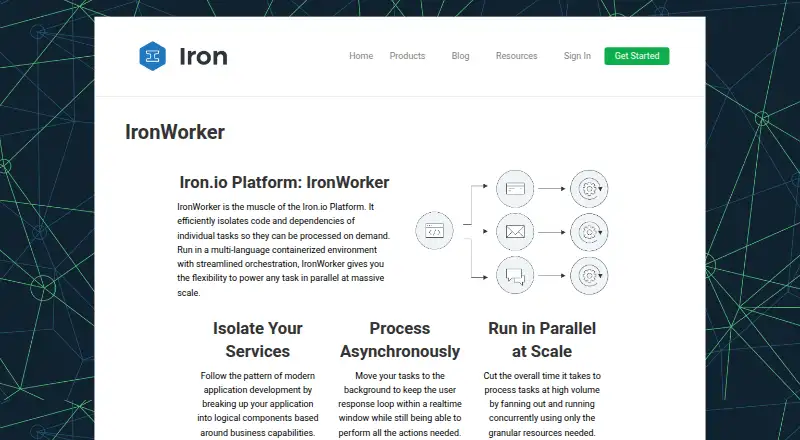
What IronWorker is
IronWorker runs custom code as queued, asynchronous background tasks in Docker containers. It supports parallel processing, and jobs can run once, a specified number of times, or on a recurring schedule. Workers can be written in Ruby, Python, PHP, Java, .NET, Node.js, or Go. Tasks may be triggered by HTTP POST webhooks, other workers, or IronMQ queues, while the Iron.io dashboard shows task status and performance. The platform describes SSL connections, isolated Docker sandboxes, and OAuth2 for task execution. Deployment choices include shared, dedicated, hybrid, and on-premise options. Listed use cases include image and video processing, push notifications, ETL, email delivery, and cron replacement. The Basic plan costs nothing and includes five hours per month, one concurrency, 512 MB RAM, and a 30-minute runtime. Standard costs $169 a month; a 14-day trial is available only for non-dedicated clusters. IronWorker supports Linux, Windows, web, API, and self-hosted environments.
Good
- Jobs can run once or on recurring schedules.
- Workers support seven listed programming languages.
- HTTP POST webhooks can trigger workers.
- On-premise deployment is available.
- Dashboard displays task status and performance.
Watch out
- Free Basic plan includes five hours per month.
- Basic plan has one concurrency.
- Trial is limited to non-dedicated clusters.
- Maximum payload size is 0.0625 MB.
Who it suits
IronWorker suits developers and teams that need to run queued background jobs using supported programming languages. Its deployment options include dedicated and on-premise environments.
Verdict
IronWorker is aimed at queued background processing, with several deployment choices and language options. Compare the Basic plan limits and trial cluster restriction with your workload needs.
Plans and prices
From IronWorker's own pricing page, checked 29 Sep 2026.
| Plan | Price | What it gives you |
|---|---|---|
| Basic | Free | Public Cluster · 1 concurrency · 5 hours/mo · 512 MB RAM · 30m runtime · 50 scheduled tasks · Basic Support · Free |
| Standard | $169 a month | Public Cluster · 10 concurrency · Unlimited hours · 512 MB RAM · 60m runtime · 100 scheduled tasks · Standard Support · $169/mo |
| Premium | $699 a month | Dedicated Cluster · 15 concurrency · Unlimited hours · 512 MB RAM · Unlimited runtime · 1,000 scheduled tasks · Premium Support · Autoscaling to 15 · VPC Peering · $699/mo |
| Enterprise | Priced on request | Dedicated or On-Premise · Unlimited concurrency and hours · Configurable RAM · Custom runtime · Unlimited scheduled tasks · Enterprise Support · Custom Autoscaling · VPC Peering · Contact for Quote |
The facts
Each one read from IronWorker's own pages, with the date it was checked.
What it does
- Async processing
- IronWorker runs background tasks asynchronously and supports parallel processing at scale.checked 29 Sep 2026
- Containers and languages
- Workers run in Docker containers and support languages including Ruby, Python, PHP, Java, .NET, Node.js, and Go.checked 29 Sep 2026
- Deployment choices
- IronWorker supports shared, dedicated, hybrid, and on-premise deployment options.checked 29 Sep 2026
- Logging integrations
- The maker lists PaperTrail, New Relic, DataDog, and StatHat as monitoring and logging integrations.checked 29 Sep 2026
- Monitoring
- The Iron.io dashboard provides task performance and status information.checked 29 Sep 2026
- Purpose
- IronWorker is a container based distributed work-on-demand platform for running custom code as queued tasks.checked 29 Sep 2026
- Scheduling
- Jobs can be scheduled to run once, a set number of times, or on a recurring basis.checked 29 Sep 2026
- Security
- IronWorker describes SSL connections, isolated Docker sandboxes, and OAuth2 for task execution.checked 29 Sep 2026
- Support
- The pricing page lists Basic, Standard, Premium, and Enterprise support across its plans.checked 29 Sep 2026
- Use cases
- The product page lists image and video processing, push notifications, ETL processing, email delivery, and cron replacement as use cases.checked 29 Sep 2026
- Webhooks
- Workers can be triggered through HTTP POST webhooks, other workers, or IronMQ queues.checked 29 Sep 2026
The company
- Company founding
- Iron.io says it was founded in 2010 by Chad Arimura and Travis Reeder.checked 29 Sep 2026
Money
- Trial limitation
- The 14-day trial is available only for non-dedicated clusters.checked 29 Sep 2026
The full review of IronWorker
Overview
IronWorker is a managed platform for running custom code as queued tasks in Docker containers. It suits teams that need asynchronous processing across several languages and deployment models; the main trade-off is that the free tier is tightly capped and the trial excludes dedicated clusters.
Tasks run in the background and can be processed in parallel. Workers can be triggered by HTTP POST webhooks, other workers, or IronMQ queues, while jobs can run once, a fixed number of times, or on a recurring schedule. That makes IronWorker relevant to workloads such as media processing, ETL, email delivery, push notifications, and cron replacement.
Ruby, Python, PHP, Java, .NET, Node.js, and Go are supported. The Iron.io dashboard shows task status and performance, and the product describes SSL connections, isolated Docker sandboxes, and OAuth2 for task execution. PaperTrail, New Relic, DataDog, and StatHat are named as logging and monitoring integrations.
Deployment choices span shared, dedicated, hybrid, and on-premise setups. That range is useful when infrastructure requirements vary, though teams seeking a simple, low-cost queue may find the plan limits or paid entry price a poor fit. See the broader Task Queue Software category for other options.
Key features
- Asynchronous and parallel work: Queued tasks run outside the immediate application flow, and parallel processing supports workloads that benefit from concurrent execution.
- Containerized workers: Docker packaging and seven supported languages give teams flexibility to run custom code without committing to a single language ecosystem.
- Scheduling and triggers: One-off, limited-repeat, and recurring jobs cover scheduled work; webhooks, other workers, and IronMQ queues provide several ways to start tasks.
- Operational visibility: Dashboard status and performance information, plus named logging integrations, help teams follow task execution.
- Deployment and security options: Shared through on-premise deployments broaden the range of possible environments. SSL, isolated Docker sandboxes, and OAuth2 are described security measures, not a substitute for evaluating a deployment against a team's own requirements.
Pricing
IronWorker uses a freemium model, with a free plan, paid plans from $169/mo, and a 14-day trial. The trial is limited to non-dedicated clusters, so it cannot evaluate the dedicated-cluster plans in their intended configuration.
| Plan | Price | What it includes |
|---|---|---|
| Basic | Free | Public cluster, 1 concurrency, 5 hours per month, 512 MB RAM, 30-minute runtime, 50 scheduled tasks, Basic Support. |
| Standard | $169/mo | Public cluster, 10 concurrency, unlimited hours, 512 MB RAM, 60-minute runtime, 100 scheduled tasks, Standard Support. |
| Premium | $699/mo | Dedicated cluster, 15 concurrency, unlimited hours, 512 MB RAM, unlimited runtime, 1,000 scheduled tasks, Premium Support, autoscaling to 15, and VPC peering. |
| Enterprise | Custom pricing | Dedicated or on-premise deployment, unlimited concurrency and hours, configurable RAM, custom runtime, unlimited scheduled tasks, Enterprise Support, custom autoscaling, and VPC peering. |
Basic is suitable for small workloads or an initial evaluation, but its five monthly hours, single concurrency slot, 30-minute runtime, and 50 scheduled tasks impose meaningful ceilings. Standard removes the hours cap and increases concurrency, but remains on a public cluster and limits runtime to 60 minutes. Premium is the step up for dedicated capacity and unlimited runtime, with a higher scheduled-task allowance and autoscaling to 15. Enterprise is the option for on-premise deployment or configurable capacity, at custom pricing. Basic, Standard, Premium, and Enterprise support are the corresponding support tiers.
The maximum payload size is 0.0625 MB, a constraint to account for when designing task inputs. Custom retry policies and scheduled jobs are supported.
Platforms
IronWorker supports API, Linux, self-hosted, web, and Windows environments. The breadth is useful for teams integrating queues across varied systems, while the deployment range extends from shared clusters to dedicated and on-premise environments.
Who it's for
IronWorker is best suited to teams with background workloads that need containerized execution, multiple language choices, scheduling, or a choice of managed and on-premise deployment. It is less compelling for light usage that can fit a basic queue: the free plan has little headroom, and paid capacity starts at $169/mo. Teams that require a dedicated cluster should also account for the trial's non-dedicated-cluster restriction.
Pros and cons
- Pros: Docker workers and seven supported languages accommodate varied codebases; multiple triggers and recurring schedules suit both event-driven and routine jobs; deployment options include dedicated and on-premise configurations.
- Cons: Basic is limited to five hours monthly and one concurrent task; Standard still uses a public cluster and caps runtime at 60 minutes; Premium starts at $699/mo for dedicated capacity and unlimited runtime; the trial does not cover dedicated clusters.
Alternatives
Consider Taskiq if a free option with Linux, macOS, self-hosted, and Windows platform support better fits your shortlist.
Faktory has a free OSS plan and an Enterprise add-on pack priced at $99 per month; consider it if those terms suit your needs.
pg-boss is a free, MIT-licensed option that runs in your own database with no per-job charges, making it a fit when that database-centered model is preferable.
Inngest offers a free plan with 5 seats, 50k executions, 500k events ingested, and 24-hour trace history; its Pro plan starts at $99.00 per month. Consider it if those seat and execution limits align better with your workload.
Dramatiq is another free option, with Linux, self-hosted, and Windows platform support.
River has a free open-source plan with no concurrency limits but no workflows or support; its Pro plan is $125.00 per month. It may suit teams that prioritize an uncapped concurrency limit over workflow features and support.
Sidekiq offers a free OSS plan and an Enterprise plan starting at $269/mo; consider it if its open-source or commercial licensing model is a better match.
BullMQ offers a Standard per-deployment license at $1,395 per year or $139 monthly; consider it if a per-deployment licensing model suits your organization.
Verdict
Choose IronWorker if your team needs queued containerized work, broad language support, and the option to move from shared clusters to dedicated or on-premise deployment. Its clearest advantage is that combination of execution flexibility and deployment choice. Look elsewhere if your workload is modest and cost-sensitive, or if you need to trial a dedicated cluster before committing: the free plan is narrow, paid service begins at $169/mo, and the 14-day trial excludes dedicated clusters.
Getting started
- Visit the IronWorker website.
- Choose a plan: Free, Standard, Premium, or Enterprise.
- Use the 14-day trial if you want to try a non-dedicated cluster.
- Run workers in Docker containers with a supported language.
- Trigger work using a webhook, another worker, or an IronMQ queue.
Limits worth knowing
The free plan includes five hours per month, one concurrency, 512 MB RAM, a 30-minute runtime, and 50 scheduled tasks. Standard costs $169/mo and includes ten concurrency, unlimited hours, a 60-minute runtime, and 100 scheduled tasks. The 14-day trial applies only to non-dedicated clusters.
Questions
Is IronWorker free?
Yes. Its Free plan costs nothing and includes five hours per month, one concurrency, 512 MB RAM, a 30-minute runtime, and 50 scheduled tasks.
How much does IronWorker cost?
Standard is $169/mo and Premium is $699/mo. Enterprise pricing is by quote; the Free plan is also available.
Does IronWorker offer a free trial?
Yes, it offers a 14-day trial for non-dedicated clusters.
Which languages does IronWorker support?
Its official SDK languages are Ruby, PHP, Python, Java, Node.js, Go, and .NET.
What deployment options does it offer?
IronWorker supports shared, dedicated, hybrid, and on-premise deployment options.
What can trigger an IronWorker task?
Tasks can be triggered through HTTP POST webhooks, other workers, or IronMQ queues.
Alternatives to IronWorker
- 1

Inngest
Free planOpen sourceWebAPILinuxmacOS8.3From $99 a month - 2
Hangfire
Free planOpen sourceWebAPILinuxSelf-hosted8.0From $500 a year - 3
Graphile Worker
Free planOpen sourceAPILinuxmacOSSelf-hosted7.9From $25 a month - 4
Gearman
Free planOpen sourceAPILinuxmacOSSelf-hosted7.3Free plan - 5
Google Tasks
Free planAndroidiOSWeb7.0Free plan - 6
Trigger.dev
Free planWebAPISelf-hosted6.8From $10 a month