
Faktory
Faktory is a language-agnostic system for persistent background jobs, with a responsive web interface for viewing and managing jobs.
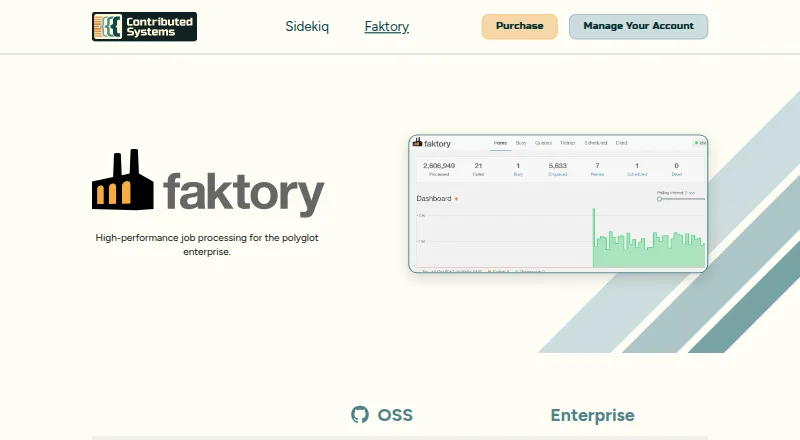
What Faktory is
Faktory is a language-agnostic system for persistent background jobs, with a responsive web interface for viewing and managing jobs. It uses Redis as a child process for local storage and keeps data in its configured data directory. The maker lists hobbyists and startups as the open-source audience, and companies with budgets as the Enterprise audience. Enterprise features include cron jobs, unique and expiring jobs, Redis Gateway, StatsD metrics, queue throttling, batches or workflows, and job status. Worker bindings are listed for Node/JavaScript, Ruby, Go, Python, PHP, Elixir, Rust, Swift, Crystal, Haskell, Java/JVM, .NET, and Clojure. Installation options include Linux RPM/DEB packages, macOS Homebrew, and Docker. Faktory supports TLS on worker and HTTP ports, with clients authenticated using a configured global password. The OSS plan is free under AGPL and has no dedicated support. Enterprise production use requires a valid license and is limited by purchased connections. The first pack is $299 a month for 100 connections; each additional pack is $99 a month for 100 connections.
Good
- Responsive web UI manages and displays jobs.
- Worker bindings span many programming languages.
- Supports TLS and password-based client authentication.
- Enterprise includes cron jobs and queue throttling.
- Linux, macOS, and Docker installation options.
Watch out
- OSS has no dedicated support.
- Enterprise production use requires a valid license.
- Enterprise connections are limited by purchased packs.
- No clustered high-availability mode is provided.
Who it suits
Faktory suits hobbyists and startups using its OSS edition, or companies with budgets that need Enterprise features. It is a self-hosted option for teams comfortable with its Redis-based persistence model.
Verdict
Faktory offers persistent background jobs with a broad range of worker bindings and a web UI. Teams considering Enterprise should account for its connection-based licensing and lack of clustered high availability.
Plans and prices
From Faktory's own pricing page, checked 28 Sep 2026.
| Plan | Price | What it gives you |
|---|---|---|
| Faktory OSS | Free | AGPL · no dedicated support |
| Faktory Enterprise — additional packs | $99 a month | Each pack adds 100 connections · Monthly |
| Faktory Enterprise — first pack | $299 a month | 100 connections per pack · email support · Monthly |
The facts
Each one read from Faktory's own pages, with the date it was checked.
What it does
- Audience
- The maker lists hobbyists and startups as the OSS audience and companies with budgets as the Enterprise audience.checked 28 Sep 2026
- Data persistence
- Faktory starts Redis as a child process and uses it for local storage, persisting data to its configured data directory.checked 28 Sep 2026
- Enterprise features
- Enterprise features listed by the maker include cron jobs, unique and expiring jobs, Redis Gateway, StatsD metrics, queue throttling, batches or workflows, and job status.checked 28 Sep 2026
- Enterprise licensing
- Enterprise production use requires a valid license and is limited to the number of connections purchased.checked 28 Sep 2026
- High availability limit
- The maker says Faktory does not provide a clustered high availability mode and relies on Redis replication for persistence and failover.checked 28 Sep 2026
- Installation
- The maker documents Linux RPM/DEB packages, macOS Homebrew installation, and a Docker image.checked 28 Sep 2026
- Language integrations
- The maker's related-projects page lists worker bindings for Node/JavaScript, Ruby, Go, Python, PHP, Elixir, Rust, Swift, Crystal, Haskell, Java/JVM, .NET, and Clojure.checked 28 Sep 2026
- Managed hosting
- The maker's related-projects page says there are no managed Faktory-as-a-service providers listed yet.checked 28 Sep 2026
- Purpose
- Faktory is a language-agnostic, persistent background job system.checked 28 Sep 2026
- Security
- Faktory supports TLS for worker and HTTP ports and authenticates clients using a configured global password.checked 28 Sep 2026
- Support
- The maker lists no dedicated support for OSS and email support for Enterprise.checked 28 Sep 2026
- Web UI
- Faktory includes a responsive web UI for viewing and managing jobs.checked 28 Sep 2026
The full review of Faktory
Overview
Faktory is a self-hosted system for durable background work, with worker bindings spanning many programming languages. It fits developers who want to operate their own job service across a mixed-language stack. Its free edition is a practical starting point; Enterprise adds job controls and support, but connection-based licensing and the absence of clustered high availability are significant constraints.
Key features
Faktory stores job data locally using Redis, which it starts as a child process and persists to a configured data directory. That keeps the storage model within the self-managed deployment, but operators remain responsible for persistence and failover: Faktory has no clustered high-availability mode and relies on Redis replication.
A responsive web UI lets operators view and manage jobs. Scheduled jobs, custom retry policies, and a dead-letter queue support delayed work and failed-job handling. Enterprise adds cron jobs, unique and expiring jobs, a Redis Gateway, StatsD metrics, queue throttling, batches or workflows, and job status. Those controls make the paid edition better suited to teams needing more operational visibility and job orchestration.
Official SDK languages are Go and Ruby. Worker bindings are also listed for Node/JavaScript, Python, PHP, Elixir, Rust, Swift, Crystal, Haskell, Java/JVM, .NET, and Clojure. This reach is useful for mixed-language teams, though the narrower official SDK list is worth weighing if official integrations are important.
Faktory supports TLS on worker and HTTP ports, and authenticates clients with a configured global password. Installation is documented through Linux RPM and DEB packages, macOS Homebrew, and a Docker image.
Pricing
Faktory OSS costs nothing and is AGPL-licensed, with no dedicated support. It suits hobbyists and startups willing to self-host and manage operations themselves.
Faktory Enterprise — first pack costs $299 a month, billed monthly, and includes 100 connections per pack and email support. Each additional pack costs $99 a month, billed monthly, and adds 100 connections. Production use requires a valid license, and usage is limited to the number of purchased connections, so teams should size their worker connections against the recurring cost. Enterprise is aimed at companies with budgets; the OSS edition gives up dedicated support and Enterprise features.
Platforms
Faktory is available for Linux and macOS, as a self-hosted deployment, and through a web UI. It is not presented as managed hosting; the maker's related-projects page says there are no managed Faktory-as-a-service providers listed yet.
Who it's for
Choose Faktory if you need persistent background jobs, want to run the service yourself, and expect workers in more than one language. The free OSS edition is the natural fit for hobbyists and startups that can handle support and operations independently. Enterprise makes more sense for companies that need its additional job controls and email support and can budget for connection packs.
Look elsewhere if clustered high availability is a requirement, or if you want a managed service rather than operating the deployment and Redis replication yourself.
Pros and cons
- Pro: Broad worker language coverage. Bindings across many ecosystems can let teams share one job system, beyond the two official SDK languages.
- Pro: Useful baseline job handling. Scheduling, custom retries, a dead-letter queue, and a management UI cover common operational needs.
- Pro: Enterprise adds concrete controls. Queue throttling, workflows, metrics, and job status extend the service for teams with more demanding operations.
- Con: Enterprise capacity is connection-limited. Production licensing is tied to purchased connections, with each 100-connection pack adding monthly cost.
- Con: No clustered high availability. Redis replication is the stated basis for persistence and failover, which may not suit workloads requiring clustered resilience.
- Con: OSS has no dedicated support. Teams needing vendor assistance must consider Enterprise email support.
Alternatives
pg-boss is a free, MIT-licensed option that runs in your own database and has no per-job charges; choose it if that database-centered model is a better fit than Faktory's Redis-backed storage.
Celery is a free open-source distributed task queue installable through PyPI or from source; it is a straightforward alternative for teams seeking that model.
IronWorker offers a free plan with one concurrency, five hours per month, 512 MB RAM, a 30-minute runtime, and 50 scheduled tasks, plus a free trial. Choose it if those stated limits and its public cluster suit the workload better than self-hosting Faktory.
Inngest has a free tier with five seats, 50k executions, 500k events ingested, and 24-hour trace history; consider it if those explicit usage allowances match your needs better than Faktory's connection-pack licensing.
River offers an open-source plan with an intuitive web UI, no workflows, no concurrency limits, and no support. Its Pro plan is $125 a month; choose between the two based on whether River's stated plan boundaries better suit your requirements.
Sidekiq has a free OSS plan aimed at hobbyists and an Enterprise plan starting at $269 a month; it is an alternative for readers comparing a Ruby-oriented job system with Faktory's broader worker bindings.
Trigger.dev offers a free plan with $5 / month free credits, 20 concurrent runs, unlimited tasks, five team members, and development and production environments. Consider it if those included allowances fit better than Faktory's self-hosted connection model.
Taskiq is another free option, available for Linux, macOS, self-hosted deployments, and Windows.
Browse the Task Queue Software category for more options.
Verdict
Faktory is best for teams that want to self-host persistent jobs and connect workers across language ecosystems, with a free OSS entry point and a feature-rich Enterprise tier. Its breadth and job-management tools are compelling, but connection-based licensing can raise Enterprise costs and the lack of clustered high availability rules it out for teams that need that resilience.
Getting started
- Choose the OSS or Enterprise edition.
- Install using Linux RPM or DEB packages, macOS Homebrew, or the Docker image.
- Configure the data directory used for local persistence.
- Set the global password for client authentication and configure TLS as needed.
- For Enterprise production use, obtain a valid license with the required connection capacity.
Limits worth knowing
The free OSS edition has no dedicated support. Enterprise production use requires a valid license and is limited to purchased connections: the first pack covers 100 connections, and each additional pack adds 100.
Questions
Is Faktory free?
Yes. Faktory OSS is free under AGPL and has no dedicated support.
How much does Faktory Enterprise cost?
The first pack costs $299 a month for 100 connections. Each additional pack costs $99 a month and adds 100 connections.
Which programming languages have worker bindings?
The maker lists Node/JavaScript, Ruby, Go, Python, PHP, Elixir, Rust, Swift, Crystal, Haskell, Java/JVM, .NET, and Clojure.
How can I install Faktory?
Documented options include Linux RPM and DEB packages, macOS Homebrew, and a Docker image.
Does Faktory provide high availability?
It does not provide a clustered high-availability mode. Persistence and failover rely on Redis replication.
What support is available?
The OSS edition has no dedicated support. Enterprise includes email support.
Alternatives to Faktory
- 1

Inngest
Free planOpen sourceWebAPILinuxmacOS8.3From $99 a month - 2
Hangfire
Free planOpen sourceWebAPILinuxSelf-hosted8.0From $500 a year - 3
Graphile Worker
Free planOpen sourceAPILinuxmacOSSelf-hosted7.9From $25 a month - 4
Gearman
Free planOpen sourceAPILinuxmacOSSelf-hosted7.3Free plan - 5
Google Tasks
Free planAndroidiOSWeb7.0Free plan - 6
IronWorker
Free planWebAPILinuxSelf-hosted6.9From $169 a month