Django Q2
Django Q2 is a free, MIT-licensed task queue, scheduler, and worker application for Django.
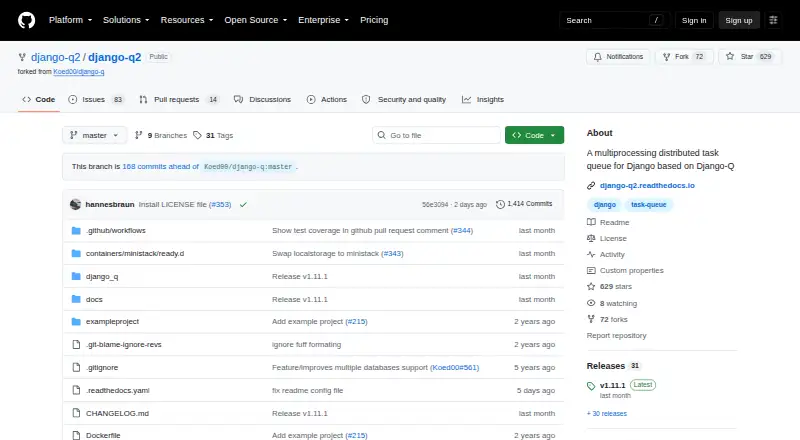
What Django Q2 is
Django Q2 is a free, MIT-licensed task queue, scheduler, and worker application for Django. It uses Python multiprocessing worker pools to run asynchronous tasks, and supports scheduled, cron, and repeated jobs. Result hooks, groups, and chains provide task workflow options. For monitoring, it offers a multi-cluster monitor and integration with Django Admin.
Supported brokers include Redis, IronMQ, Amazon SQS, MongoDB, and Django ORM. The project lists Rollbar and Sentry support for error reporting, as well as signed and compressed packages. Its documentation says it is tested with Python 3.10 through 3.14 and works with Django 5.2, 6.0, and 6.1. The README describes it as PaaS compatible with multiple instances; its deployment model is self-hosted. Installation uses pip with the package name django-q2. Documentation is available through Read the Docs. The README also notes that Disque support was dropped.
Good
- Supports scheduled, cron, and repeated tasks
- Includes groups, chains, and result hooks
- Works with several listed brokers, including Redis and Amazon SQS
- Integrates with Django Admin for monitoring
- Free and MIT licensed
Watch out
- Disque support has been dropped
- Deployment model is self-hosted
Who it suits
Django Q2 suits Django developers who need asynchronous task execution, scheduling, and monitoring in a self-hosted setup. Its listed brokers and Django Admin integration offer options for teams already working with those tools.
Verdict
Django Q2 covers task execution, scheduling, and monitoring for Django projects, with several broker choices. Its self-hosted deployment and dropped Disque support are worth noting before adoption.
Plans and prices
From Django Q2's own pricing page, checked 8 Oct 2026.
| Plan | Price | What it gives you |
|---|---|---|
| Django Q2 | Free | MIT-licensed software |
The facts
Each one read from Django Q2's own pages, with the date it was checked.
What it does
- Brokers
- Supported brokers include Redis, IronMQ, Amazon SQS, MongoDB and Django ORM.checked 8 Oct 2026
- Compatibility
- The documentation says it is tested with Python 3.10 through 3.14 and works with Django 5.2, 6.0 and 6.1.checked 8 Oct 2026
- Error reporting
- The project lists Rollbar and Sentry support.checked 8 Oct 2026
- Installation
- The README installs Django Q2 with pip using the package name django-q2.checked 8 Oct 2026
- Languages
- The documentation lists English, German and French as available languages.checked 8 Oct 2026
- License
- The repository includes the MIT License.checked 8 Oct 2026
- Monitoring
- It provides a multi-cluster monitor and integrates with Django Admin.checked 8 Oct 2026
- Notable limit
- The README says Disque support was dropped.checked 8 Oct 2026
- Purpose
- Django Q2 is a native Django task queue, scheduler and worker application using Python multiprocessing.checked 8 Oct 2026
- Scheduling
- It supports scheduled, cron and repeated tasks.checked 8 Oct 2026
- Security feature
- The listed features include signed and compressed packages.checked 8 Oct 2026
- Support channel
- The project links to its full documentation on Read the Docs.checked 8 Oct 2026
- Task execution
- It supports asynchronous tasks with multiprocessing worker pools.checked 8 Oct 2026
- Task workflows
- It includes result hooks, groups and chains.checked 8 Oct 2026
Where it runs
- Platform deployment
- The README describes it as PaaS compatible with multiple instances.checked 8 Oct 2026
The full review of Django Q2
Overview
Django Q2 is a task queue and scheduler designed for Django applications, with Python multiprocessing at its core. It is best suited to Django teams that want background work to live alongside their application rather than adopt a separate hosted service. The appeal is breadth without a software fee; the trade-off is that the deployment is self-hosted.
Key features
Multiprocessing worker pools run asynchronous tasks, and scheduling supports cron, repeated, and other scheduled work. Groups, chains, and result hooks provide ways to coordinate tasks and respond to results, which makes Django Q2 more useful for workflows than a queue limited to isolated jobs.
Monitoring combines a multi-cluster monitor with Django Admin integration, a practical fit for teams already operating in Django’s administrative interface. Redis, IronMQ, Amazon SQS, MongoDB, and Django ORM are supported broker choices. That range can accommodate different infrastructure preferences, but teams must choose and operate a broker as part of their self-hosted setup. Rollbar and Sentry support help connect error reporting to those services; signed and compressed packages are among the listed security features.
The project documents compatibility with Python 3.10 through 3.14 and Django 5.2, 6.0, and 6.1. Installation uses pip and the django-q2 package. It is described as PaaS-compatible and able to run multiple instances. Disque support has been dropped, so projects that depend on that broker should look elsewhere. Documentation is available in English, German, and French, with full documentation on Read the Docs.
Pricing
Django Q2 is free open-source software under the MIT License: the Django Q2 plan is free. There is no paid tier to unlock, and the software includes scheduled jobs and custom retry policy support. There is no free trial because the product is free. The cost advantage is clearest for teams comfortable managing their own deployment and broker; the software price does not remove that operational responsibility.
Platforms
Django Q2 supports Linux, macOS, web, and self-hosted deployment. Its Python SDK language and Django focus make it a backend choice rather than a general-purpose task app for end users on phones or desktops.
Who it's for
Choose Django Q2 if your application is built with Django and you want asynchronous execution, recurring schedules, workflow primitives, and monitoring within a self-managed stack. It is a weaker fit if you want someone else to run the queue, rely on Disque, or need a task product outside a Python/Django environment.
Pros and cons
- Pros: Multiple broker options let teams align the queue with existing infrastructure.
- Pros: Scheduling, chains, groups, result hooks, and monitoring cover more than basic background execution.
- Pros: MIT licensing and a free plan avoid a software subscription.
- Cons: Self-hosted deployment leaves operation of the application and broker to the adopting team.
- Cons: Disque is no longer supported, ruling it out for projects that require that broker.
- Cons: Its Django and Python orientation makes it a specialized choice, not a cross-platform consumer task manager.
Alternatives
Task Queue Software is the broader category for comparing queue tools. Pick IronWorker instead if its free Basic plan’s public cluster, one concurrency, five hours per month, and 50 scheduled tasks suit your workload better. Faktory is another option, with a free AGPL-licensed OSS plan and an Enterprise pack priced at $99 a month.
Google Tasks is a better fit for personal task lists, subtasks, due dates, and notifications across Android, iOS, and web. Consider Graphile Worker for a free MIT-licensed, self-hosted alternative, or for its Worker Pro Launch Offer at $25 a month. Hangfire offers a free Open plan with Hangfire Core under LGPL 3.0 and SQL Server or in-memory storage. pg-boss is a free MIT-licensed option that runs in your own database without per-job charges, while Gearman is a free BSD-licensed open-source alternative. Inngest may suit teams seeking a freemium option with a stated free allowance of five seats, 50,000 executions, 500,000 events ingested, and 24-hour trace history.
Verdict
Django Q2 is a strong fit for Django teams that want a capable, self-hosted queue with scheduling, workflow support, and monitoring at no software cost. Choose it when those features and broker flexibility outweigh the work of operating the stack; look elsewhere if you need managed operation, Disque support, or a tool for users beyond Django and Python projects.
Getting started
- Install the django-q2 package with pip.
- Use a supported setup: Linux, macOS, self-hosted or web.
- Consult the full documentation linked through Read the Docs.
Questions
How much does Django Q2 cost?
It is free, listed as free plan, and MIT licensed.
Is there a free trial?
No. Django Q2 is listed as free, with no free trial.
Which platforms does it support?
Linux, macOS, self-hosted and web are listed.
Which brokers can it use?
Supported brokers include Redis, IronMQ, Amazon SQS, MongoDB and Django ORM. The README says Disque support was dropped.
Which Python and Django versions are documented?
The documentation says it is tested with Python 3.10 through 3.14 and works with Django 5.2, 6.0 and 6.1.
What license does Django Q2 use?
The repository includes the MIT License.
Alternatives to Django Q2
- 1

Inngest
Free planOpen sourceWebAPILinuxmacOS8.3From $99 a month - 2
Hangfire
Free planOpen sourceWebAPILinuxSelf-hosted8.0From $500 a year - 3
Graphile Worker
Free planOpen sourceAPILinuxmacOSSelf-hosted7.9From $25 a month - 4
Gearman
Free planOpen sourceAPILinuxmacOSSelf-hosted7.3Free plan - 5
Google Tasks
Free planAndroidiOSWeb7.0Free plan - 6
IronWorker
Free planWebAPILinuxSelf-hosted6.9From $169 a month