Haltman mail-forwarding-core
Haltman mail-forwarding-core is an open-source mail-forwarding stack and the reference implementation for Haltman.io’s public forwarding service.
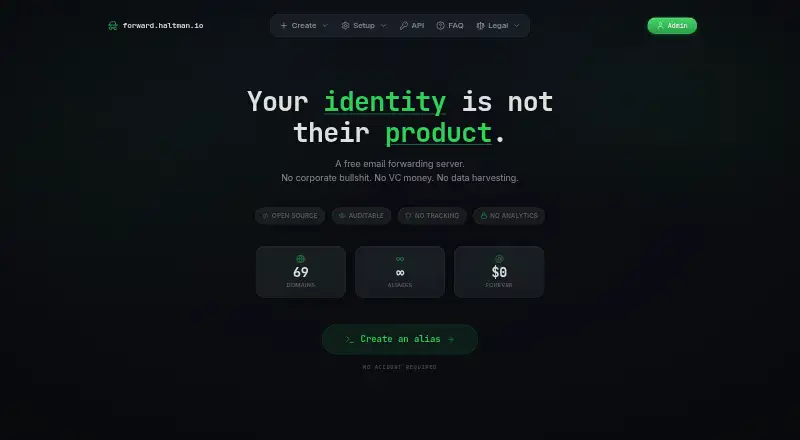
What Haltman mail-forwarding-core is
Haltman mail-forwarding-core is an open-source mail-forwarding stack and the reference implementation for Haltman.io’s public forwarding service. It sends mail to external destinations but does not store messages or deliver them to a local mailbox. Its components include Postfix, Dovecot, PostSRSd, MariaDB, DNS configuration, and optional OpenDKIM. A NestJS API manages alias rules, and API keys can support programmatic management. The reference configuration includes recipient allowlisting, sender anti-spoofing, and rate limits for connections, messages, and recipients. Authenticated submission requires TLS and Dovecot SASL, while PostSRSd rewrites senders on forwarded mail. The project says it does not log message content or persist plaintext tokens in its database. Self-hosting requires Debian 13 or compatible, root or sudo access, a public IP with port 25 open, and DNS control for each forwarded domain. The free plan is free and allows unlimited forwarding rules, users, addresses, domains, and emails. Forwarding does not support replying from an alias, which can expose the sender’s real address.
Good
- Unlimited forwarding rules, users, addresses, domains, and emails.
- Includes recipient allowlisting and sender anti-spoofing.
- Authenticated submission requires TLS.
- API keys support programmatic alias management.
- Released under the Unlicense.
Watch out
- Does not store messages or deliver to local mailboxes.
- Does not support replying from an alias.
- Self-hosting requires Debian 13 or compatible and port 25.
- Strict DMARC policies can cause forwarding issues.
Who it suits
It suits people seeking a forwarding-only service for research, education, or legitimate privacy use, and operators able to meet its self-hosting requirements. Programmatic alias management is possible through its API.
Verdict
Haltman mail-forwarding-core is a forwarding stack with documented security controls and API-based alias management. Its forwarding-only model and self-hosting prerequisites are important constraints, and replies from aliases are not supported.
Plans and prices
From Haltman mail-forwarding-core's own pricing page, checked 8 Oct 2001.
| Plan | Price | What it gives you |
|---|---|---|
| Free | Free | Unlimited forwarding rules, users, addresses, domains, and emails · forwarding only · No payment |
The facts
Each one read from Haltman mail-forwarding-core's own pages, with the date it was checked.
What it does
- Abuse controls
- The reference configuration uses recipient allowlisting, sender anti-spoofing, and connection, message, and recipient rate limits.checked 7 Oct 2001
- API
- A NestJS API manages alias rules, and API keys can be used for programmatic management.checked 8 Oct 2001
- Audience
- The maker describes the service as intended for research, education, and legitimate privacy use.checked 7 Oct 2001
- Components
- The core combines Postfix, Dovecot, PostSRSd, MariaDB, DNS configuration, and optional OpenDKIM.checked 7 Oct 2001
- Confirmation tokens
- The maker says alias confirmation tokens are six digits, stored as SHA-256 hashes, and expire after 10 minutes.checked 8 Oct 2001
- Core components
- The stack uses Postfix, Dovecot, PostSRSd, MariaDB, DNS, and optional OpenDKIM.checked 8 Oct 2001
- Data handling
- The core says it stores no mailboxes, logs no message content, and does not persist plaintext tokens in the database.checked 8 Oct 2001
- Deliverability caveat
- The maker says strict DMARC rejection policies can still cause forwarding issues and shared domain reputation can affect deliverability.checked 8 Oct 2001
- DKIM
- OpenDKIM signing is optional; the reference configuration fails closed if the signing service is enabled but unavailable.checked 7 Oct 2001
- Forwarding flow
- Users choose a handle, domain, and destination, then confirm the forwarding rule by email.checked 8 Oct 2001
- Intended use
- The maker describes the service as intended for research, education, and legitimate privacy use.checked 8 Oct 2001
- License
- The core is released under the Unlicense, which the repository describes as public domain.checked 8 Oct 2001
- Limits
- The service does not provide reply-from-alias, message storage, PGP, or a mobile app for the service.checked 8 Oct 2001
- Mail authentication
- Authenticated submission requires TLS and Dovecot SASL, while PostSRSd rewrites forwarded senders.checked 7 Oct 2001
- Mail handling
- The stack forwards mail to external destinations and does not store messages or provide local mailbox delivery.checked 7 Oct 2001
- Notable limit
- The maker states that forwarding does not support replying from an alias, and replies can expose the real address.checked 7 Oct 2001
- Purpose
- The core is an open-source mail-forwarding stack used by Haltman.io for its public forwarding service.checked 8 Oct 2001
- Security controls
- The reference configuration includes recipient allowlisting, TLS-required authenticated submission, sender anti-spoofing, rate limits, and rejection of inbound SRS-formatted senders.checked 8 Oct 2001
- Self-hosting
- The project provides reference configurations and describes self-hosting with a server, a clean IP, and DNS control for each forwarded domain.checked 8 Oct 2001
- Support
- The security page says questions can be sent by email and that the maker replies faster on Telegram.checked 8 Oct 2001
Where it runs
- Browser extension
- A Firefox add-on is available; the maker says it stores the API key locally with AES-GCM encryption and PBKDF2 key derivation.checked 8 Oct 2001
The full review of Haltman mail-forwarding-core
Overview
Haltman mail-forwarding-core is an open-source email-forwarding service and the reference stack behind Haltman.io’s public service. It suits people who want free, API-managed aliases or are prepared to operate their own mail infrastructure. Its strongest case is uncapped forwarding; it is a poor fit if you need a mailbox or want to reply from an alias.
Key features
Users choose a handle, domain and destination, then confirm the forwarding rule by email. Custom domains and API access make the service useful for managing aliases programmatically, but it does not offer catch-all forwarding. Messages go to an external destination rather than a local inbox, so this is a forwarding layer, not an alternative email account.
The stack brings together Postfix, Dovecot, PostSRSd, MariaDB and DNS configuration, with optional OpenDKIM signing. Its NestJS API manages alias rules, and API keys support programmatic administration. A Firefox extension is also available; its maker says it encrypts the API key locally using AES-GCM and PBKDF2 key derivation. The extension is useful for Firefox users, but there is no mobile app for the service.
The reference setup uses recipient allowlisting, sender anti-spoofing and rate limits on connections, messages and recipients. Authenticated submission requires TLS and Dovecot SASL; PostSRSd rewrites forwarded senders, and inbound SRS-formatted senders are rejected. Confirmation tokens are six digits, stored as SHA-256 hashes and set to expire after 10 minutes. The project says it avoids logging message content and storing plaintext tokens in the database. Optional OpenDKIM signing fails closed if enabled but unavailable.
Those controls make the project a more considered foundation than a bare forwarding rule, but they do not guarantee delivery: strict DMARC rejection policies can disrupt forwarding, and shared domain reputation can affect results. Most importantly, replies cannot be sent from an alias, and replying may expose the real address. There is no message storage or PGP.
Pricing
The Free plan costs nothing, billed with no payment. It includes unlimited forwarding rules, users, addresses, domains and emails, plus API access and custom domains. There is no free trial because the plan is free. The trade-off is not a lower quota tier but the product’s forwarding-only scope: no catch-all forwarding, stored mailbox, or reply-from-alias. Choose it for cost-free forwarding without stated usage caps; look elsewhere if those missing email functions are essential.
Platforms
Haltman mail-forwarding-core supports API, extension, Linux, self-hosted and web use. Running the stack yourself requires Debian 13 or compatible, root or sudo access, a public IP with port 25 open, and DNS control for each forwarded domain. Those prerequisites give technically capable operators control over deployment, but make self-hosting a substantial commitment rather than a turnkey option. The project is released under the Unlicense, which its maker describes as public domain.
Who it's for
This is best for people who need privacy-oriented forwarding for research, education or legitimate personal use, and for operators comfortable administering mail infrastructure. It is not the right choice for anyone who needs a full mailbox, PGP, mobile service access or reliable alias-based replies.
Pros and cons
- Pros: The free plan has no stated caps on rules, users, addresses, domains or forwarded emails, making it suitable for broad forwarding needs without a paid tier.
- Pros: API management and a Firefox extension offer practical ways to handle aliases, with local encryption for the extension’s API key.
- Pros: The reference configuration combines TLS-required submission, anti-spoofing, allowlisting and rate limits rather than relying on forwarding alone.
- Cons: There is no mailbox storage, so users must rely on an external destination for every message.
- Cons: Replies cannot come from the alias and may reveal the real address, limiting use for ongoing correspondence.
- Cons: Self-hosting needs a public mail server, open port 25 and domain-level DNS control; forwarding can also face DMARC and shared-reputation delivery problems.
Alternatives
Forward Email is worth considering if you want a freemium service with broader platform coverage, including Android, iOS, macOS and Windows, as well as self-hosting. Its company describes the service as built with 100% open-source software.
Forward is a closer alternative for someone who wants a hosted free tier with defined limits: one domain, 25 aliases, 500 forwards per day, seven days of logs and one team seat.
ImprovMX may suit users who prefer a hosted free plan with a stated 99% uptime guarantee, 25 aliases, 500 forwarded emails per day, seven-day email logs, API access and standard email and chat support.
MailerZ is an option if message storage matters more than unlimited forwarding: its free plan includes a 14-day message store, but is limited to one domain, three aliases and one seat, with sending, SMTP and API disabled.
DNSExit Email Forwarding is another freemium service, with its free plan applying to domains registered through DNSExit.
EForw offers a free tier with one domain and unlimited catch-all aliases, a better match for users who specifically need catch-all forwarding.
InboxMail is a freemium alternative with a free plan priced in euros and a broader set of email and campaign allowances.
KaiMail offers a free tier with one custom domain and one mailbox, for users who want a mailbox rather than forwarding alone.
For a wider comparison, see Email Forwarding Services.
Verdict
Choose Haltman mail-forwarding-core if you want free forwarding without stated rule or address caps, value API control, and can accept that messages live elsewhere. Its security-minded reference setup and self-hosting option are compelling for technically capable users. Look elsewhere if you need a mailbox, catch-all rules, mobile access or replies that keep your real address private.
Getting started
- Open https://forward.haltman.io/.
- For the public service, choose a handle, domain, and destination.
- Confirm the forwarding rule by email.
- For self-hosting, use Debian 13 or compatible and root or sudo access.
- Provide a public IP with port 25 open and DNS control for each forwarded domain.
- Use the API keys for programmatic alias management, if needed.
Limits worth knowing
The free plan is forwarding-only, despite allowing unlimited forwarding rules, users, addresses, domains, and emails. It does not provide reply-from-alias, message storage, PGP, or a mobile app for the service.
Questions
What does the free plan cost?
The Free plan is free, billed No payment.
Can I reply from an alias?
No. The maker says forwarding does not support replying from an alias, and replies can expose the real address.
Can I host the stack myself?
Yes. The installation guide requires Debian 13 or compatible, root or sudo access, a public IP with port 25 open, and DNS control for each forwarded domain.
Is the project open source?
Yes. It is released under the Unlicense, which the maker describes as public domain.
Does it store forwarded messages?
No. It forwards to external destinations without storing messages or providing local mailbox delivery.
Does it have API access?
Yes. A NestJS API manages alias rules, and API keys can be used for programmatic management.
Alternatives to Haltman mail-forwarding-core
- 1
DNSExit Email Forwarding
Free planWebAPI7.3From $0.58 a month - 2

Forward Email
Free planAndroidiOSWebAPI7.3From $3 a month - 3

ImprovMX
Free planWebAPI6.8From $4.17 a month - 4

SMTP Zen Email Forwarding
AndroidiOSWeb6.8From $1.20 a month - 5
Gomailify
AndroidiOSWeb6.7From $1 a month - 6
KaiMail
Free planWebAPI6.7From ¥550 a month