
Gua
Gua is a free, open-source protocol for testing and automating games made with Godot and Unity.
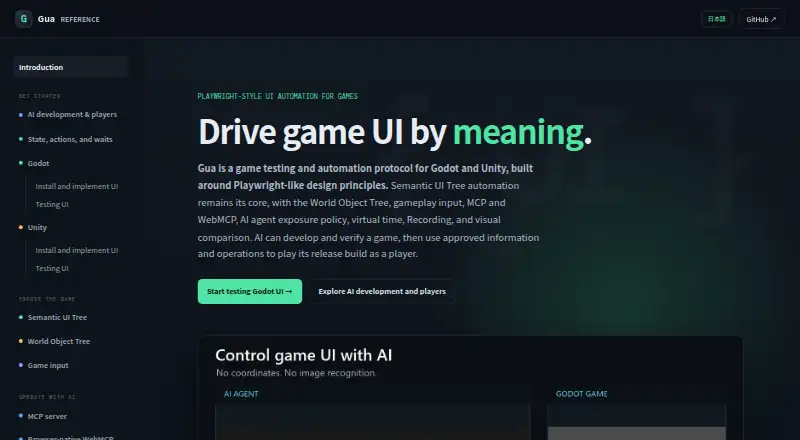
What Gua is
Gua is a free, open-source protocol for testing and automating games made with Godot and Unity. It exposes semantic interface state—such as control roles, text, visibility, values, and selection—so tests or AI agents can inspect and operate controls. Tests can wait for interface conditions in NUnit, xUnit, MSTest, or C++ rather than relying on fixed sleeps. Its visual testing tools compare PNG screenshots with baselines using thresholds, masks, and environment variants. Recording captures semantic actions and wait conditions for replay, while failure artifacts can include interface details, logs, screenshots, and environment information. The native MCP server connects to a running game over WebSocket; WebMCP exposes tools in Godot Web and Unity WebGL builds. The documentation describes a Godot 4.7 add-on and Unity 6 support for UI Toolkit, uGUI, and TextMeshPro. Player mode denies screenshots by default, and WebMCP requires a browser with an experimental API. Stable Unity desktop support excludes IL2CPP, IMGUI, and EditorWindow automation. Gua targets Windows, Linux, and macOS, and its documentation links to an MIT License.
Good
- Free and open source under an MIT License.
- Supports Godot and Unity game testing.
- Tests can wait for UI state without fixed sleeps.
- Failure artifacts can include logs and screenshots.
- Semantic actions can be recorded and replayed.
Watch out
- Player mode denies screenshots by default.
- WebMCP requires a browser with an experimental API.
- Unity stable desktop support excludes IL2CPP and IMGUI.
- EditorWindow automation is unsupported.
Who it suits
Gua suits game developers who need automated tests or AI-assisted interaction with Godot or Unity interfaces. It is also relevant to teams that want semantic recordings, visual comparisons, and failure diagnostics, provided their engine and platform fit its documented limits.
Verdict
Gua provides semantic game UI automation and testing for Godot and Unity, with recording, visual comparisons, and diagnostic artifacts. Check its screenshot rules, WebMCP requirement, and Unity exclusions against your target workflow.
The facts
Each one read from Gua's own pages, with the date it was checked.
What it does
- AI integrations
- The native MCP server connects AI tools to a running game over WebSocket, while WebMCP exposes tools in Godot Web and Unity WebGL browser builds.checked 4 Oct 2026
- Core automation
- Gua exposes semantic UI state and lets tests operate controls through actions such as click, focus, set value, select, scroll, and press key.checked 4 Oct 2026
- Diagnostics
- Failure artifacts can include the UI tree and diff, pending requests, event history, logs, runtime version, environment, screenshot, and game-process output.checked 3 Oct 2026
- Download
- The site directs users to GitHub Releases for the Godot add-on and Windows Inspector.checked 4 Oct 2026
- Engines
- The site describes a recommended GDScript add-on for Godot 4.7 and a Unity package for Unity 6 that reflects UI Toolkit, uGUI, and TextMeshPro.checked 3 Oct 2026
- Game engine support
- The site documents a Godot 4.7 add-on and Unity 6 support for UI Toolkit, uGUI, and TextMeshPro.checked 4 Oct 2026
- Integrations
- The native MCP server connects to a running game over WebSocket, while WebMCP registers semantic tools in a Godot Web Export or Unity WebGL browser tab.checked 3 Oct 2026
- License
- The official documentation links to an MIT License.checked 4 Oct 2026
- Product
- Gua is a game testing and automation protocol for Godot and Unity built around Playwright-like design principles.checked 4 Oct 2026
- Recording
- Gua.Testing.Recording records semantic actions and wait conditions for replay, with sensitive values stored as secret keys rather than plaintext.checked 4 Oct 2026
- Screenshot restriction
- Player mode denies screenshots by default because semantic rules cannot redact rendered pixels; the game host may opt in before starting the bridge.checked 4 Oct 2026
- Secret handling
- Sensitive values can be redacted from snapshots, logs, diagnostics, and recordings, then resolved in memory during replay.checked 4 Oct 2026
- Security controls
- An AI player policy can hide UI or world objects, omit or redact fields, replace or quantize values, and restrict allowed UI actions.checked 4 Oct 2026
- Semantic UI automation
- It exposes UI state such as IDs, roles, text, hierarchy, bounds, visibility, enabled state, values, focus, and selection for semantic queries and actions.checked 3 Oct 2026
- Support
- The site directs users with questions to its support Discord server.checked 4 Oct 2026
- Supported desktop scope
- Unity stable desktop support covers Windows x64, Linux x64, Intel macOS, and Apple Silicon macOS; IL2CPP, Unity IMGUI, and EditorWindow automation are unsupported.checked 4 Oct 2026
- Testing
- Its .NET testing support includes NUnit, xUnit, MSTest, and C++ helpers, with state-based waits intended to avoid fixed sleeps.checked 4 Oct 2026
- Unity limits
- The documented stable Unity desktop scope is Unity 6000.5+ Mono on Windows, Linux, and Intel or Apple Silicon macOS; IL2CPP, IMGUI, and EditorWindow automation are unsupported.checked 3 Oct 2026
- Use cases
- Gua supports AI-assisted game development and verification, as well as AI agents playing release builds with approved information and operations.checked 3 Oct 2026
- Visual testing
- Gua.Testing.Visual compares rendered PNG screenshots with baselines and supports pixel thresholds, masks, and OS or renderer variants.checked 4 Oct 2026
- WebMCP limitation
- WebMCP requires a browser implementing the experimental document.modelContext API, and the released Godot and Unity built-in ports do not currently advertise screenshot support.checked 3 Oct 2026
Alternatives to Gua
- 1

Antidote
Free planAndroidiOSWebLinux8.1From $99.95 a month - 2
GameDriver
Free planAndroidiOSWebAPI8.0From $200 a month - 3

Backtrace
Free planAndroidiOSWebLinux7.7From $600 a year - 4

GameBench
Free planAndroidiOSWebAPI7.6Free plan - 5
FirstLook Engagement Analytics
Free planAndroidiOSWebAPI7.4From $149 a month - 6

PlaytestCloud
AndroidiOSWebWindows7.2From €1,025 a month