
Grapity
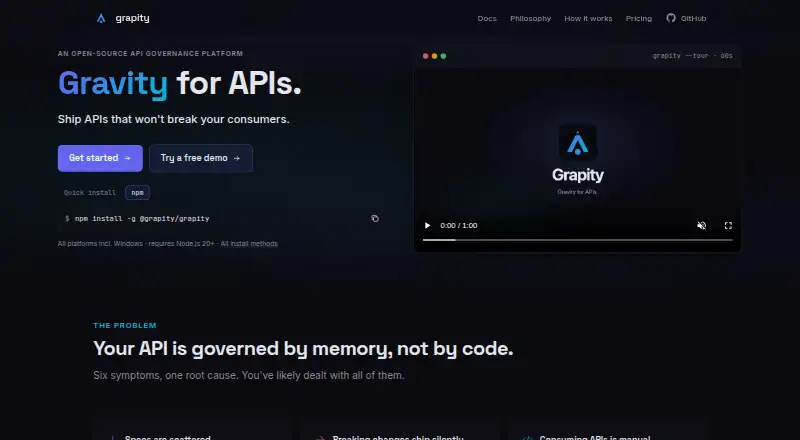
Grapity is an open-source API governance platform for teams managing API contracts and changes that could affect consumers.
What Grapity is
Grapity is an open-source API governance platform for teams managing API contracts and changes that could affect consumers. Its Registry checks a pushed specification against the previous version and blocks breaking changes with an explanation. It also enforces semantic version increments and tracks deprecation lifecycles, including affected consumers and sunset dates. The Hub gives teams a searchable API list, endpoint exploration, side-by-side version comparisons, and a version timeline. For Kong, Grapity Gateway generates configuration from registered specifications, while its CLI provisions that configuration through decK. Kong access logs can be sent to the Registry with the http-log plugin for querying and traffic statistics. Grapity supports OpenAPI and AsyncAPI, CI/CD integration, and role-based access control. It runs on the web, Windows, macOS, Linux, or as a self-hosted deployment. The project is licensed under Apache 2.0 and says no features are locked behind paywalls. Self-hosting is free; Cloud costs $29.95/mo and includes five APIs and five users, with additional monthly charges for extra APIs or users.
Good
- Registry blocks breaking changes with explanations.
- Tracks deprecations, consumers, and sunset dates.
- Hub provides version comparisons and timelines.
- Self-hosted plan is free.
Watch out
- Cloud includes five APIs and five users.
- Extra APIs cost $1.99/mo each.
- Extra users cost $0.99/mo each.
- Windows CLI installation requires npm or WSL.
Who it suits
Grapity suits teams that need to govern API contracts, catch breaking changes, and coordinate with API consumers. It is relevant to teams using OpenAPI or AsyncAPI and, for Kong configuration workflows, Kong with decK.
Verdict
Grapity brings specification checks, lifecycle tracking, and a developer portal into one API governance workflow. Teams should account for the Cloud plan’s included API and user limits, or choose self-hosting.
Plans and prices
From Grapity's own pricing page, checked 7 Oct 2001.
| Plan | Price | What it gives you |
|---|---|---|
| Self-hosted | Free | Unlimited APIs · Unlimited team members · Self-managed PostgreSQL · Free forever |
| Cloud | $29.95 a month | 5 APIs and 5 users included · +$1.99 per additional API / mo · +$0.99 per additional user / mo · $29.95/mo |
The facts
Each one read from Grapity's own pages, with the date it was checked.
What it does
- Compatibility checks
- The Registry compares each pushed spec with its previous version and blocks breaking changes with an explanation.checked 7 Oct 2001
- Demo retention
- Demo instances and their credentials expire and are deleted two hours after creation.checked 7 Oct 2001
- Developer portal
- The Hub provides a searchable API list, endpoint exploration, side-by-side version comparison, and a version timeline.checked 7 Oct 2001
- Gateway integration
- Grapity Gateway generates Kong configuration from registered specs, and the CLI provisions it to Kong via decK.checked 7 Oct 2001
- Gateway logs
- Kong can send access logs to the Registry through its http-log plugin for querying and traffic statistics.checked 7 Oct 2001
- Installation
- The CLI supports macOS and Linux installers; Windows users are directed to npm or WSL, and npm installation requires Node.js 20 or later.checked 7 Oct 2001
- Intended users
- Grapity presents the product for teams that need to manage API contracts, prevent breaking changes, and coordinate API consumers.checked 7 Oct 2001
- License
- The project says it is open source under the Apache 2.0 license, with no features locked behind paywalls.checked 7 Oct 2001
- Privacy and security
- For its demo service and website, Grapity says it uses HTTPS, signed session cookies, and rate limiting, and does not store passwords or billing information.checked 7 Oct 2001
- Product
- Grapity describes itself as an open-source API governance platform for shipping APIs without breaking consumers.checked 7 Oct 2001
- Roadmap
- The site labels Forge typed clients, Schema registry bridges, and Mind LLM-optimized specs as coming later.checked 7 Oct 2001
- Support
- The maker lists [email protected] for contact and privacy questions, and says community support is available through GitHub Sponsors.checked 7 Oct 2001
- Versioning
- The Registry enforces semantic version increments and tracks API deprecation lifecycles, including consumers and sunset dates.checked 7 Oct 2001
The full review of Grapity
Grapity is an open-source API governance platform for teams that need to manage contracts, versions, and consumer access in one workflow. It is strongest for organizations coordinating several API producers and consumers; smaller projects seeking only linting or testing may find its broader governance model unnecessary.
Overview
Grapity’s Registry compares every pushed specification with its previous version, blocks breaking changes, and explains the incompatibility. That puts compatibility review inside the delivery process instead of leaving consumers to discover failures after release. OpenAPI and AsyncAPI are supported, with CI/CD integration and role-based access control.
The project is open source under the Apache 2.0 license, and Grapity says no features are restricted by paywalls. Self-hosting therefore offers the complete feature set to teams prepared to operate PostgreSQL and the surrounding service themselves. Its hosted option removes that infrastructure work but introduces usage-based charges as API and user counts rise.
Key features
Contracts and lifecycle governance
The Registry enforces semantic-version increments and records deprecation lifecycles, including affected consumers and sunset dates. This is useful when multiple teams depend on shared APIs: producers get explicit release rules, while owners can identify who needs migration before a version is retired. A team that only wants a basic specification linter will not use much of this additional control.
Discovery and consumer access
The Hub provides a searchable API catalogue, endpoint exploration, side-by-side version comparison, and a version timeline. Those views give developers a practical way to understand available endpoints and see how an API changed, rather than relying on scattered specification files. They are most valuable when an organization has enough services that discovery itself becomes a coordination problem.
Gateway integration and traffic data
Grapity Gateway generates Kong configuration from registered specifications, and the CLI provisions that configuration to Kong through decK. Kong can also send access logs to the Registry through its http-log plugin, where teams can query traffic and statistics. This creates a path from contract registration to gateway deployment and operational visibility, but it is specifically centered on Kong and its tooling.
Installation and roadmap
macOS and Linux users get CLI installers. Windows users are directed to npm or WSL, and npm installation requires Node.js 20 or newer, so Windows teams should account for that extra setup choice. Forge typed clients, Schema registry bridges, and Mind LLM-optimized specifications are presented as future additions rather than current capabilities.
Pricing
| Plan | Price | What it includes |
|---|---|---|
| Self-hosted | free, billed Free forever | Unlimited APIs, unlimited team members, and self-managed PostgreSQL |
| Cloud | $29.95 a month | 5 APIs and 5 users; additional APIs cost 1.99 USD each per month and additional users cost 0.99 USD each per month |
Self-hosted is the clear fit for teams with infrastructure capability or unusually large API and member counts: the included limits are unlimited, but PostgreSQL and operations remain your responsibility. Cloud suits teams that want a managed starting point at $29.95 a month. Its five-API and five-user allowance covers a small group, while larger organizations should model the recurring per-API and per-user additions before committing. No trial term is stated for either plan.
Platforms
Grapity is available on Linux, macOS, Windows, the web, and as a self-hosted deployment. Windows CLI installation uses npm or WSL rather than the macOS/Linux installer path. The npm route requires Node.js 20 or later.
Who it's for
Choose Grapity when API contracts span teams, compatibility checks need to run with CI/CD, and consumers need a maintained catalogue with deprecation visibility. It is also a good match for organizations standardizing gateway work on Kong and decK. Teams wanting a narrow, standalone linter, or those unwilling to operate self-hosted infrastructure and likely to exceed Cloud’s included quotas, should consider alternatives.
Pros and cons
- Pro: Registry comparisons explain and block breaking specification changes before consumers encounter them.
- Pro: Semantic version enforcement and consumer-aware sunset tracking make deprecation an explicit process.
- Pro: The Hub combines search, endpoint exploration, version comparison, and timelines for developer discovery.
- Pro: Apache 2.0 licensing and a free, unlimited self-hosted plan avoid feature paywalls.
- Con: Cloud includes only five APIs and five users, then charges separately for each additional API and user.
- Con: Windows installation requires npm or WSL, with Node.js 20 or later for npm.
- Con: Gateway automation is built around Kong and decK, which limits its relevance for teams using other gateways.
Alternatives
ATA API Governance is a better fit when a free plan capped at 30 endpoints, one team, three users, and five Developer Studio applications matches a smaller governance rollout.
Postman is the more natural choice for teams prioritizing an API client, mock servers, collection running, and native Git in a freemium workflow.
Routebase suits teams wanting a free plan with one user, two projects, 1,000 mock requests per month, and an auto-generated documentation portal.
Zally is a focused open-source API linter under an MIT license with an exception.
oasdiff is an alternative for teams seeking an Apache 2.0 open-source engine, CLI, and GitHub Action.
Karate is aimed at broader REST, GraphQL, and SOAP API testing plus browser and desktop UI automation.
SwaggerHub is a paid hosted option with a free tier for basic API design and documentation.
Apiway offers a free starting plan based on credits and read/write rate limits.
Verdict
Grapity is a strong choice for multi-team API programs that need contract compatibility gates, lifecycle accountability, consumer discovery, and Kong deployment in one open-source platform. Its main reason to look elsewhere is operational or financial scale: self-hosting requires PostgreSQL management, while Cloud’s five-API/five-user baseline and metered expansion can become costly as the organization grows.
Alternatives to Grapity
- 1

Karate
Free planOpen sourceAPIExtensionLinuxmacOS8.1From $8.33 a month - 2
ATA API Governance
Free planWebAPIExtensionLinux7.7From $0.88 a month - 3

Postman
Free planWebExtensionLinuxmacOS7.5From $9 a month - 4
oasdiff
Free planWebAPILinuxmacOS7.2From $100 a month - 5

Routebase
Free planWebAPILinuxmacOS7.1From $9 a month - 6
SwaggerHub
Free planWebSelf-hosted7.0From $61.67 a month