oasdiff
oasdiff compares OpenAPI specifications, creates changelogs, and flags breaking changes before release.
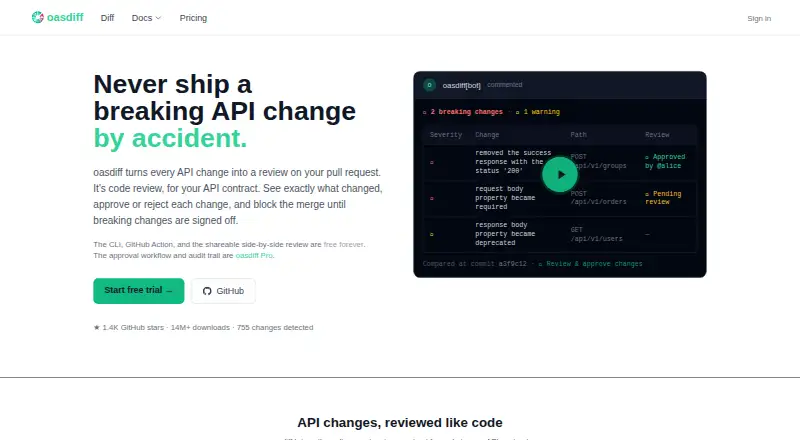
What oasdiff is
oasdiff compares OpenAPI specifications, creates changelogs, and flags breaking changes before release. It supports OpenAPI 3.0, 3.1, and 3.2, and detects 755 distinct breaking and non-breaking API changes. The CLI can be installed through Homebrew, a shell installer, Docker, or pre-built binaries for Linux, macOS, and Windows. Its output formats include text, JSON, YAML, HTML, Markdown, and GitHub Actions annotations. A GitHub Action compares pull-request specifications with a base branch and adds inline annotations for breaking changes. The browser tool compares OpenAPI or Swagger specifications without installation or sign-up. Specs and changelogs are encrypted client-side before upload, with servers retaining ciphertext they cannot read. The engine, CLI, and GitHub Action are open source under Apache 2.0. The free plan includes CLI diffing, changelogs, GitHub Action annotations, side-by-side review, and encrypted spec storage. Pro costs $100/month and adds approval workflows, an audit trail, a merge gate, and up to five reviewers across five repositories.
Good
- Supports OpenAPI 3.0, 3.1, and 3.2.
- CLI offers multiple installation and output options.
- Browser comparisons require no installation or sign-up.
- Free plan requires no account.
- Engine, CLI, and GitHub Action use Apache 2.0.
Watch out
- Pro costs $100/month.
- Free review links expire after seven days.
- AsyncAPI and GraphQL are not supported.
Who it suits
oasdiff suits teams that review OpenAPI changes in pull requests or compare specifications through a browser. It also fits workflows that need CLI output or composed comparisons across multiple service files.
Verdict
oasdiff provides specification comparison through a CLI, browser tool, and GitHub Action. The free plan covers core review functions, while approval controls and longer review retention are among the paid-plan details.
Plans and prices
From oasdiff's own pricing page, checked 1 Oct 2026.
| Plan | Price | What it gives you |
|---|---|---|
| Free | Free | CLI diff, breaking changes and changelog · GitHub Action inline PR annotations · side-by-side review · encrypted spec storage · no account required · Free forever |
| Pro | $100 a month | Approval workflow · audit trail · merge gate · up to 5 reviewers across 5 repositories · $100/month |
| Enterprise | Priced on request | Unlimited repositories and reviewers · SLA · dedicated support · optional no-upload GitHub mode · Custom |
The facts
Each one read from oasdiff's own pages, with the date it was checked.
What it does
- AI integrations
- oasdiff provides a hosted MCP server that works with Claude, Cursor, and other Streamable HTTP MCP clients.checked 1 Oct 2026
- Change coverage
- oasdiff detects 755 distinct breaking and non-breaking API changes.checked 1 Oct 2026
- CLI installation
- The CLI is available through Homebrew, a shell installer, Docker, and pre-built Linux, macOS, and Windows binaries.checked 1 Oct 2026
- Encryption
- Specs and changelogs are encrypted client-side before upload, and servers retain only ciphertext that oasdiff cannot read.checked 1 Oct 2026
- Enterprise privacy
- Enterprise can load specs directly from GitHub at review time using each reviewer's access without uploading or storing specs.checked 1 Oct 2026
- GitHub integration
- The GitHub Action compares pull-request and base-branch specifications and adds inline breaking-change annotations.checked 1 Oct 2026
- Microservices
- Composed mode compares collections of OpenAPI files together for APIs split across multiple services.checked 1 Oct 2026
- OpenAPI support
- oasdiff supports OpenAPI 3.0, 3.1, and 3.2.checked 1 Oct 2026
- Open source
- The oasdiff engine, including its CLI and GitHub Action, is open source under the Apache 2.0 license.checked 1 Oct 2026
- Output formats
- CLI output supports text, JSON, YAML, HTML, Markdown, and GitHub Actions annotations.checked 1 Oct 2026
- Purpose
- oasdiff compares OpenAPI specifications, generates changelogs, and detects breaking changes before release.checked 1 Oct 2026
- Review retention
- Free review links expire after 7 days, while Pro reviews remain for the life of the pull request.checked 1 Oct 2026
- Support
- oasdiff provides support and security or procurement contact through [email protected].checked 1 Oct 2026
Where it runs
- Browser tool
- The web diff tool compares OpenAPI or Swagger specifications without installation or sign-up and exports text, YAML, JSON, Markdown, and HTML.checked 1 Oct 2026
The full review of oasdiff
oasdiff is a tool for comparing OpenAPI specifications and reviewing API changes. It is best suited to teams that want to catch contract changes before release, whether from a terminal, a pull request, or a browser. Its broad change detection and free core are strong; teams needing formal approvals or longer-lived reviews will need Pro or Enterprise.
Overview
oasdiff compares OpenAPI specifications, creates changelogs, and flags breaking changes before release. It supports OpenAPI 3.0, 3.1, and 3.2, and detects 755 distinct breaking and non-breaking changes. That breadth makes it useful for reviewing routine evolution as well as compatibility risks. It is not a fit for teams whose contracts are in AsyncAPI or GraphQL, neither of which it supports.
The engine, CLI, and GitHub Action are open source under Apache 2.0, and the product also offers a browser diff tool and paid review controls. Self-hosted deployment is supported, giving teams another deployment option alongside its web and platform-specific tools.
Key features
Compare in scripts, pull requests, or a browser
The CLI installs through Homebrew, a shell installer, Docker, or pre-built binaries for Linux, macOS, and Windows. It can emit text, JSON, YAML, HTML, Markdown, or GitHub Actions annotations, so teams can use the same comparison in a script, report, or automated workflow. Composed mode compares collections of OpenAPI files together, which is useful when an API is divided among microservices.
The GitHub Action compares a pull request's specification with the base branch and adds inline annotations for breaking changes. That puts compatibility issues in the review context rather than leaving developers to inspect a separate report. The browser diff tool compares OpenAPI or Swagger specifications without installation or sign-up, and exports text, YAML, JSON, Markdown, or HTML. It is convenient for occasional comparisons, although it does not replace automated pull-request checks for teams that need those checks on every change.
Review privacy and retention
Specifications and changelogs are encrypted client-side before upload; servers retain ciphertext that oasdiff cannot read. Free review links expire after seven days, while Pro reviews remain for the life of the pull request. Enterprise can load specifications directly from GitHub at review time using each reviewer's access, without uploading or storing the specifications. That no-upload mode is a meaningful privacy option for organizations with stricter handling requirements.
AI clients
A hosted MCP server works with Claude, Cursor, and other Streamable HTTP MCP clients. This adds a route for compatible AI clients to use oasdiff, but it does not broaden the underlying contract formats beyond OpenAPI.
Pricing
oasdiff has a free plan, a paid Pro plan, and custom-priced Enterprise. The free tier is unusually capable for teams that mainly need comparisons and pull-request feedback; paid plans are aimed at review governance and organizational support rather than unlocking the basic engine.
- Free — free, free forever. Includes CLI diffing, breaking-change detection and changelogs, GitHub Action inline pull-request annotations, side-by-side review, and encrypted specification storage. No account is required. Its key trade-offs are review links that expire after seven days and the absence of Pro's approval workflow, audit trail, and merge gate.
- Pro — $100 a month, billed $100/month. Adds an approval workflow, audit trail, and merge gate, and covers up to five reviewers across five repositories. This is the appropriate step up for a small team that needs controlled sign-off, but the reviewer and repository caps may constrain broader rollouts.
- Enterprise — custom pricing. Includes unlimited repositories and reviewers, an SLA, dedicated support, and an optional no-upload GitHub mode. It suits organizations that need scale, service commitments, or the stricter GitHub-based privacy path; it is a substantial commitment compared with the free core, and its price depends on the custom arrangement.
A 30-day trial is offered. The free plan is the sensible starting point for individual use or basic team checks; paying makes most sense when review retention or governance controls matter in day-to-day release work.
Platforms
oasdiff supports API workflows and runs on Linux, macOS, and Windows, with web and self-hosted options. The CLI's pre-built binaries cover those desktop and server operating systems, while Docker is another installation route. This range suits teams mixing local development with hosted pull-request review, though contract support remains specifically OpenAPI 3.0, 3.1, and 3.2 in JSON or YAML.
Who it's for
oasdiff is a strong fit for developers and API teams that publish OpenAPI contracts and want repeatable change checks before release. The CLI and open-source GitHub Action suit teams comfortable integrating tooling into development workflows; the browser tool serves reviewers who want a one-off comparison without setup. Teams coordinating approvals across repositories, retaining reviews through a pull request, or enforcing a merge gate have a clearer case for Pro. Enterprises that cannot upload specifications may value Enterprise's optional no-upload GitHub mode. Teams working in GraphQL or AsyncAPI should look elsewhere.
Pros and cons
- Pro: Detects 755 distinct breaking and non-breaking changes across three OpenAPI versions, making review broader than a breaking-only check.
- Pro: Open-source CLI and GitHub Action, plus multiple output formats, support both custom automation and inline pull-request review.
- Pro: The free tier includes core comparisons, changelogs, and pull-request annotations without requiring an account.
- Pro: Client-side encryption and Enterprise's optional no-upload mode give teams distinct privacy choices.
- Con: It does not support AsyncAPI or GraphQL, so teams with those contract types need another tool.
- Con: Free review links last only seven days, and approval, audit, and merge-gating controls require the $100/month Pro plan.
- Con: Pro is limited to five reviewers and five repositories, which may be restrictive for larger teams before Enterprise.
Alternatives
For broader choices, see Contract Testing Tools, API Governance Software, and API Design Tools.
Microcks is a free, fully open-source, community-driven CNCF Incubating project; choose it if that project model and its broader platform range suit your needs better. Pact is free open-source tooling, a reasonable alternative for readers seeking that approach. Specmatic offers free OpenAPI and WSDL contract testing, API resilience testing, and service virtualization, so it is worth considering when testing is the priority. Karate is a free MIT-licensed framework spanning REST, GraphQL, and SOAP API testing as well as browser and desktop UI automation; choose it when that broader testing remit matters more than OpenAPI diffing.
Pact Broker offers a free self-hosted option and PactFlow Starter with unlimited users, two integrations, and bi-directional contract testing, making it an alternative for readers focused on contract coordination. Confluent Cloud has a free Basic tier with managed Kafka clusters and connectors, a different fit for readers seeking managed Kafka resources. Schemathesis is a free open-source tool that generates tests from OpenAPI and GraphQL schemas; choose it when generated schema-based tests are the goal. GraphQL Hive offers a free Hobby plan with one million operations per month and seven-day usage-data retention, an alternative for GraphQL teams.
Verdict
Choose oasdiff if your team uses OpenAPI and wants a capable free comparison engine with a direct path into GitHub pull-request review. Its strongest case is the combination of broad change coverage, open-source automation, and accessible browser comparisons. Look elsewhere if your contracts are GraphQL or AsyncAPI, or if you need approvals and merge controls but cannot justify Pro's $100/month price.
Getting started
- Open https://www.oasdiff.com/ to access oasdiff.
- Use the browser diff tool to compare OpenAPI or Swagger specifications without installation or sign-up.
- Install the CLI with Homebrew, a shell installer, Docker, or a pre-built binary for Linux, macOS, or Windows.
- Use the free plan without an account for CLI diffing, changelogs, GitHub Action annotations, and side-by-side review.
- Consider the 30-day trial or Pro at $100/month for approval workflow, audit trail, merge gate, and up to 5 reviewers across 5 repositories.
Limits worth knowing
The free plan’s review links expire after 7 days. Pro costs $100/month and supports up to 5 reviewers across 5 repositories; Enterprise offers unlimited repositories and reviewers at a custom price.
Questions
Is there a free plan?
Yes. Free includes CLI diffing, breaking-change detection and changelogs, GitHub Action inline pull-request annotations, side-by-side review, and encrypted spec storage. It does not require an account.
How much does Pro cost?
Pro costs $100/month and includes an approval workflow, audit trail, merge gate, and up to 5 reviewers across 5 repositories.
Is there a free trial?
Yes, a 30-day trial is offered.
Which platforms does oasdiff support?
Its listed platforms are API, Linux, macOS, self-hosted, web, and Windows. The CLI is available through Homebrew, a shell installer, Docker, and pre-built Linux, macOS, and Windows binaries.
Is oasdiff open source?
The oasdiff engine, including its CLI and GitHub Action, is open source under Apache 2.0.
Which formats and integrations does it support?
It supports OpenAPI 3.0, 3.1, and 3.2, with JSON and YAML contract formats; AsyncAPI and GraphQL are not supported. Integrations include a GitHub Action and a hosted MCP server for Claude, Cursor, and other Streamable HTTP MCP clients.
Alternatives to oasdiff
- 1

Karate
Free planOpen sourceAPIExtensionLinuxmacOS8.2From $100 a year - 2
ATA API Governance
Free planWebAPIExtensionLinux7.7Free plan - 3

Postman
Free planWebExtensionLinuxmacOS7.6From $9 a month - 4
Apistaq
Free planWebAPI7.2From $149 a month - 5

DigitalAPI
WebAPISelf-hosted7.1From $2,500 a month - 6

Routebase
Free planWebAPILinuxmacOS7.1From $9 a month