ATA API Governance
ATA API Governance centralizes API ownership, specifications, compliance, lifecycle management, and dependencies across teams.
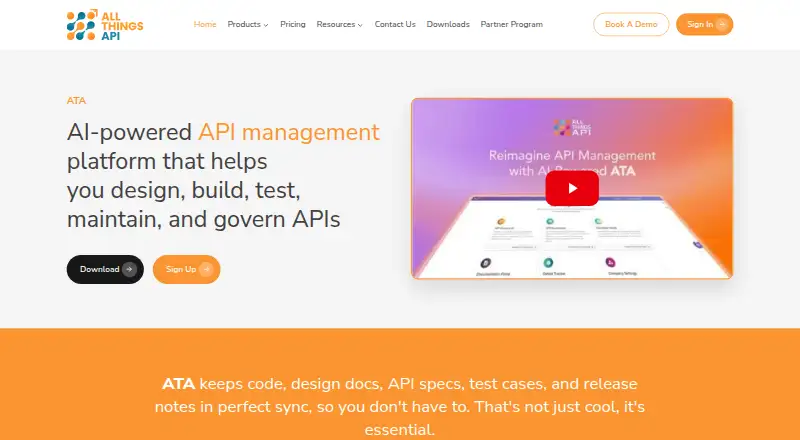
What ATA API Governance is
ATA API Governance centralizes API ownership, specifications, compliance, lifecycle management, and dependencies across teams. Its inventory records endpoint, method, version, exposure type, owning team, and deployment environment, while lifecycle tracking covers APIs from draft through deprecated and supports multiple versions. A visual dependency tree connects API owners with consumer teams, projects, and services to help reveal change impacts. Teams can set rules for OpenAPI structure, methods, naming, headers, and security standards, with real-time feedback on violations. Reusable schemas can flag mismatches, and a dashboard surfaces commonly used security protocols, potential PII exposure, and APIs missing required schemas. Ask AI answers questions about APIs, projects, rules, schema use, and versions. ATA provides a web platform, desktop clients, Linux downloads, an npm command-line package, agents, and a browser extension. The free tier includes 30 API endpoints; paid tiers raise limits, while Enterprise limits are custom. ATA states its services are not designed for HIPAA, FISMA, or GLBA compliance.
Good
- Tracks APIs from draft through deprecated.
- Custom rules provide real-time violation feedback.
- Dependency tree maps owners and consumers.
- Free tier includes 30 API endpoints.
Watch out
- Free tier is limited to 30 endpoints.
- Enterprise endpoint count is custom.
- Not designed for HIPAA, FISMA, or GLBA compliance.
Who it suits
ATA API Governance suits teams that need shared API inventory, lifecycle controls, dependency visibility, and OpenAPI policy checks. It is not designed for HIPAA, FISMA, or GLBA compliance.
Verdict
ATA API Governance combines API inventory, lifecycle tracking, dependency mapping, and policy enforcement. Consider endpoint limits and stated regulatory exclusions when evaluating it.
Plans and prices
From ATA API Governance's own pricing page, checked 15 Oct 2001.
| Plan | Price | What it gives you |
|---|---|---|
| Free | Free | UI automation basics · API testing · 3 users · 500 endpoints · 2 scheduled monitoring runs · 7-day monitoring history · 30 governance endpoints |
| Basic | $10.58 a year | 10 users · 800 endpoints · 5 scheduled monitoring runs · 15-day monitoring history · 25,000 mock calls/user/month · 100 governance endpoints · per user/month, billed annually |
| Startup | $35.60 a year | 200 users · 7,500 endpoints · 60 scheduled monitoring runs · 60-day monitoring history · 100,000 mock calls/user/month · 500 governance endpoints · per user/month, billed annually |
| Enterprise | Priced on request | Custom users, endpoints, monitoring, history, testing, documentation, SSO and support · dedicated server listed at $10,000/month |
The facts
Each one read from ATA API Governance's own pages, with the date it was checked.
What it does
- Access management
- Auditable approval workflows control which consumers can use particular APIs.checked 15 Oct 2001
- AI assistant
- Ask AI answers questions about projects, APIs, active governance rules, schema usage, and versions.checked 2 Oct 2001
- API inventory
- API Governance provides a centralized inventory showing API status, versions, ownership and schemas.checked 15 Oct 2001
- API testing
- ATA supports ad-hoc API testing, API chaining, security checks, performance checks, robustness testing and vulnerability testing.checked 15 Oct 2001
- Ask AI
- The built-in assistant answers questions about projects, rules, schemas, API versions and governance policies.checked 15 Oct 2001
- CLI and CI/CD
- ATA CLI is distributed as an npm package for running tests and workflows from a terminal or CI/CD process.checked 15 Oct 2001
- Compliance limitation
- Terms state that the service is not designed for HIPAA, FISMA or GLBA compliance obligations.checked 15 Oct 2001
- Data processors
- ATA lists OpenAI in the United States for AI research and deployment and AWS in Northern Virginia for cloud product services as subprocessors, current as of July 21, 2025.checked 2 Oct 2001
- Desktop support
- The desktop client is installable on Windows and Mac computers.checked 15 Oct 2001
- Documentation depth
- The documentation site organizes Governance.dev into API Governance, AI Governance, Controls and Compliance, Developer Studio and Engineering Health pillars.checked 15 Oct 2001
- Documentation portal
- Documentation Portal offers Markdown, HTML and visual editing, versioned publishing, API linking, access control and public or private sharing.checked 15 Oct 2001
- Governance dashboard
- The dashboard reports API versions, schema status, usage, security protocols, PII exposure and ownership.checked 15 Oct 2001
- Integrations
- ATA advertises Jira issue synchronization and third-party integrations for sourcing and deployment.checked 15 Oct 2001
- Inventory
- Its inventory lists APIs across teams and applications with endpoint, method, version, exposure type, owning team, and environment deployment status.checked 2 Oct 2001
- Licence
- The terms identify Pioneer AI Technologies as owner of the site's source code and software content; no open-source licence is stated.checked 15 Oct 2001
Where it runs
- Agent platforms
- ATA Agent downloads are offered for Windows, Mac and Linux.checked 15 Oct 2001
- Browser extension
- ATA Bridge is a Chrome extension for recording interactions, capturing screenshots and creating issues.checked 15 Oct 2001
- Dependency mapping
- Dependency views show producer and consumer relationships and help assess the effect of API changes.checked 15 Oct 2001
- Deployment and platforms
- ATA offers a web platform, desktop clients for Windows and Mac, Linux downloads, a command-line npm package, local and server agents, and the ATA Bridge browser extension.checked 2 Oct 2001
The company
- Company founded
- G2's seller profile lists Pioneer AI Technologies LLC as founded in 2024.checked 15 Oct 2001
- Company headquarters
- ATA lists a sales office at 545 Metro Place South, Suite 100, Dublin, Ohio, USA.checked 15 Oct 2001
- Company legal name
- The product footer identifies the maker as Pioneer AI Technologies LLC.checked 15 Oct 2001
- Company size
- LinkedIn lists Pioneer AI Technologies as a self-owned IT services company with 51–200 employees.checked 15 Oct 2001
- Headquarters
- Dublin, Ohio, United Stateschecked 28 Sep 2001
The full review of ATA API Governance
Overview
ATA API Governance is designed to give teams a shared view of API ownership, specifications, compliance rules, lifecycle status, and dependencies. Its inventory brings APIs from multiple teams and applications together, with details such as endpoint, method, version, exposure type, owner, and deployment status by environment. It supports OpenAPI, style guide enforcement, API linting, design review workflows, and role-based access control.
Lifecycle tracking follows APIs from draft through deprecated and accommodates multiple versions. A visual dependency tree links APIs with their owners, consumer teams, projects, and services, making it easier to see which parts of a wider system may be affected by a change. The product's scope is governance across an API portfolio, rather than specification management alone.
Key features
Teams can set custom rules for OpenAPI structure, methods, naming, headers, and security standards. ATA provides real-time feedback when an API violates those rules. Reusable schema components support shared data expectations, while mismatch alerts flag APIs that diverge from defined schemas.
The governance dashboard reports commonly used security protocols, potential PII exposure, and APIs missing required schemas. These are signals for teams to review, not a guarantee that an API is compliant or secure. Ask AI can answer questions about projects, APIs, active governance rules, schema usage, and versions.
ATA says it encrypts sensitive information, limits access to authorized personnel, and conducts regular security assessments and audits. Its downloads page displays ISO 27001:2022, ISO 42001, and SOC 2 Type II badges. Listed subprocessors, current as of July 21, 2025, are OpenAI in the United States for AI research and deployment and AWS in Northern Virginia for cloud product services. ATA's terms state that its site and related services are not designed for HIPAA, FISMA, or GLBA compliance.
ATA also describes third-party integrations for sourcing and deploying applications through Developer Studio; its homepage specifically describes Jira issue creation with real-time synchronization.
Pricing
ATA uses a freemium model. The free plan costs nothing and includes 30 API Governance endpoints, 1 team, 3 users, and 5 Developer Studio applications.
- Basic: $10.58 a year, billed per user/month, billed annually. Includes 100 endpoints, 3 teams, 10 users, and 10 Developer Studio applications.
- Startup: $35.60 a year, billed per user/month, billed annually. Includes 500 endpoints, 20 teams, 200 users, and 50 Developer Studio applications.
- Enterprise: Price not listed. Endpoint, user, team, and application limits are custom; SSO and a dedicated server option are included.
The endpoint allowances make the plan distinctions concrete, while Enterprise is the option for organizations that need custom limits. Paid plans offer Basic, Premium, and Priority Support options.
Platforms
ATA offers a web platform, desktop clients for Windows and Mac, Linux downloads, a command-line npm package, local and server agents, and the ATA Bridge browser extension. Its listed platform coverage also includes API and self-hosted use.
Who it's for
ATA is suited to teams that need to coordinate API rules, ownership, versions, and dependencies across projects. It is particularly relevant when several teams share schemas or need to understand how a change may affect consumers. Teams with regulatory obligations should note ATA's stated limitations: its services are not designed for HIPAA, FISMA, or GLBA compliance.
Pros and cons
- Pros: Central inventory includes ownership and environment status; lifecycle and dependency views help contextualize change; custom OpenAPI rules and reusable schemas support consistent governance; a free plan is available.
- Cons: The free tier is limited to 30 endpoints, 1 team, and 3 users; paid plans also have defined endpoint caps until Enterprise; Enterprise pricing is not listed; the stated compliance exclusions may rule it out for some regulated use cases.
Alternatives
For a wider selection, see API Governance Software. Other options include Postman, Routebase, oasdiff, Karate, Redocly, SwaggerHub, Apiway, and CodeRifts.
Verdict
ATA API Governance combines an API catalog with lifecycle controls, dependency mapping, configurable rules, and schema checks. That breadth makes it a practical fit for teams managing shared APIs across owners and projects. The main trade-offs are capacity limits on the lower plans and the explicit exclusion of HIPAA, FISMA, and GLBA compliance; teams should weigh those constraints against their portfolio size and requirements.
Getting started
- Visit https://ata.dev/.
- Choose the Free plan or review paid plans starting at $10.58 per user per month, billed annually.
- Use the web platform or select a Windows, Mac, Linux, command-line, agent, or browser-extension route.
- Add APIs to the inventory and define governance rules and reusable schemas.
Limits worth knowing
The Free plan covers 30 endpoints, one team, three users, and five Developer Studio applications. Basic includes 100 endpoints, three teams, 10 users, and 10 applications; Startup includes 500 endpoints, 20 teams, 200 users, and 50 applications.
Questions
Is there a free plan?
Yes. Free includes 30 API Governance endpoints, one team, three users, and five Developer Studio applications.
Which platforms does ATA support?
It offers web, Windows and Mac desktop clients, Linux downloads, an npm command-line package, local and server agents, and the ATA Bridge browser extension.
What API formats does it govern?
The listed governed format is OpenAPI.
What integrations are described?
ATA says Developer Studio uses third-party integrations to source and deploy applications. The homepage describes Jira issue creation with real-time synchronization.
Does ATA describe security and privacy safeguards?
ATA says it encrypts sensitive information, restricts access to authorized personnel, and conducts regular security assessments and audits. Its terms say the services are not designed for HIPAA, FISMA, or GLBA compliance.
Alternatives to ATA API Governance
- 1

Karate
Free planOpen sourceAPIExtensionLinuxmacOS8.1From $8.33 a month - 2

Postman
Free planWebExtensionLinuxmacOS7.5From $9 a month - 3
oasdiff
Free planWebAPILinuxmacOS7.2From $100 a month - 4

DigitalAPI
WebAPISelf-hosted7.1From $2,500 a month - 5

Routebase
Free planWebAPILinuxmacOS7.1From $9 a month - 6
SwaggerHub
Free planWebSelf-hosted7.0From $61.67 a month