Google Agent Development Kit
Google Agent Development Kit (ADK) is an open-source framework for building, debugging, evaluating, and deploying AI agents.
What Google Agent Development Kit is
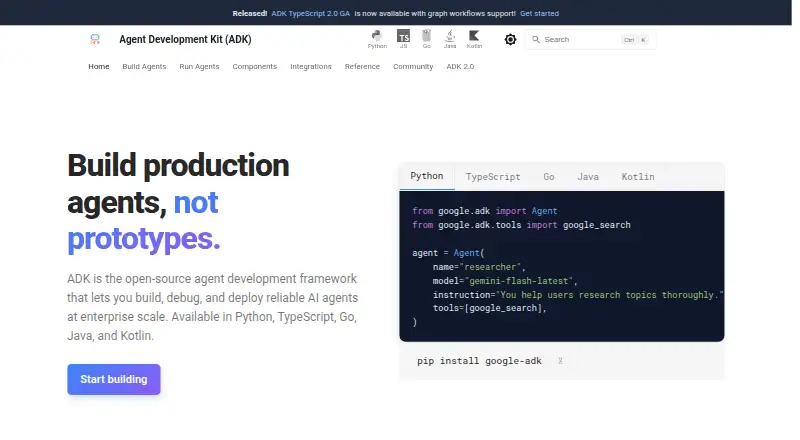
Google Agent Development Kit (ADK) is an open-source framework for building, debugging, evaluating, and deploying AI agents. It is available for Python, TypeScript, Go, Java, and Kotlin. Graph-based workflows can mix deterministic code with adaptive AI reasoning, and hierarchical agents can delegate tasks to specialists. ADK supports Gemini and adapters for other model providers, including locally running models. Its integration catalog covers MCP, Google Cloud, databases, search, observability, and third-party services. Teams can create multi-turn evaluation datasets and run evaluations locally through the CLI or development UI. ADK also supports live agents with two-way text and audio streaming, manages session context, and connects to longer-term memory services. Deployment options include Google Cloud Agent Runtime, Cloud Run, GKE, container-friendly infrastructure, and local Docker or Podman environments. Security guidance covers identity and authorization, guardrails, sandboxed code execution, and network controls. Agent Config is narrower: it currently supports only Gemini models and requires Python. ADK is free and open source, though model and cloud service usage may require separate access or billing.
Good
- Available for Python, TypeScript, Go, Java, and Kotlin
- Supports hierarchical multi-agent delegation
- Includes local evaluation tools and datasets
- Supports live text and audio streaming
Watch out
- Agent Config currently supports only Gemini models
- Agent Config requires Python
- Model and cloud service usage may require separate access or billing
Who it suits
ADK may suit developers building agents in one of its five supported languages, including projects that use hierarchical teams or local evaluations. Its deployment choices also suit teams targeting Google Cloud, containers, or local environments.
Verdict
ADK offers a free framework for building and deploying agents across several languages and environments. Note the narrower model and language limits of Agent Config, and that model or cloud usage may have separate requirements or billing.
Plans and prices
From Google Agent Development Kit's own pricing page, checked 15 Oct 2026.
| Plan | Price | What it gives you |
|---|---|---|
| ADK framework | Free | Apache 2.0 open source · no seat charge or usage cap |
| Google Agent Development Kit (ADK) | Free | Open-source framework; model and cloud service usage may require separate access or billing |
The facts
Each one read from Google Agent Development Kit's own pages, with the date it was checked.
What it does
- Agent orchestration
- The framework supports modular multi-agent composition, delegation and routing between specialized agents.checked 15 Oct 2026
- API surface
- Official references include Python, TypeScript, Go, Java and Kotlin APIs plus CLI, configuration and REST API references.checked 15 Oct 2026
- CLI
- Agents CLI can scaffold, build, test, evaluate and deploy ADK agents from an AI-enabled development environment.checked 15 Oct 2026
- Context and memory
- ADK manages session context and provides integration points for longer-term memory services.checked 4 Oct 2026
- Context management
- ADK manages sessions, memory, events, tool outputs and artifacts, including summarization and context compression controls.checked 15 Oct 2026
- Deployment
- Agents can run locally, in containers, on Cloud Run, on GKE or on Google's managed Agent Runtime.checked 15 Oct 2026
- Developer UI
- The local ADK web interface lets developers chat with agents and inspect events, state and execution traces step by step.checked 15 Oct 2026
- Documentation depth
- The documentation site includes getting-started guides, component references, deployment, observability, evaluation, safety, MCP, A2A and API references.checked 15 Oct 2026
- Evaluation
- Documentation covers evaluation criteria, user and environment simulation, custom metrics and optimization workflows.checked 15 Oct 2026
- Graph workflows
- ADK 2.0 adds graph-based workflows that combine deterministic code with model reasoning and explicit execution paths.checked 15 Oct 2026
- Installation
- The installation guide provides package installation instructions for all five supported languages.checked 4 Oct 2026
- Installation requirement
- The Python quickstart requires Python 3.10 or later and installs the package with pip install google-adk.checked 15 Oct 2026
- Integration ecosystem
- Google lists integrations spanning Google Cloud services, databases, observability platforms, communication tools, productivity apps and many third-party agent tools.checked 15 Oct 2026
- Integrations
- The integrations catalog includes tools and connectors for MCP, Google Cloud, databases, search, observability, and third-party services.checked 4 Oct 2026
- Languages
- Official implementations are provided for Python, TypeScript, Go, Java and Kotlin.checked 15 Oct 2026
- Launch news
- Google announced ADK on April 9, 2025 at Google Cloud NEXT as an open-source framework for production agent and multi-agent development.checked 15 Oct 2026
- License
- The Python ADK repository is licensed under the permissive Apache License 2.0.checked 15 Oct 2026
- Limit: beta components
- ChatForest reports that Python 2.0 and Kotlin 0.1.0 were beta releases and that ADK for Android was not production-ready at review time.checked 15 Oct 2026
- Limit: ecosystem maturity
- ChatForest says ADK's community, tutorials and production case studies still lag behind LangGraph.checked 15 Oct 2026
- Limit: Google Cloud dependence
- Independent reviewers say the managed deployment path is Google Cloud-specific, creating friction for cloud-agnostic teams.checked 15 Oct 2026
- Limit: learning curve
- InfoWorld reports that ADK's extensive capabilities require substantial time and effort to learn.checked 15 Oct 2026
The company
- Company founded
- Google was founded in 1998 by Larry Page and Sergey Brin.checked 15 Oct 2026
- Company legal identity
- Google LLC is Alphabet's technology subsidiary and is headquartered in Mountain View, California.checked 15 Oct 2026
- Company size
- LinkedIn lists Google as a public software-development company with 10,001-plus employees and headquarters in Mountain View, California.checked 15 Oct 2026
The full review of Google Agent Development Kit
Google Agent Development Kit (ADK) is an open-source framework for building, evaluating and deploying AI agents. It suits developers who want to shape agent behavior in code across multiple languages and environments. Its breadth is a strength, though Agent Config’s narrower model and language support matters if you plan to use that feature.
Overview
ADK combines deterministic code with adaptive AI reasoning in graph-based workflows, and lets agents delegate work through a hierarchy of specialized agents. That makes it a flexible foundation for applications that need structured control as well as model-driven decisions, rather than a single conversational flow.
The framework supports Gemini, adapters for other model providers and locally running models. Its integrations catalog spans MCP, Google Cloud, databases, search, observability and third-party services. Model choice is therefore broader than Gemini alone, but Agent Config currently works only with Gemini and requires Python—a meaningful constraint for teams using other models or languages.
Key features
ADK provides tools to build, debug and evaluate agents, including multi-turn evaluation datasets and local evaluation through the CLI or development UI. That gives developers a way to assess behavior as conversations unfold, not just at a single prompt.
Agents can stream text and audio bidirectionally, and ADK manages session context while offering integration points for longer-term memory services. Deployment options include Google Cloud Agent Runtime, Cloud Run, GKE and container-friendly infrastructure, including local Docker or Podman environments. The range supports development locally and deployment across several environments, though cloud or model usage may bring separate access requirements or billing.
Security guidance addresses identity and authorization, input and output guardrails, sandboxed code execution and network controls. These are useful areas to account for when building agents, but guidance is not a substitute for configuring and operating the safeguards in a deployment.
Pricing
Google Agent Development Kit (ADK): free. The open-source framework is free, with no paid ADK tier described. That suits developers who want the framework without a license charge; it does not make model or cloud services free, as those may require separate access or billing.
Platforms
ADK supports API, Linux, macOS, Windows, web and self-hosted environments. It is available in Python, TypeScript, Go, Java and Kotlin, with installation instructions for all five languages. That breadth is useful for teams working across different stacks, although Agent Config remains limited to Python and Gemini.
Who it's for
ADK is a strong fit for developers building agents that need custom workflows, delegation, evaluation, voice streaming or deployment beyond a single hosted environment. Its multiple language options and model adapters suit teams that want to integrate agents into existing software systems.
It is less suitable for teams seeking a model-agnostic Agent Config experience or a turnkey managed service: that configuration feature is Gemini-only and Python-only, while ADK itself is a framework to build and deploy with. Community resources are linked, but Google and the ADK team do not support content in external community resources.
Pros and cons
- Pro: Five supported languages and adapters for external and local models give developers room to fit ADK to different stacks and model choices.
- Pro: Graph workflows, hierarchical delegation and multi-turn evaluation tools support more involved agent systems than a single-step interaction.
- Pro: Local containers and several Google Cloud deployment targets allow teams to choose where to run agents.
- Con: Agent Config is restricted to Gemini and Python, limiting its usefulness for teams standardizing on other models or languages.
- Con: Free framework access does not cover potential model or cloud service costs, so total operating expense depends on the services used.
- Con: External community resources do not carry support from Google or the ADK team.
Alternatives
For a broader comparison, browse AI Agent Platforms.
Choose Camunda if you want a freemium option with a free self-managed development plan for local development and testing, plus a free trial. Choose Workato Agentic if its Free plan’s 50,000 one-time credits suit your needs, or if you want its listed Pro plan at $75 a month.
Flowise is worth considering if a free hosted-style allowance of two flows and assistants, 100 predictions per month and 5MB storage fits your project. UiPath Agentic Automation offers free basic development and attended automation capabilities, with Community available at no cost subject to eligibility under its Community Agreement.
Relevance AI may suit a small web-based workload: its Free plan includes 100 credits per day, one user and 10MB of knowledge. Langflow is another free option with API, web and self-hosted platform support.
Consider StackAI if its free allowance of 500 runs per month, two projects and one seat is a closer match. Dify offers a free Sandbox with 200 message credits, one workspace member and five apps, among other caps.
Verdict
Choose ADK if you want a free, code-oriented framework for building agents across languages, models and deployment environments. Its combination of workflow control, delegation and evaluation is the main reason to choose it; look elsewhere if you need Agent Config to work beyond Gemini and Python, or want model and cloud costs bundled into a fixed framework price.
Alternatives to Google Agent Development Kit
- 1
Vellum
Free planOpen sourceAndroidiOSWebAPI8.7From $30 a month - 2
SmythOS
Free planOpen sourceAndroidiOSWebAPI8.5From $39 a month - 3
Dify
Free planOpen sourceWebAPIExtensionLinux8.4From $590 a year - 4
Workato Agent Studio
Free planiOSWebAPILinux8.3Free plan - 5
Microsoft Copilot
Free planAndroidiOSWebWindows8.2From $99.99 a year - 6
Voiceflow
Free planAndroidiOSWebAPI8.2From $972 a year