GetMax
GetMax is a web-based revenue cycle management platform for US healthcare, covering eligibility, coding, billing, prior authorization, accounts-receivable fo…
What GetMax is
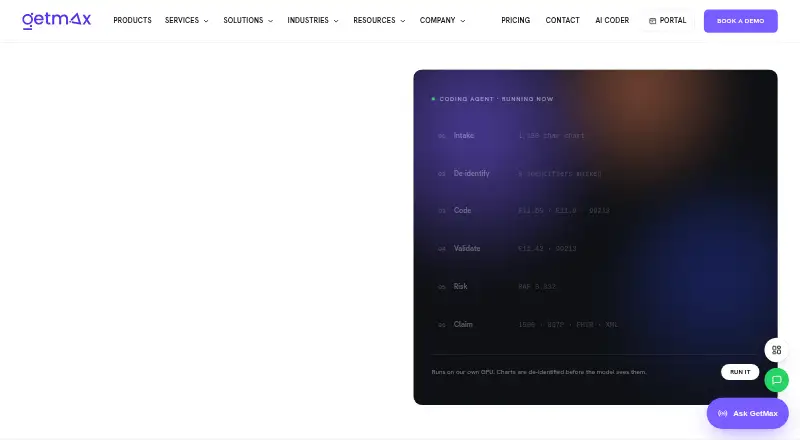
GetMax is a web-based revenue cycle management platform for US healthcare, covering eligibility, coding, billing, prior authorization, accounts-receivable follow-up, denial management, and payment posting. Its live Practice Portal includes eligibility checks, A/R summaries, denial and appeal tools, fee schedule lookup, underpayment detection, and provider search.
The coding assistant is available to try without sign-in, a trial timer, or a card. It proposes ICD-10 and CPT codes, validates them against the live NIH ICD-10-CM set using deterministic rules, and flags ambiguous cases for certified-coder review. Claims can be built in CMS-1500, X12 837P, FHIR, and XML formats. The broader AI workflow can pre-check claims, route denials by root cause, prioritize worklists, and retain payer rule memory. GetMax says it connects with existing EHRs and clearinghouses but does not name specific systems. The coding assistant and Practice Portal are live; eligibility, prior authorization, denial, and collections agents are in build. Revenue-cycle pricing is quoted as a percentage of collections, with the rate depending on specialty, claim volume, payer mix, and scope.
Good
- Coding assistant is open to use without sign-in or a card.
- Proposes and validates ICD-10 and CPT codes.
- Supports four listed claim formats.
- Practice Portal includes eligibility and denial tools.
Watch out
- Revenue-cycle pricing is quoted and not published as a fixed rate.
- Several agents are still in build.
- The coding demo warns not to submit identified patient data.
Who it suits
GetMax suits US healthcare practices seeking revenue-cycle tools, from a coding assistant to broader claim and denial workflows. The company says it can scale from a single clinic to multi-site health systems.
Verdict
GetMax combines a live Practice Portal and coding assistant with a wider revenue-cycle workflow that is still partly in build. Its pricing is quote-based, and prospective users should note the coding demo’s warning about identified patient data.
Plans and prices
From GetMax's own pricing page, checked 5 Oct 2026.
| Plan | Price | What it gives you |
|---|---|---|
| AI Coding Assistant | Free | Open coding demo · Do not submit identified patient data · Free to try; no sign-in, trial timer, or card. |
| Revenue cycle management | Priced on request | No published rate · Pricing depends on claim volume · Specialty and service scope affect pricing · Quoted as a percentage of collections; the percentage depends on specialty, claim volume, payer mix, and scope. |
The facts
Each one read from GetMax's own pages, with the date it was checked.
What it does
- AI workflow
- Its clinic AI OS can read and pre-check claims, assist coding with a human in the loop, route denials by root cause, prioritize worklists, and retain payer rule memory.checked 4 Oct 2026
- Claim formats
- The agent workflow page says claims can be built in CMS-1500, X12 837P, FHIR, and XML formats.checked 5 Oct 2026
- Coding
- The coding agent proposes ICD-10 and CPT codes and applies deterministic rules to correct model errors.checked 4 Oct 2026
- Coding assistant
- The coding assistant proposes ICD-10 and CPT codes, then validates them against the live NIH ICD-10-CM set using deterministic rules.checked 5 Oct 2026
- Current availability
- The FAQ says the coding assistant is live and open to use, while eligibility, prior authorization, denials, and collections agents are in build.checked 4 Oct 2026
- Data handling
- The privacy policy says PHI is processed under HIPAA and a client BAA, is not used for marketing or sold to third parties, and is not used to train public generalized AI models.checked 4 Oct 2026
- Encryption
- The privacy policy states that data is encrypted in transit using TLS 1.2+ and at rest using AES-256, with least-privilege access controls and continuous monitoring.checked 4 Oct 2026
- Human review
- Ambiguous coding cases are flagged for a certified coder in the open demo and routed to one on a real account.checked 5 Oct 2026
- Integrations
- GetMax says it is built to work with existing EHRs and clearinghouses so organizations can keep their current systems.checked 5 Oct 2026
- Intended users
- The company lists hospitals, medical groups, physician practices, dental clinics, behavioral health, and telehealth among its target industries.checked 5 Oct 2026
- Model hosting
- GetMax says its models run on its own GPUs rather than a third-party AI provider.checked 5 Oct 2026
- Notable pricing limit
- GetMax does not publish a fixed price and says its percentage-of-collections quote varies with specialty, claim volume, payer mix, and the stages it handles.checked 5 Oct 2026
- PHI handling
- GetMax says it signs a Business Associate Agreement with each client, does not use PHI to train public generalized AI models, and masks HIPAA Safe Harbor identifiers before its coding model receives text.checked 5 Oct 2026
- Practice Portal
- The Practice Portal includes eligibility checks, A/R summaries, denials and appeals, fee schedule lookup, underpayment detection, and provider search.checked 4 Oct 2026
- Product availability
- The Practice Portal is described as live today, while the coding assistant is open to use and some eligibility, prior authorization, denial, and collections agents are listed as in build.checked 5 Oct 2026
- Purpose
- GetMax provides AI-assisted revenue cycle management for US healthcare, including eligibility verification, coding, billing, prior authorization, denial management, A/R follow-up, and payment posting.checked 5 Oct 2026
- Security
- The privacy policy says data is encrypted in transit with TLS 1.2+ and at rest with AES-256, with least-privilege access controls and continuous monitoring.checked 5 Oct 2026
- Support and contact
- GetMax offers workflow-specific demos and lists [email protected] as its contact email.checked 4 Oct 2026
- Support and sales
- Prospective customers can request a demo tailored to their practice, and the site lists [email protected] for contact.checked 5 Oct 2026
- Try before sales
- The FAQ says the AI coding assistant can be used without sign-in, a trial timer, or a card.checked 4 Oct 2026
The company
- Headquarters
- The site lists operations in Thiruvanmiyur, Chennai, and a registered office in Velachery, Chennai, India.checked 4 Oct 2026
The full review of GetMax
GetMax is a revenue-cycle platform for US healthcare, pairing a live Practice Portal with an open AI coding assistant and a broader workflow that is still coming together. It best suits clinics and health systems evaluating coding support or an end-to-end collections operation. The coding assistant is free to try, but the main service is custom-priced and several agents remain in build.
Overview
GetMax covers eligibility, coding, billing, prior authorization, A/R follow-up, denial management, and payment posting. Its Practice Portal is live and brings together eligibility checks, A/R summaries, denials and appeals, fee schedule lookup, underpayment detection, and provider search. That range may appeal to organizations seeking a connected revenue-cycle workflow, but practices should distinguish the live portal from automated agents for eligibility, prior authorization, denials, and collections that are still in build.
Key features
Coding and claims
The coding assistant proposes ICD-10 and CPT codes, validates them against the live NIH ICD-10-CM set, and uses deterministic rules to correct model errors. Ambiguous cases are flagged for certified-coder review in the open demo and routed to a coder on a real account. That human checkpoint is useful where uncertain coding needs scrutiny, though the assistant is support for the coding process, not a reason to skip review. The claim agent can build claims in CMS-1500, X12 837P, FHIR, and XML formats.
Revenue-cycle automation
The clinic AI OS can pre-check claims, route denials by root cause, prioritize worklists, and retain payer-rule memory. These capabilities point toward a more coordinated operation, but several related agents—including denial and collections workflows—are still in build, limiting how much of the proposed automation is ready today.
Integration and data handling
GetMax says it is designed to fit into existing EHR and clearinghouse workflows, but does not name specific systems in its text. It says models run on its own GPUs and patient data stays within infrastructure it controls. Its privacy policy says PHI is processed under HIPAA and a client BAA, is not sold or used for marketing, and is not used to train public generalized AI models. Before text reaches the coding model, GetMax says it masks HIPAA Safe Harbor identifiers. The policy also states TLS 1.2+ encryption in transit, AES-256 at rest, least-privilege access controls, and continuous monitoring.
Pricing
AI Coding Assistant: free. It is free to try without sign-in, a trial timer, or a card, making it a low-commitment way to explore coding support. The open demo warns users not to submit identified patient data.
Revenue cycle management: custom pricing, quoted as a percentage of collections. The rate depends on specialty, claim volume, payer mix, and service scope, so this is aimed at practices prepared to discuss their operation with sales rather than compare a fixed subscription. GetMax offers workflow-specific demos. There is no free trial for the paid service.
Platforms
GetMax runs on the web. Its stated scope is end-to-end revenue-cycle management, including eligibility verification, denial management, payment posting, and revenue analytics, although some agents remain in build.
Who it's for
GetMax is built for US healthcare and says it can scale from a single clinic to multi-site health systems. It is most compelling for organizations interested in AI-assisted coding alongside a wider revenue-cycle service, and willing to assess readiness workflow by workflow. Practices that need all listed automation agents operating now, or require named EHR and clearinghouse integrations before evaluating a product, should look elsewhere or request a tailored demo first.
Pros and cons
- Pros: The open coding assistant can be tried without an account or payment card, and ambiguous cases are routed for certified-coder review.
- Pros: The live Practice Portal combines useful revenue-cycle views and lookups, while claims can be built in four stated formats.
- Pros: GetMax describes specific safeguards for PHI, including identifier masking, a client BAA, encryption, and keeping its models on infrastructure it controls.
- Cons: Eligibility, prior authorization, denials, and collections agents are still in build, so the broader automation promise is not yet uniformly available.
- Cons: The main service has no fixed price; its percentage-of-collections quote varies with several practice and scope factors.
- Cons: GetMax does not name specific EHR or clearinghouse integrations in its text, leaving compatibility to confirm before adoption.
Alternatives
Revenue Cycle Management Software is the broader category directory for comparing options. InterSystems IRIS may suit readers seeking a platform with a free Community Edition and a free trial. ENTER is an alternative with a $99 a month CTRL ENTER plan priced per seat. Optum Global EAP is another paid option, with pricing available by contacting Optum. Quadax is another web-based paid option. eCareHealth Revenue Cycle Management is worth considering for a practice seeking a monthly Solo plan at $99 a month, with a free trial. TruBridge Revenue Cycle Management is another web-based paid option. CareCloud RCM offers custom solutions with pricing through sales. Veradigm Practice Management is another paid option with pricing through a demo or contact.
Verdict
GetMax is a sensible candidate for US clinics and health systems that want to explore coding assistance now and may later want a broader revenue-cycle workflow. Its strongest reasons to consider it are the no-cost coding demo, explicit human review for ambiguous cases, and a live portal that already brings several operational views together. Look elsewhere if you need all of the automation agents ready immediately or want a predictable published price; the main service is custom-priced and parts of its workflow remain in build.
Getting started
- Open the GetMax website
- Use the coding assistant directly without signing in, a trial timer, or a card
- Avoid submitting identified patient data in the open coding demo
- Request a workflow-specific demo for broader revenue-cycle management
- Contact [email protected] for sales or support
Limits worth knowing
The free AI Coding Assistant is an open demo and should not receive identified patient data. Revenue-cycle management is quoted as a percentage of collections, with the percentage varying by specialty, claim volume, payer mix, and handled stages.
Questions
Is there a free plan?
Yes. The AI Coding Assistant plan is free to try and requires no sign-in, trial timer, or card.
What does the paid plan cost?
Revenue cycle management is quoted as a percentage of collections; the percentage depends on specialty, claim volume, payer mix, and scope.
Which platforms are supported?
GetMax is available on the web.
What coding standards does it support?
The assistant proposes ICD-10 and CPT codes and validates them against the live NIH ICD-10-CM set.
Are integrations available?
GetMax says it connects with existing EHRs and clearinghouses, without naming specific systems.
Is the coding assistant live?
Yes. The coding assistant and Practice Portal are live; eligibility, prior authorization, denial, and collections agents are in build.
Alternatives to GetMax
- 1
Tebra
AndroidiOSWebAPI7.7From $49 a month - 2
ENTER
WebAPIExtensionLinux7.3From $99 a month - 3

eCareHealth Revenue Cycle Management
AndroidiOSWebAPI7.0From $99 a month - 4
Oracle Health Revenue Cycle
AndroidiOSWebAPI6.7 - 5
Solventum 360 Encompass System
AndroidiOSWebAPI6.3 - 6
ArkCloud RCM
WebAPI6.1From $499 a month