
CareCloud RCM
CareCloud RCM is a web-based revenue cycle management service for healthcare organizations.
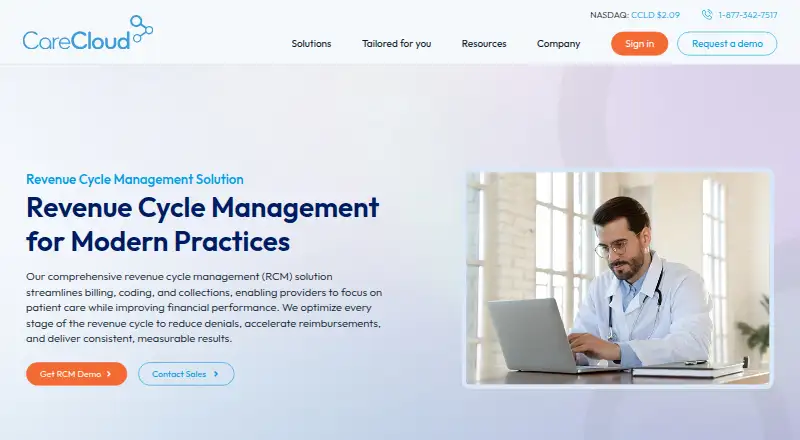
What CareCloud RCM is
CareCloud RCM is a web-based revenue cycle management service for healthcare organizations. Its workflow spans registration, eligibility verification, charge capture, coding, claim submission, denial appeals, payment posting, accounts receivable follow-up, patient collections and analytics. CareCloud describes the solution as AI-powered, with automated workflows and tools to identify billing errors and coding discrepancies before claims are submitted. It also automates appeal filing and obtaining payer authorizations to reduce manual follow-up. CareCloud says RCM estimates claim payment amounts and timelines, and its analytics show measures such as accounts-receivable days, net collection rate and first-pass resolution rate. The service can exchange financial and clinical data with existing EHR and practice management systems without requiring their replacement. CareCloud says the solution can serve solo practices through large multispecialty groups. Pricing is not displayed; the company offers a personalized demo and complimentary RCM evaluations. CareCloud, Inc. was founded in 1999 and is headquartered in Somerset, New Jersey.
Good
- Covers the revenue cycle from registration to analytics.
- Flags billing errors before claim submission.
- Can integrate with existing EHR systems.
- Complimentary RCM evaluations are offered.
Watch out
- Product pricing is not displayed.
- No software trial period is stated.
Who it suits
CareCloud RCM is presented for healthcare practices ranging from solo practices to large multispecialty groups. It may suit organizations seeking revenue-cycle workflows that can integrate with existing EHR and practice management systems.
Verdict
CareCloud RCM covers billing, claims, appeals and collections, with analytics and integration options for existing systems. Prospective customers need to contact CareCloud for pricing and can request an evaluation or demo.
Plans and prices
From CareCloud RCM's own pricing page, checked 4 Oct 2026.
| Plan | Price | What it gives you |
|---|---|---|
| CareCloud RCM | Priced on request | Custom solutions; contact sales for pricing |
The facts
Each one read from CareCloud RCM's own pages, with the date it was checked.
What it does
- AI and automation
- CareCloud describes RCM as AI-powered, with automated workflows for billing and claims.checked 4 Oct 2026
- Analytics
- The RCM assessment describes visibility into metrics including accounts-receivable days, net collection rate, and first-pass resolution rate.checked 4 Oct 2026
- Automation
- The solution is described as AI-powered and includes automated workflows and denial-prevention tools that identify billing errors and coding discrepancies before claim submission.checked 4 Oct 2026
- Complimentary evaluation
- CareCloud offers complimentary RCM evaluations and a personalized demo.checked 4 Oct 2026
- Demo and assessment
- CareCloud offers a personalized demo and complimentary RCM evaluations; the page does not state a software trial period.checked 4 Oct 2026
- Denial prevention
- The solution detects billing errors and coding discrepancies before claim submission.checked 4 Oct 2026
- Integration
- CareCloud says RCM can integrate with existing EHR and practice management systems, exchanging financial and clinical data without requiring their replacement.checked 4 Oct 2026
- Integrations
- CareCloud says RCM can integrate with existing EHR and practice management systems so financial and clinical data can be exchanged without replacing those systems.checked 4 Oct 2026
- Intended users
- CareCloud says solo practices through large multispecialty groups can use its RCM solution, and the page also describes support for practices of all sizes.checked 4 Oct 2026
- Pricing availability
- The RCM page directs prospects to contact sales and does not display a product price.checked 4 Oct 2026
- Prior authorization
- The product automates obtaining payer authorizations and reduces manual follow-ups.checked 4 Oct 2026
- Purpose
- CareCloud RCM streamlines billing, coding, and collections to reduce denials and accelerate reimbursements.checked 4 Oct 2026
- Reimbursement
- CareCloud says RCM estimates claim payment amounts and timelines to help reduce delays between submission and payment.checked 4 Oct 2026
- Revenue cycle coverage
- The solution covers registration, eligibility verification, charge capture, coding, claims, denials and appeals, payment posting, accounts receivable follow-up, patient collections, and analytics.checked 4 Oct 2026
- Support
- CareCloud lists customer support at [email protected] and 877-342-7517.checked 4 Oct 2026
- Workflow
- Its revenue-cycle workflow covers registration, eligibility verification, charge capture, coding, claim submission, denial appeals, payment posting, accounts receivable follow-up, patient collections, and analytics.checked 4 Oct 2026
Where it runs
- Appeals
- The product automates appeal filing to improve accuracy and speed resolution.checked 4 Oct 2026
The company
- Company
- CareCloud, Inc. describes itself as a healthcare technology company providing proprietary cloud-based solutions for healthcare organizations.checked 4 Oct 2026
- Founded
- CareCloud's 2025 Form 10-K says the company was founded in 1999 as Medical Transcription Billing, Corp.checked 4 Oct 2026
- Headquarters
- CareCloud lists its Somerset, New Jersey office at 7 Clyde Road, Somerset, NJ 08873.checked 4 Oct 2026
The full review of CareCloud RCM
CareCloud RCM is a revenue-cycle management service for healthcare practices, from solo offices to large multispecialty groups. It is best suited to practices that want billing, claims and collections work coordinated around their existing systems. Its breadth is a strength, but custom pricing means cost needs to be assessed with CareCloud before committing.
Overview
The workflow spans registration and eligibility checks through charge capture, coding, claim submission, denial appeals, payment posting, accounts-receivable follow-up, patient collections and analytics. Keeping those stages within one service can help practices manage the handoffs that occur across a revenue cycle; the trade-off is that prospective customers must determine with CareCloud how the service fits their own operations.
CareCloud, Inc. is a healthcare technology company founded in 1999 and headquartered in Somerset, New Jersey. It describes its business as providing proprietary cloud-based solutions for healthcare organizations.
Key features
Claims, coding and denials
CareCloud describes RCM as AI-powered, with automated billing and claims workflows. Its denial-prevention tools identify billing errors and coding discrepancies before claim submission, which can help practices address issues earlier rather than only after a claim is rejected. The service also automates appeal filing, a practical advantage for teams handling denial resolution at volume.
Eligibility verification, coding support, claim scrubbing and denial management sit alongside payment posting, ERA auto-posting and patient payments. This makes the product relevant to practices seeking coverage across both claim preparation and follow-through, rather than a tool focused only on submission.
Reimbursement and authorizations
RCM estimates claim payment amounts and timelines to help practices anticipate reimbursement delays. It also automates payer authorization requests to reduce manual follow-up. These capabilities target common administrative bottlenecks, though practices should assess how they fit their payer mix and existing procedures.
Integrations and analytics
The service can exchange financial and clinical data with existing EHR and practice management systems, so adopting it does not require replacing those platforms. Its RCM assessment provides visibility into accounts-receivable days, net collection rate and first-pass resolution rate. Those measures can help a practice understand performance across collections and claims, rather than relying on workflow automation alone.
Pricing
CareCloud RCM is paid, with custom pricing available by contacting sales. There is no published price to compare against a practice's budget before a sales conversation. CareCloud offers a complimentary RCM evaluation and personalized demo; no software trial period is stated, so practices should not assume they can use the service free for a set term.
Platforms
CareCloud RCM is available on the web. Its integration with existing EHR and practice management systems is useful for practices that want to keep those systems in place while exchanging clinical and financial data.
Who it's for
Solo practices through large multispecialty groups are within CareCloud's intended audience. It is a stronger fit for organizations looking to coordinate multiple revenue-cycle stages, including appeals and collections, than for buyers seeking a narrowly scoped billing tool. Practices can request an evaluation and demo; customer support is available at [email protected] or 877-342-7517.
Pros and cons
- Pros: Broad workflow coverage from registration through patient collections can reduce the need to coordinate separate tools for each revenue-cycle stage.
- Pros: Pre-submission checks for billing and coding issues, automated appeals and payer authorizations target administrative work that can delay claims and reimbursement.
- Pros: Integration with existing EHR and practice management systems avoids requiring their replacement.
- Cons: Custom pricing requires a sales conversation before practices can judge affordability.
- Cons: A complimentary evaluation and demo are offered, but no software trial period is stated.
Alternatives
Quadax is another paid option, available on the web and through an API. athenaIDX is another paid alternative.
ENTER is worth comparing for teams seeking a desktop AI assistant; its CTRL ENTER plan is $99 a month per seat and supports Windows, Mac, Debian Linux and Fedora Linux. eCareHealth Revenue Cycle Management offers a free trial and a Solo plan at $99 a month, with unlimited patients and visits, EHR and practice management, HIPAA telehealth, and a patient portal and intake.
Waystar is another web-based paid option with claim-management plans priced by request. athenaCollector is a paid option with Android, iOS and web support. Experian Health Revenue Cycle Management is a paid web-based option with pricing available by contacting Experian Health. ArkCloud RCM offers a free trial and an Essentials plan at $499 a month, with up to five users, queue management, payment processing, standard reporting and email support.
For broader comparisons, browse Revenue Cycle Management Software, Medical Billing Software or Medical Appointment Scheduling Software.
Verdict
CareCloud RCM is a compelling option for practices that want one service spanning claims, denials, appeals, payment posting and collections while retaining their existing EHR and practice management systems. Its broad workflow and automation are the main reasons to consider it; look elsewhere if you need a clear upfront price or a stated trial period before engaging with sales.
Alternatives to CareCloud RCM
- 1
Tebra
AndroidiOSWebAPI7.7From $49 a month - 2
ENTER
WebAPIExtensionLinux7.3From $99 a month - 3

eCareHealth Revenue Cycle Management
AndroidiOSWebAPI7.0From $99 a month - 4
Oracle Health Revenue Cycle
AndroidiOSWebAPI6.7 - 5
GetMax
Free planWeb6.6Free plan - 6
Solventum 360 Encompass System
AndroidiOSWebAPI6.3