
Gaea
Gaea is a Windows terrain design platform for visual effects, games, and virtual production.
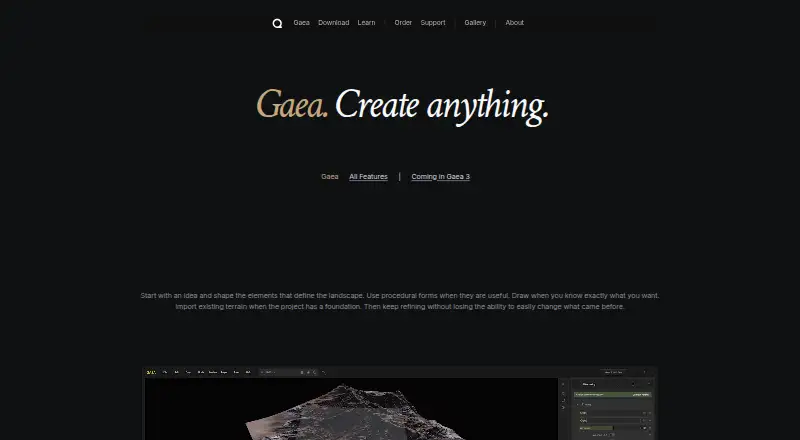
What Gaea is
Gaea is a Windows terrain design platform for visual effects, games, and virtual production. It creates terrain from procedural forms, imported data, and hand-drawn elements, and provides physics-driven simulations for erosion, debris, glaciers, rivers, snow, and vegetation. It can generate terrain-aware color, textures, masks, material zones, vegetation data, and flow maps, then export heightfields, meshes, point clouds, textures, masks, and other terrain data. Bridges connect Gaea to Unreal Engine and Houdini, although the Gaea2Houdini plugin requires a Professional or Enterprise license. The product supports node-based compositing and uses a hybrid render engine. Gaea requires Windows, an AVX2-capable CPU, and at least 16 GB of RAM. CPU-only use is supported; GPU compute requires CUDA 12.5 or higher or HIP 6.0 or higher. Its license must connect to the internet at least once every 28 days to refresh; offline licenses are available for Enterprise at additional cost. Community Edition is for non-commercial use. Listed one-time perpetual-license prices are $99.00 USD for Indie, $199.00 USD for Professional, and $299.00 USD for Enterprise.
Good
- Builds terrain from procedural, imported, and drawn inputs
- Simulates erosion, rivers, snow, and vegetation
- Exports heightfields, meshes, and point clouds
- Supports CPU-only use
Watch out
- Requires Windows, AVX2 CPU, and 16 GB RAM minimum
- License refresh requires internet at least every 28 days
- Community Edition is non-commercial only
- Houdini plugin requires Professional or Enterprise
Who it suits
Gaea suits terrain artists working in VFX, games, or virtual production who use Windows and need terrain simulation or export tools. Community Edition is restricted to non-commercial use; the listed Indie edition has a stated revenue eligibility limit.
Verdict
Gaea offers terrain creation, simulation, and export tools for Windows-based production workflows. Check the system requirements, license refresh condition, and edition restrictions before choosing a plan.
Plans and prices
From Gaea's own pricing page, checked 3 Oct 2026.
| Plan | Price | What it gives you |
|---|---|---|
| Community Edition | Free | Free for evaluation and non-commercial use · create and view terrains up to 4096 × 4096 · export up to 1024 × 1024 |
| Indie | $99, paid once | Node-locked · one named user on up to 2 computers · annual gross revenue under US $100,000 · 8K resolution · One-time price for a perpetual license |
| Professional | $199, paid once | Node-locked · one named user on up to 2 computers · annual gross revenue under US $1,000,000 · 16K resolution · 256K with tiles · One-time price for a perpetual license |
| Enterprise | $299, paid once | Movable license · annual gross revenue over US $1,000,000 · 16K resolution · 256K with tiles · One-time price for a perpetual license |
The facts
Each one read from Gaea's own pages, with the date it was checked.
What it does
- Commercial use
- The Community Edition is for non-commercial use; the Indie edition is listed for individuals or businesses under US $100,000 in annual gross revenue or capital.checked 3 Oct 2026
- Exports
- Gaea exports heightfields, meshes, point clouds, textures, masks, and other terrain data.checked 3 Oct 2026
- Integrations
- Gaea provides bridges for Unreal Engine and Houdini; the Gaea2Houdini plugin requires a Professional or Enterprise license.checked 3 Oct 2026
- License connectivity
- Gaea must connect to the internet at least once every 28 days to refresh its license; offline licenses are available for Enterprise at additional cost.checked 3 Oct 2026
- Notable restriction
- Using Gaea or its assets to train AI systems is prohibited without QuadSpinner’s prior written consent.checked 3 Oct 2026
- Purpose
- Gaea is a terrain design platform for VFX, games, and virtual production.checked 3 Oct 2026
- Security
- QuadSpinner says its Gaea binaries are signed with a code-signing certificate and provides an installer VirusTotal report.checked 3 Oct 2026
- Simulation
- Gaea provides physics-driven terrain simulations including erosion, debris, glaciers, rivers, snow, and vegetation.checked 3 Oct 2026
- Support
- Support, maintenance, and minor updates are included at no additional cost, and the company says it does not offer a guaranteed support SLA.checked 3 Oct 2026
- Surface and color
- Gaea can generate terrain-aware color, textures, masks, material zones, vegetation data, and flow maps.checked 3 Oct 2026
- System requirements
- Gaea requires Windows, a CPU supporting AVX2, and at least 16 GB RAM; GPU compute requires CUDA 12.5 or higher or HIP 6.0 or higher, though CPU-only use is supported.checked 3 Oct 2026
- Terrain creation
- Gaea supports terrain creation from procedural forms, imported data, and hand-drawn elements.checked 3 Oct 2026
Money
- Free plan
- Yeschecked 20 Sep 2026
The company
- Headquarters
- Questa, New Mexico, USAchecked 28 Sep 2026
- Maker
- QuadSpinner is a bootstrapped software studio based in Questa, New Mexico, founded in 2008 by Dax Pandhi and Cynthia Najim.checked 3 Oct 2026
The full review of Gaea
Gaea is a terrain design platform for VFX, games, and virtual production, built around procedural creation and physics-driven simulation. It suits artists and production teams that need to shape terrain and export it into a wider workflow. Its range of terrain tools is substantial, but the Windows and hardware requirements and the edition limits make plan choice important.
Overview
Terrain can start from procedural forms, imported data, or hand-drawn elements, then be shaped with simulations for erosion, debris, glaciers, rivers, snow, and vegetation. Gaea also generates terrain-aware color and textures, masks, material zones, vegetation data, and flow maps. That makes it useful not just for creating a landform but for preparing related data for downstream production.
Exports include heightfields, meshes, point clouds, textures, masks, and other terrain data. Bridges for Unreal Engine and Houdini connect Gaea to common production workflows, although the Gaea2Houdini plugin is restricted to Professional and Enterprise. Node-based compositing and a hybrid render engine round out the toolset.
Key features
- Terrain creation: Procedural, imported, and hand-drawn inputs give artists several starting points rather than locking them into one terrain-generation method.
- Simulation: A broad set of physics-driven effects can help shape and detail landscapes; the range is especially relevant to users who need erosion, water, snow, or vegetation effects in the same platform.
- Production outputs: Multiple export formats and Unreal Engine and Houdini bridges make Gaea a better fit for production pipelines than a tool focused only on generating a heightmap. Houdini users should note the plugin's edition restriction.
Pricing
Gaea is freemium. The Community Edition has no published price and is limited to non-commercial use and 1,024 × 1,024 single-build resolution, so it is the entry point for non-commercial work rather than a production license.
Indie costs $99 a month, billed One-time price for a perpetual license. It allows one named user on up to two computers, supports single builds up to 8,192 × 8,192, and is intended for individuals or businesses under $100,000 in annual gross revenue or capital. It is the relevant paid tier for smaller commercial users, but its resolution ceiling is lower than the higher editions.
Professional costs $199 a month, billed One-time price for a perpetual license. It raises single-build resolution to 16,384 × 16,384 and adds tiled-world resolution up to 262,144 × 262,144, while allowing one named user on up to two computers and revenue under $1,000,000. This is the first tier with the Gaea2Houdini plugin, making it the practical choice for eligible teams that need that connection or large tiled worlds.
Enterprise costs $299 a month, billed One-time price for a perpetual license. It retains Professional's resolution limits and is for revenue over $1,000,000, with one machine per license rather than two computers for a named user. Offline licenses are available at additional cost. Support, maintenance, and minor updates are included at no extra cost, but there is no guaranteed support SLA.
Platforms
Gaea runs on Windows and requires a CPU that supports AVX2 and at least 16 GB of RAM. GPU compute requires CUDA 12.5 or higher or HIP 6.0 or higher; CPU-only use is supported. A license must connect to the internet at least once every 28 days, which may complicate work in disconnected environments unless an Enterprise offline license is arranged.
Who it's for
Gaea is aimed at terrain artists and production teams in VFX, games, and virtual production who need simulation, terrain-derived surface data, and multiple export types. Indie suits smaller commercial users within its revenue threshold; Professional is the stronger fit for larger outputs, tiled worlds, or Houdini integration. The Community Edition is limited to non-commercial work. Gaea is a poor fit for users who need a non-Windows platform, fall short of its minimum hardware requirements, or need continuous offline licensing without Enterprise's additional-cost option.
QuadSpinner says Gaea binaries are signed with a code-signing certificate and provides an installer VirusTotal report. Use of Gaea or its assets to train AI systems is prohibited without QuadSpinner's prior written consent.
Pros and cons
- Pro: Terrain creation, simulation, surface data, and exports cover several stages of landscape production in one platform.
- Pro: The Professional and Enterprise tiled-world ceiling of 262,144 × 262,144 supports work beyond the single-build limits.
- Con: Community is non-commercial and capped at 1,024 × 1,024, so it cannot serve as a low-cost commercial tier.
- Con: Houdini integration through Gaea2Houdini requires Professional or Enterprise, putting it beyond the Indie license.
- Con: Windows-only availability, a 16 GB RAM minimum, and a 28-day license refresh requirement rule out some devices and disconnected workflows.
- Con: Enterprise offline licensing costs extra, and support has no guaranteed SLA.
Alternatives
For a broader set of tools to compare, see Game Map Generators, Visual Effects Software, Game Texture Software, and 3D modeling software.
- World Machine is worth considering if Linux or macOS support matters, or if its free Basic plan's 1025x1025 maximum output is sufficient.
- Heightmap Level Generator is a free option for readers who want a no-install, no-account tool across web, Windows, or self-hosted use.
- MapMagic 2 is an alternative for readers seeking a free core asset and optional $45 once Biomes and Functions add-on, provided they already have MapMagic 2 installed.
- Ymir is a free GPL-3.0 option for Linux or Windows users.
- 3D Dungeon Generator is a web-based free creator for dungeon layouts, with presets from 16×16 to custom 60×60 dimensions and GLB export.
- WaveFunctionCollapse is a free option for users who want a tool available on Linux, macOS, web, or Windows.
- TerraWorld 2023 is a paid alternative at $99, paid once.
- Mapgen4 is a free web-based or self-hosted alternative.
Verdict
Choose Gaea if you need a Windows terrain platform that combines creation, simulation, terrain-aware data, and production exports. Its higher editions offer large tiled-world outputs, and Professional unlocks the Houdini plugin. Look elsewhere if you need another operating system, a commercial plan below Indie, or reliable offline licensing without paying extra for Enterprise.
Alternatives to Gaea
- 1

World Machine
Free planLinuxmacOSWindows7.6$119 one-time - 2
Heightmap Level Generator
Free planOpen sourceWebSelf-hostedWindows7.2Free plan - 3
Infinity Generation
Free planAPILinuxmacOSWindows6.8Free plan - 4
Voxel Plugin
Free planAndroidmacOSWindows6.8$349 one-time - 5
L3DT
Free planLinuxWindows6.7$34.95 one-time - 6
MapMagic 2
Free planmacOSWindows6.5$45 one-time