Forminit
Forminit is a headless form backend API for teams that want to design their own form interface while offloading submission handling.
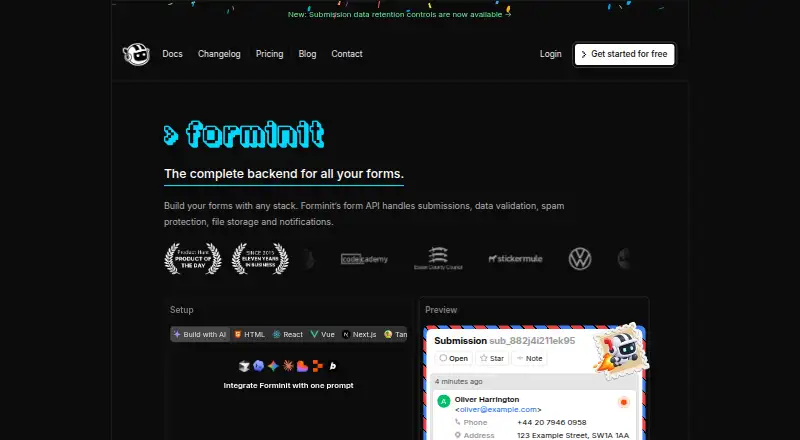
What Forminit is
Forminit is a headless form backend API for teams that want to design their own form interface while offloading submission handling. Build a form in a framework or language of your choice and send its submissions to Forminit’s API endpoint. It handles server-side validation, storage, notifications, file uploads, webhooks, spam protection, and integrations. Validation covers fields such as email, phone, URL, date, ratings, and country codes. Uploads can be up to 25 MB per submission; the Free plan includes 100 MB of storage. Listed integrations include Google Sheets, Zapier, Make, Slack, Discord, and custom webhooks. Its JavaScript SDK captures marketing attribution details, including UTM parameters, advertising click IDs, referrer URL, and submitter geolocation. Forminit lists support for web frameworks and site builders, and mobile apps can submit through its HTTP API. It states that data is hosted in AWS Ireland, encrypted in transit and at rest, and handled in compliance with GDPR and UK GDPR.
Good
- Build a custom form interface in any framework or language.
- Server-side validation covers several common typed fields.
- Uploads supported up to 25 MB per submission.
- Integrates with Google Sheets, Zapier, Make, Slack, and Discord.
- Free plan includes one form and 100 monthly submissions.
Watch out
- Free plan storage is limited to 100 MB.
- Free submissions remain until manually deleted.
- Form templates are not available.
- Branding control is limited.
Who it suits
Forminit suits developers, agencies, freelancers, startups, and AI/vibe coders who want control over form design without managing form backend functions themselves. It can also suit mobile projects that submit through an HTTP API.
Verdict
Forminit separates a custom-designed form interface from submission processing and provides validation, storage, spam controls, and integrations. Its Free plan offers a starting point, while paid plans add higher limits and features such as autoresponders, webhooks, and analytics.
Plans and prices
From Forminit's own pricing page, checked 14 Oct 2026.
| Plan | Price | What it gives you |
|---|---|---|
| Free | Free | 1 form · 100 submissions/month · 100 MB file storage · email notifications · workflows · redirections · validations · spam protection · $0 /m |
| Pro | $16 a month | 15 forms · 5,000 submissions/month · 1 GB storage · autoresponder · webhooks · REST API · Slack · Discord · Google Sheets · CSV export · Zapier · analytics · $190 billed yearly; 2 months free |
| Business | $50 a month | Unlimited forms · 50,000 submissions/month · 10 GB storage · unlimited workspaces · unlimited collaborators · custom email sender · remove Forminit branding · $594 billed yearly; 6 months free |
| Pro (yearly) | $190 a year | 15 forms · 5,000 submissions/month · 1 GB file storage · 2 months free · $190 billed yearly |
| Business (yearly) | $594 a year | Unlimited forms · 50,000 submissions/month · 10 GB file storage · unlimited workspaces and collaborators · custom email sender · remove Forminit branding · 6 months free · $594 billed yearly |
The facts
Each one read from Forminit's own pages, with the date it was checked.
What it does
- Analytics
- Form analytics reports submission trends, UTM and ad-click attribution, field responses, locations and devices.checked 14 Oct 2026
- API authentication
- Public mode allows unauthenticated browser submissions while Protected mode requires a secret API key for server-side requests.checked 14 Oct 2026
- API rate limits
- The documented limit is 5 requests per second with an API key and one request per five seconds without one.checked 14 Oct 2026
- Availability target
- The company targets 99.9% uptime and explicitly describes this as a goal rather than a contractual SLA.checked 14 Oct 2026
- Custom forms
- Users build their own form UI in any framework or language and submit it to Forminit’s API endpoint.checked 8 Oct 2026
- Custom frontend
- Users keep their own HTML or framework-based form interface and submit it to Forminit rather than using a hosted form builder.checked 14 Oct 2026
- Data retention
- Pro and Business customers can choose retention periods, after which submissions and uploaded files are deleted automatically.checked 14 Oct 2026
- Documentation depth
- The docs provide SDK references, block schemas, error codes, rate limits, webhook payloads and framework walkthroughs.checked 14 Oct 2026
- Encryption
- Forminit states that stored submission data uses AES-256 encryption and connections use TLS 1.2 or higher.checked 14 Oct 2026
- File uploads
- Uploads support files up to 25 MB per submission and more than 50 file types.checked 14 Oct 2026
- Framework support
- Documentation includes guides for React, Next.js, Nuxt, Node.js, Flask, Django, FastAPI and Cloudflare Workers.checked 14 Oct 2026
- Integrations
- Native workflow steps include webhooks, Slack, Discord and Google Sheets, while Zapier connects Forminit to more than 8,000 apps.checked 14 Oct 2026
- Intended users
- Forminit says it is built for developers, agencies, freelancers, startups, and AI/vibe coders who want to control form design while offloading backend work.checked 8 Oct 2026
- JavaScript SDK
- An official JavaScript/TypeScript SDK is distributed through npm, yarn, pnpm and a browser CDN.checked 14 Oct 2026
- Legal operator
- The service is operated by UXPLUS LTD, UK company number 11357429, at 86-90 Paul Street in London.checked 14 Oct 2026
- Limit: directory data mismatch
- The GetApp page describes the former Getform listing as a cloud form builder and email-marketing suite and shows a usage-based starting price of 7, which differs from Forminit's current headless-backend positioning and official pricing.checked 14 Oct 2026
- Limit: sparse independent evidence
- Independent directory coverage is thin, with only 3 G2 reviews, 2 GetApp reviews and 1 Trustpilot review.checked 14 Oct 2026
- Marketing attribution
- The JavaScript SDK automatically captures UTM parameters, advertising click IDs, referrer URL, and submitter geolocation.checked 8 Oct 2026
- Mobile/API access
- The site says mobile apps for iOS and Android can submit through its plain HTTP API.checked 8 Oct 2026
The company
- Company founding and headquarters
- LinkedIn lists the company as founded in 2015 and headquartered in London, United Kingdom.checked 14 Oct 2026
- Company size
- LinkedIn lists Forminit as a privately held software-development company with 2–10 employees.checked 14 Oct 2026
- Founded
- 2015checked 28 Sep 2026
- Headquarters
- London, United Kingdomchecked 28 Sep 2026
Money
- Limit: plan overages
- When submission limits are exceeded, forms pause and reject new submissions; those submissions are not queued for later recovery.checked 14 Oct 2026
The full review of Forminit
Forminit is a backend service for custom-built forms, suited to developers and teams who want to own the interface without also maintaining submission processing. It is a strong fit when control and integrations matter more than templates; its free tier is useful for a small form, but the monthly submission cap makes scaling a paid decision.
Overview
Rather than supplying a ready-made form builder, Forminit receives submissions from forms created in a framework or language of your choice. It handles validation, storage, notifications, uploads, spam protection and integrations. That division gives product teams room to match forms to their sites and apps, but leaves interface design and implementation in their hands; there are no form templates to speed that work.
Server-side validation covers email format, E.164 phone numbers, URLs, ISO dates, rating ranges and ISO country codes. Those checks are useful when valid structured data matters beyond what a browser can enforce. Supported frameworks include React, Next.js, Vue, Nuxt.js, Svelte, Angular and Astro, as well as static-site generators and platforms such as WordPress, Webflow, Squarespace and Ghost.
Key features
Uploads can be as large as 25 MB per submission, but the Free plan has only 100 MB of total file storage. That is enough for occasional attachments, not a deep archive of large files; Pro raises storage to 1 GB and Business to 10 GB. Forminit also supports built-in spam filtering and optional Cloudflare Turnstile, reCAPTCHA, hCaptcha or honeypot fields, giving teams several ways to reduce unwanted submissions.
Integrations include Google Sheets, Zapier, Make, Slack, Discord and custom webhooks. The JavaScript SDK captures UTM parameters, advertising click IDs, referrer URL and submitter geolocation, which can help teams connect submissions with campaign sources. Mobile apps on iOS and Android can submit through the plain HTTP API, so developers are not limited to browser forms.
Forminit says submission data is hosted in AWS Ireland and encrypted at rest with AES-256 and in transit over HTTPS using TLS 1.2 or higher. It states GDPR and UK GDPR compliance and provides a Data Processing Agreement. Automatic submission retention is available on Pro and above; Free submissions remain until manually deleted. The company states a 99.9% uptime target and provides a public status page.
Pricing
The Free plan costs nothing and includes one form, 100 submissions per month, 100 MB of file storage and an unlimited submission archive. That is a sensible way to run a modest contact form or prototype, but one form and 100 monthly submissions leave little room for multiple projects or a busy launch. Its archive is unlimited, though automatic retention is not included.
Pro costs $16 a month, billed $190 billed yearly, or $190 a year. It allows 15 forms, 5,000 submissions per month and 1 GB of storage, and adds an autoresponder, webhooks, REST API, integrations and analytics; the annual plan includes two months free. This is the practical step up for a freelancer or small team handling several live forms or needing automated follow-up and analysis. Business costs $50 a month, billed $594 billed yearly, or $594 a year. It includes unlimited forms, 50,000 submissions per month, 10 GB storage, unlimited workspaces and collaborators, a custom email sender and removal of Forminit branding; the annual plan includes six months free. Its higher quotas and collaboration controls suit agencies or larger teams, but exceed the needs of a single low-volume form.
Forminit is freemium, with paid access starting at $15.83/mo (annual). The free-to-Pro jump raises the monthly allowance from 100 to 5,000 submissions, while Business is the only listed plan with unlimited forms, unlimited collaborators and branding removal. Choose the tier based on expected monthly volume and storage as well as form count.
Platforms
Forminit supports web, API, iOS and Android use. Its API-first model can serve custom interfaces across frameworks and mobile apps, while the backend services remain centered on submission handling rather than a visual builder.
Who it's for
Developers, agencies, freelancers and startups are the natural audience: they can shape a form to a product or client site and offload validation, storage and integrations. It also suits AI/vibe coders who want a backend for forms they generate. It is less appropriate for someone who wants to select a template, publish a finished form quickly or avoid writing interface code.
Pros and cons
- Pro: Custom interfaces can connect to a backend with structured server-side validation, storage and notifications, avoiding the need to build those pieces independently.
- Pro: Multiple spam controls and integrations, plus campaign attribution capture, support workflows that go beyond collecting a basic message.
- Pro: The Free plan includes an unlimited submission archive, making it possible to retain records without a paid storage-style archive cap.
- Con: There are no templates, so teams must build and maintain the form experience themselves.
- Con: Free is capped at one form and 100 submissions per month, and its 100 MB upload storage can be consumed quickly by larger attachments.
- Con: Automatic retention starts at Pro, so free users must delete submissions manually when they want them removed.
Alternatives
Endatix is worth considering for teams that want an always-free, MIT-licensed self-hosted API; its listed hosted option is $360 a month. Paperform is an alternative with a free plan and trial for people comparing form software with a free-forever option for individuals and small teams. forms.app offers a free plan with five forms, unlimited responses and unlimited team members, a different fit for teams prioritizing those quotas over Forminit’s custom-backend approach.
Formsite has a free tier with five forms and 10 results per form, and may suit someone comparing a form-oriented service with a very small results allowance. SurveyJS lists unlimited forms, submissions and file uploads on its Essential plan, and is a candidate when those allowances are the priority. Feathery offers a free plan with 500 monthly submissions, five live forms and 10 MB uploads, useful for a higher free submission allowance with smaller uploads.
FormKeep offers a free plan with unlimited forms, 50 submissions per month and one-month retention, while its Essential plan costs $4.99 a month; it may suit users whose form count matters more than Forminit’s free submission cap. Formsort offers a free plan with unlimited users and forms but 100 flow starts per month; consider it when those form and user allowances fit better.
Browse more options in Form API Software or Form Builder Software.
Verdict
Choose Forminit if you can build your own form interface and want validation, storage, spam defenses and integrations handled by an API backend. Its flexibility and practical free entry point are the case for it; the absence of templates and the sharp gap between 100 free monthly submissions and paid quotas are the reasons to look elsewhere if you want a ready-made builder or expect meaningful volume without a subscription.
Getting started
- Visit the Forminit website.
- Choose the Free plan or a paid plan.
- Build a form interface in a supported framework or language.
- Send submissions to Forminit’s API endpoint.
- For mobile apps, submit through the plain HTTP API.
Limits worth knowing
The Free plan includes one form, 100 submissions per month, and 100 MB of file storage. It keeps submissions until manually deleted; automatic submission retention is available on Pro and higher.
Questions
Does Forminit have a free plan?
Yes. The Free plan costs 0.00 USD and includes one form, 100 submissions per month, and 100 MB of file storage.
What do the paid plans cost?
Pro is $16 a month, billed yearly at $190. Business is $50 a month, billed yearly at $594.
Which platforms can use Forminit?
Forminit is listed for Android, API, iOS, and web. Its site says iOS and Android apps can submit through its plain HTTP API.
Does Forminit provide form templates?
No. Form templates are listed as unavailable.
What integrations are listed?
The site lists Google Sheets, Zapier, Make, Slack, Discord, and custom webhooks.
Where is Forminit based?
Forminit was founded in 2015 and is headquartered in London, United Kingdom.
Alternatives to Forminit
- 1
FormTitan
Free planAndroidiOSWebAPI8.2From $150 a month - 2

OpnForm
Free planOpen sourceWebAPISelf-hosted7.9From $25 a month - 3
Orbeon Forms
Free planOpen sourceWebAPILinuxSelf-hosted7.9From $1,300 a year - 4

SurveyJS
Free planOpen sourceWebAPISelf-hosted7.9Free plan - 5

Paperform
Free planWebAPI7.6Free plan - 6

forms.app
Free planWeb7.5From $19 a month