ForgeGradle
ForgeGradle is a Gradle plugin and Minecraft mod development framework for Forge and FML.
What ForgeGradle is
ForgeGradle is a Gradle plugin and Minecraft mod development framework for Forge and FML. It supports mod development on Linux, macOS, and Windows, and the documentation focuses on preparing a development environment rather than teaching Java, Groovy, or Gradle. Setup requires a Java Development Kit and familiarity with an integrated development environment. The guide provides commands to create run configurations for Eclipse, IntelliJ IDEA, and Visual Studio Code; configurations can define arguments, working directories, task names, environment properties, and system properties. Forge supplies client, server, data, and gameTestServer run types. Developers can select human-readable mappings for development and use a reobf task to convert a mod JAR to SRG mappings for production. Dependencies can come from repositories or a local flat directory, with fg.deobf wrapping them for use. An optional Jar-in-Jar system packages selected dependencies inside the mod JAR and writes build metadata. ForgeGradle is free, and its repository identifies the license as LGPL-2.1.
Good
- Creates configurations for Eclipse, IntelliJ IDEA, and VS Code.
- Supports four Forge run types.
- Handles dependency deobfuscation and optional Jar-in-Jar packaging.
- Free to use on Linux, macOS, and Windows.
Watch out
- Default stable and snapshot mapping sets are typically incomplete.
- Those documented default mapping sets are unavailable as of Minecraft 1.17.
- Setup assumes a JDK and IDE familiarity.
Who it suits
ForgeGradle suits Minecraft mod developers working with Forge or FML who have a JDK and IDE familiarity. Its documentation is for configuring ForgeGradle, not learning Java, Groovy, or Gradle.
Verdict
ForgeGradle covers key parts of a Forge or FML mod workflow, from IDE run configurations to mapping and dependency handling. Its documentation assumes foundational Java and IDE knowledge, and its default stable and snapshot mapping sets have limitations.
Plans and prices
From ForgeGradle's own pricing page, checked 4 Oct 2026.
| Plan | Price | What it gives you |
|---|---|---|
| ForgeGradle | Free | No pricing or usage limits stated |
The facts
Each one read from ForgeGradle's own pages, with the date it was checked.
What it does
- Audience
- The documentation describes setting up a development environment for Minecraft mod development.checked 4 Oct 2026
- Bundled dependencies
- The optional Jar-in-Jar system bundles selected dependencies inside a mod JAR and writes metadata during the build.checked 4 Oct 2026
- Compatibility limit
- The documented default stable and snapshot mapping sets are typically incomplete and are no longer available as of Minecraft 1.17.checked 4 Oct 2026
- Dependency support
- Mod dependencies can be added through repositories or a local flat directory, and are wrapped with fg.deobf before use.checked 4 Oct 2026
- Distribution
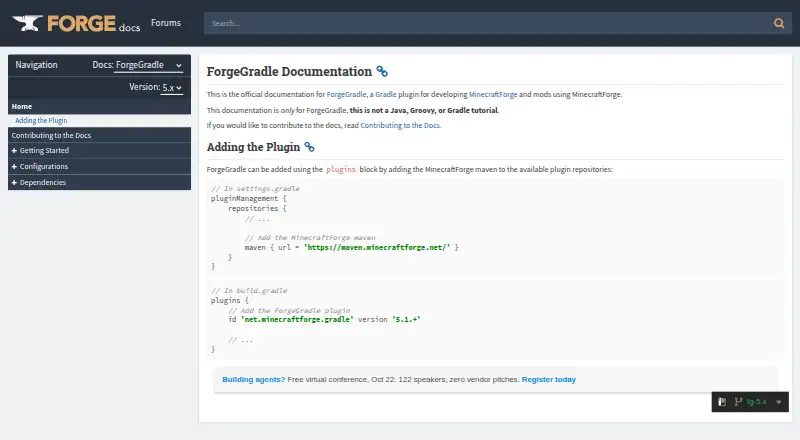
- The docs show adding the MinecraftForge Maven repository and the net.minecraftforge.gradle plugin to a Gradle build.checked 4 Oct 2026
- Documentation scope
- The ForgeGradle documentation says it covers ForgeGradle and is not a Java, Groovy, or Gradle tutorial.checked 4 Oct 2026
- Forge run types
- Forge provides client, server, data, and gameTestServer run configurations.checked 4 Oct 2026
- IDE support
- The guide provides commands to generate run configurations for Eclipse, IntelliJ IDEA, and Visual Studio Code.checked 4 Oct 2026
- License
- The ForgeGradle GitHub repository identifies its license as LGPL-2.1.checked 4 Oct 2026
- Prerequisite
- The setup guide requires a Java Development Kit and familiarity with an integrated development environment.checked 4 Oct 2026
- Purpose
- ForgeGradle is a Gradle plugin and Minecraft mod development framework used by Forge and FML.checked 4 Oct 2026
- Run configurations
- ForgeGradle run configurations can set arguments, working directories, task names, environment properties, and system properties.checked 4 Oct 2026
Where it runs
- Mappings
- ForgeGradle lets users choose a human-readable mapping set and converts the mod JAR to SRG mappings for production with a reobf task.checked 4 Oct 2026
The full review of ForgeGradle
ForgeGradle is a Gradle plugin and development framework for building Minecraft mods with Forge and FML. It suits developers comfortable with Java and an IDE who want a build-based workflow; it is a poor starting point for anyone looking for a Java or Gradle tutorial.
Overview
ForgeGradle brings mod development tasks into a Gradle build, including IDE run configurations, mapping conversion, and dependency handling. It supports Forge and FML across Minecraft versions 1.12 through 1.19.4. The workflow offers useful control over how a mod is built and run, but expects users to arrive with the underlying development skills already in place.
The setup guide requires a Java Development Kit and familiarity with an integrated development environment. It covers ForgeGradle itself, not Java, Groovy, or Gradle fundamentals, so newcomers will need to learn those elsewhere before this framework becomes useful.
Key features
IDE runs and Forge run types
Commands generate run configurations for Eclipse, IntelliJ IDEA, and Visual Studio Code. Configurations can specify arguments, working directories, task names, environment properties, and system properties. Forge supplies client, server, data, and gameTestServer run types, giving developers distinct launch setups for common mod-development tasks rather than a single generic run target.
Mappings and production builds
Developers can select a human-readable mapping set while working, then use the reobf task to convert a mod JAR to SRG mappings for production. That separates readable development names from the production artifact’s mapping format. The documented default stable and snapshot mapping sets are typically incomplete and are no longer available as of Minecraft 1.17, a meaningful constraint for projects relying on those defaults or later versions.
Dependencies and packaging
Mod dependencies can come from repositories or a local flat directory, and must be wrapped with fg.deobf before use. That handling is tailored to mod development, though it adds a ForgeGradle-specific step to dependency setup. The optional Jar-in-Jar system bundles selected dependencies inside a mod JAR and writes metadata during the build, useful when the mod needs to package dependencies alongside its artifact.
Distribution involves adding the MinecraftForge Maven repository and the net.minecraftforge.gradle plugin to a Gradle build. The project identifies its license as LGPL-2.1.
Pricing
ForgeGradle is free: the ForgeGradle plan is free. No seat or usage caps are stated, and there is no paid tier to trade off against. Its cost advantage does not remove the practical prerequisites: users still need a JDK, IDE familiarity, and enough Java and Gradle knowledge to work beyond the setup guide.
Platforms
ForgeGradle supports Linux, macOS, and Windows. Its run-configuration commands cover Eclipse, IntelliJ IDEA, and Visual Studio Code, so developers can work in those IDEs across the supported operating systems.
Who it's for
ForgeGradle is best for Java developers building Forge or FML mods who want Gradle-managed runs, mapping conversion, and mod dependency packaging in one workflow. It is less suitable for first-time programmers or users seeking a visual, no-code mod creator: the documentation assumes IDE familiarity and explicitly does not teach Java, Groovy, or Gradle.
Pros and cons
- Pro: Dedicated client, server, data, and gameTestServer run types provide useful separation for different development tasks.
- Pro: Mapping selection plus reobf conversion supports readable development names and SRG production JARs.
- Pro: Repository and local-directory dependencies, along with optional Jar-in-Jar packaging, cover key mod dependency workflows.
- Con: The setup documentation assumes Java and IDE foundations and does not teach the languages or build system involved.
- Con: Default stable and snapshot mappings are typically incomplete and unavailable from Minecraft 1.17 onward, limiting reliance on those sets.
Alternatives
For another free Gradle-based mod development option with a different loader focus, consider ModDevGradle, a plugin for developing Minecraft mods using NeoForge, maintained under the NeoForged GitHub organization. If an experimental project and a Gradle 8.1-or-newer requirement fit, Architectury Loom is free and supports IntelliJ IDEA and Visual Studio Code on Linux, macOS, and Windows.
Readers who want a free mod-creation app rather than a Gradle plugin can consider MCreator. For a free loader choice, Fabric is free to use, though the Fabric Loader download is only the bare minimum and most mods also require Fabric API. Minecraft Forge is another free option to use and modify.
IntelliJ IDEA is an IDE rather than a mod framework; its free Core functionality covers Java and Kotlin, while Ultimate is a paid subscription. For a general open-source build system rather than a Minecraft-specific framework, Gradle is free. Blockbench is also free for any type of project.
Browse the Minecraft Mod Development Tools category for more options.
Verdict
Choose ForgeGradle if you already know Java and Gradle and need a free, Forge- or FML-focused workflow for IDE runs, mappings, dependencies, and mod packaging. Its strongest case is that it brings these mod-specific build tasks together; look elsewhere if you need introductory guidance or depend on the documented default mapping sets for Minecraft 1.17 and later.
Alternatives to ForgeGradle
- 1

Blockbench
Free planOpen sourceAndroidiOSWebAPI8.1Free plan - 2

IntelliJ IDEA
Free planAPIExtensionLinuxmacOS7.8Free plan - 3

Visual Studio Code
Free planWebLinuxmacOSWindows7.4Free plan - 4

Fabric
Free planAPILinuxmacOSSelf-hosted6.8Free plan - 5
Minecraft Development MCP Server
Free planAPILinuxmacOSSelf-hosted6.6Free plan - 6
Quilt Loom
Free planLinuxmacOSWindows6.6Free plan