Architectury Loom
Architectury Loom is a free Gradle plugin for preparing deobfuscated development environments for Minecraft mods.
What Architectury Loom is
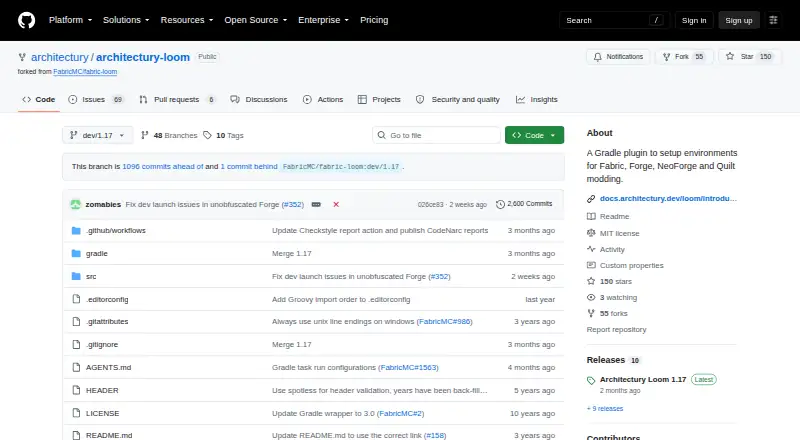
Architectury Loom is a free Gradle plugin for preparing deobfuscated development environments for Minecraft mods. It supports Fabric, Forge, NeoForge, and Quilt, and is presented as a ForgeGradle replacement built on FabricMC Loom. Mapping choices include Yarn, Official Mojang Mappings, and MCP. Loom uses Fernflower and CFR to produce source code with comments. It supports IntelliJ IDEA and Visual Studio Code; other IDEs have not been tested or supported. The project requires Gradle 8.1 or newer and runs on Linux, macOS, and Windows. Its documentation labels it experimental and warns that issues may occur, with reports directed to the issue tracker. The repository uses the MIT license, and its community offers discussion through Discord. The latest listed release is 1.17, which adds an API to convert access wideners into access transformers for Forge and NeoForge. The Architectury organization describes its work as enabling development across multiple mod loaders.
Good
- Supports Fabric, Forge, NeoForge, and Quilt.
- Offers Yarn, Official Mojang, and MCP mappings.
- Runs on Linux, macOS, and Windows.
- MIT-licensed and free.
Watch out
- Experimental status means issues may arise.
- Requires Gradle 8.1 or newer.
- Only IntelliJ IDEA and Visual Studio Code are supported.
Who it suits
This plugin suits Minecraft mod developers working across Fabric, Forge, NeoForge, or Quilt who use Gradle and a supported IDE. Its experimental status is worth considering before relying on it.
Verdict
Architectury Loom brings several Minecraft mod-loader workflows into a Gradle plugin, with multiple mapping options and decompiler support. Check its experimental status and IDE limits against your development setup.
Plans and prices
From Architectury Loom's own pricing page, checked 4 Oct 2026.
| Plan | Price | What it gives you |
|---|---|---|
| Architectury Loom | Free | Experimental project · Gradle 8.1 or newer · IntelliJ IDEA and Visual Studio Code supported |
The facts
Each one read from Architectury Loom's own pages, with the date it was checked.
What it does
- Community support
- The repository README invites users to talk with the project on Discord.checked 4 Oct 2026
- Current release
- The GitHub releases page lists Architectury Loom 1.17 as the latest release.checked 4 Oct 2026
- Decompilers
- The README says Loom uses Fernflower and CFR to generate source code with comments.checked 4 Oct 2026
- Decompiler support
- The README says it uses the Fernflower and CFR decompilers to generate source code with comments.checked 3 Oct 2026
- Development environment
- The project describes Loom as a plugin for setting up a deobfuscated development environment for Minecraft mods.checked 4 Oct 2026
- Experimental status
- The documentation describes Architectury Loom as experimental and says issues may arise, directing users to report them to the issue tracker.checked 3 Oct 2026
- ForgeGradle replacement
- The documentation describes it as a replacement plugin for ForgeGradle based on FabricMC Loom.checked 3 Oct 2026
- Forge support
- Architectury Loom is a fork based on Fabric Loom that supports the Forge modding toolchain.checked 4 Oct 2026
- Gradle requirement
- The documentation says Architectury Loom supports Gradle 8.1 and up.checked 4 Oct 2026
- IDE support
- The documentation lists IntelliJ IDEA and Visual Studio Code as supported IDEs; other IDEs are not tested or supported.checked 4 Oct 2026
- Intended users
- The Architectury organization describes itself as a project enabling development across multiple mod loaders.checked 4 Oct 2026
- Latest release
- The GitHub releases page lists Architectury Loom 1.17 as the latest release.checked 3 Oct 2026
- License
- The repository includes an MIT License.checked 4 Oct 2026
- Modding audience
- The Architectury organization describes itself as a project to enable multi-modloaders development.checked 3 Oct 2026
- Project status
- The documentation describes Architectury Loom as an experimental project and says issues may arise, with reports directed to its issue tracker.checked 4 Oct 2026
- Purpose
- Architectury Loom is a Gradle plugin for setting up environments for Fabric, Forge, NeoForge, and Quilt Minecraft modding.checked 4 Oct 2026
- Release capability
- Version 1.17 lists a new API for converting access wideners to access transformers for Forge and NeoForge.checked 3 Oct 2026
Where it runs
- Mappings
- The documentation says Loom supports Yarn or Official Mojang mappings, and also supports MCP.checked 4 Oct 2026
The full review of Architectury Loom
Architectury Loom is a Gradle plugin for building deobfuscated development environments for Minecraft mods across Fabric, Forge, NeoForge and Quilt. It suits developers targeting multiple mod loaders who want one workflow for mappings and decompilation; its experimental status and narrower IDE support make it a less certain fit for teams that need a fully supported setup.
Overview
Built on FabricMC Loom and positioned as a ForgeGradle replacement, Architectury Loom brings several Minecraft modding toolchains into a single Gradle plugin. It supports Minecraft 1.14.4 and newer, with dependency management and artifact packaging, making it relevant beyond initial environment setup. The breadth is useful for cross-loader development, but experimental status means users should expect the possibility of issues and be prepared to report them through the issue tracker.
Key features
- Multiple loaders: Fabric, Forge, NeoForge and Quilt support can reduce the need to maintain separate development setups when a project targets more than one loader.
- Mapping choices: Yarn, Official Mojang Mappings and MCP let developers work with different naming conventions. That flexibility helps accommodate project preferences, though it does not remove the need to choose mappings deliberately.
- Decompiled sources: Fernflower and CFR generate source code with comments, which can help developers inspect Minecraft code while working on a mod.
- Forge and NeoForge utility: Release 1.17 adds an API to convert access wideners to access transformers for Forge and NeoForge, a targeted convenience for projects that need that conversion.
Architectury Loom requires Gradle 8.1 or newer. IntelliJ IDEA and Visual Studio Code are supported; other IDEs are not tested or supported, so developers using a different editor should account for that limitation before adopting it.
Pricing
Architectury Loom is open-source software under the MIT license and costs nothing. The free plan includes the plugin’s experimental project, Gradle 8.1-or-newer requirement, and IntelliJ IDEA and Visual Studio Code support. There are no paid tiers to weigh against a reduced free plan; the main trade-off is accepting experimental status rather than paying for a more established support commitment.
Platforms
Architectury Loom is available for Linux, macOS and Windows. Its Gradle-based workflow makes the supported IDEs and the Gradle version requirement more consequential than platform choice for most development setups.
Who it's for
Choose it if you develop Minecraft mods across multiple loaders and want mapping options, generated decompiled sources, dependency management and artifact packaging in one plugin. It is also a plausible ForgeGradle replacement for developers comfortable with an experimental project. Look elsewhere if you rely on an IDE other than IntelliJ IDEA or Visual Studio Code, cannot use Gradle 8.1 or newer, or need a less experimental development foundation.
Pros and cons
Pros
- Four loader toolchains in one plugin: Fabric, Forge, NeoForge and Quilt support suits multi-loader development.
- Choice of three mapping families: Yarn, Official Mojang Mappings and MCP give projects room to use different naming conventions.
- Free and MIT-licensed: There is no subscription cost, and the license permits use and modification.
Cons
- Experimental project: Issues may arise, which is a meaningful risk for developers who need a dependable, settled workflow.
- IDE support is limited: IntelliJ IDEA and Visual Studio Code are supported, while other IDEs are not tested or supported.
- Recent Gradle baseline: The Gradle 8.1 minimum may rule it out for projects tied to older Gradle versions.
Alternatives
For a wider selection of tools, browse the Minecraft Mod Development Tools category.
- ForgeGradle is another free option for developers who want the plugin Architectury Loom describes itself as replacing.
- ModDevGradle is a free Gradle plugin for developing Minecraft mods using NeoForge, making it a more focused choice for NeoForge development.
- MCreator is free software with voluntary donations for readers considering a different mod-making option.
- Fabric is free; its Loader download is the bare minimum, and most mods also require Fabric API.
- Minecraft Forge is free to use and modify for readers seeking the Forge option itself.
- IntelliJ IDEA offers free Java and Kotlin core functionality, with an Ultimate subscription at $100 a year for readers comparing IDE options.
- Gradle is a free open-source build system for readers looking for the underlying build tool rather than a Minecraft-specific plugin.
- Blockbench is free for any type of project for readers considering a different kind of Minecraft-related tool.
Verdict
Architectury Loom is a strong fit for Minecraft mod developers who need a shared Gradle workflow across multiple loaders, especially those who value its mapping choices and source decompilation. Its free, MIT-licensed model removes cost as a barrier. Choose it if you can work within its Gradle and IDE requirements and tolerate an experimental project; look elsewhere if you need broader IDE support or a more established setup.
Getting started
- Open the Architectury Loom GitHub website
- Use a Linux, macOS, or Windows system
- Install Gradle 8.1 or newer
- Choose IntelliJ IDEA or Visual Studio Code
- Configure a project for Fabric, Forge, NeoForge, or Quilt
- Select a supported mapping option
Limits worth knowing
The free plan is experimental and requires Gradle 8.1 or newer. Documented IDE support is limited to IntelliJ IDEA and Visual Studio Code.
Questions
How much does Architectury Loom cost?
The listed plan is free. It is open-source software under the MIT license.
Which mod loaders are supported?
Architectury Loom supports Fabric, Forge, NeoForge, and Quilt.
Which operating systems can run it?
It runs on Linux, macOS, and Windows.
Which IDEs are supported?
The documentation supports IntelliJ IDEA and Visual Studio Code. Other IDEs are not tested or supported.
What Gradle version is required?
Architectury Loom supports Gradle 8.1 and newer.
What is the latest listed release?
The GitHub releases page lists version 1.17 as the latest release.
Alternatives to Architectury Loom
- 1

Blockbench
Free planOpen sourceAndroidiOSWebAPI8.1Free plan - 2

IntelliJ IDEA
Free planAPIExtensionLinuxmacOS7.8Free plan - 3

Visual Studio Code
Free planWebLinuxmacOSWindows7.4Free plan - 4

Fabric
Free planAPILinuxmacOSSelf-hosted6.8Free plan - 5
Minecraft Development MCP Server
Free planAPILinuxmacOSSelf-hosted6.6Free plan - 6
Quilt Loom
Free planLinuxmacOSWindows6.6Free plan