Flashduty Status Page
Flashduty Status Page publishes branded service status and incident updates for customers, partners, and internal teams.
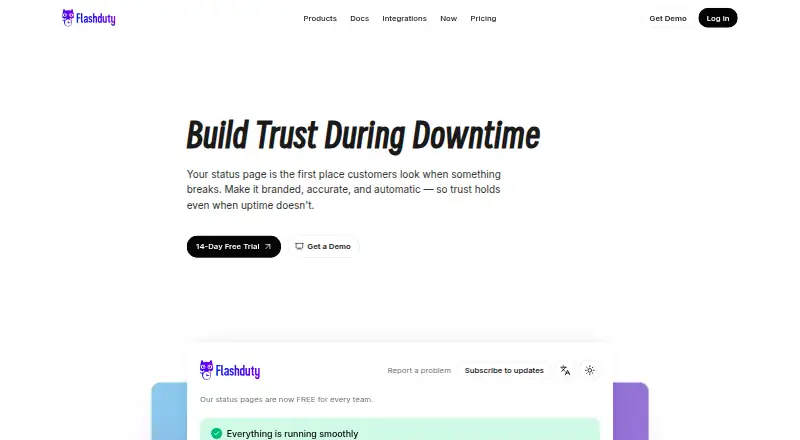
What Flashduty Status Page is
Flashduty Status Page publishes branded service status and incident updates for customers, partners, and internal teams. Pages can be public or gated for internal audiences, with access and subscriptions suited to each group. Status updates reflect the incident record maintained in Flashduty, avoiding a separate customer-facing write-up. Teams can link component availability to incident history and schedule maintenance.
Pages support custom domains, HTTPS, logos, and branded headers and footers. Public pages offer email and RSS subscriptions; internal pages can notify teams through Feishu, DingTalk, WeCom, and Slack. Public status pages are free to use with publishing, custom domains, and RSS, while email beyond the included allowance is billed on demand. The Free plan includes five users and one public page. Standard costs $14/user/mo and has one public page; Professional costs $29/user/mo and includes five public and 20 internal pages. Private Deployment has no listed price. The service also supports an Open API and webhooks.
Good
- Supports public and gated internal pages
- Custom domains, HTTPS, logos, and branded page elements
- Public pages support email and RSS subscriptions
- Internal notifications include Feishu, DingTalk, WeCom, and Slack
- Offers Open API and webhooks
Watch out
- Free plan includes one public page
- Standard costs $14/user/mo
- Email beyond the included allowance is billed on demand
Who it suits
Flashduty Status Page suits teams that need to share incident updates with customers or partners and provide gated updates to internal audiences. It also fits teams that want component availability tied to incident history.
Verdict
Flashduty Status Page supports branded public updates and access-controlled internal communications, with incident history connected to availability records. The Free plan is limited to one public page, while paid plans add more page capacity and internal pages.
Plans and prices
From Flashduty Status Page's own pricing page, checked 5 Oct 2026.
| Plan | Price | What it gives you |
|---|---|---|
| Standard | $14 a month | 1 public status page · unlimited users, schedules, and alerts · $14/user/mo |
| Professional | $29 a month | 5 public status pages · 20 internal status pages · unlimited users, schedules, and alerts · $29/user/mo |
| Free | Free | 5 users · 1 public status page · 100 alerts/day · $0/user/mo |
| Private Deployment | Priced on request | 5 public status pages · 20 internal status pages · network-isolated deployment · Contact us |
The facts
Each one read from Flashduty Status Page's own pages, with the date it was checked.
What it does
- API
- Flashduty documentation says developers can integrate through its Open API and webhooks.checked 5 Oct 2026
- Availability history
- Component-level availability is mapped to incident history so teams can share auditable uptime records.checked 5 Oct 2026
- Branding
- Pages can use a custom domain, HTTPS, logo, and branded headers and footers.checked 5 Oct 2026
- Custom domain
- Yeschecked 19 Sep 2026
- Data location
- Flashduty states that it operates as a single service hosted in mainland China and stores all customer data on servers there.checked 5 Oct 2026
- Data safeguards
- The maker lists encryption in transit and at rest where applicable, access controls, security audits, vulnerability remediation, physical security, and disaster recovery measures.checked 5 Oct 2026
- Incident sync
- The status page reflects the incident story maintained in Flashduty, avoiding duplicate customer-facing write-ups.checked 5 Oct 2026
- Incident updates
- Yeschecked 19 Sep 2026
- Integrations
- Flashduty's integrations directory lists 283 alert sources and describes connecting monitoring and observability tools for noise reduction, routing, and escalation.checked 5 Oct 2026
- Maintenance scheduling
- Yeschecked 19 Sep 2026
- Private status page
- Yeschecked 19 Sep 2026
- Public and internal pages
- It supports public pages and gated internal pages with audience-specific subscriptions and access.checked 5 Oct 2026
- Purpose
- Flashduty Status Pages publish branded service status and incident updates for customers, partners, and internal teams.checked 5 Oct 2026
- Security certifications
- The maker reports ISO/IEC 27001:2022 and ISO 9001:2015 certifications for the stated cloud-native monitoring platform development scopes.checked 5 Oct 2026
- Status page pricing
- Public status pages are free to use, with publishing, custom domains, and RSS included; email beyond the included allowance is billed on demand.checked 5 Oct 2026
- Subscriber channels
- multi-channelchecked 19 Sep 2026
- Subscriptions
- Public pages support email and RSS subscriptions; internal pages can notify teams through Feishu, DingTalk, WeCom, and Slack.checked 5 Oct 2026
- Support
- Flashduty offers contact by email, phone, demo booking, and business or technical support chat; its pricing page lists dedicated support on Professional and Private Deployment.checked 5 Oct 2026
Money
- Free plan
- Yeschecked 19 Sep 2026
- Plan limits
- The pricing page lists 1 public status page on Free and Standard, 5 on Professional and Private Deployment, and internal pages only on the latter two plans, with a limit of 20.checked 5 Oct 2026
Alternatives to Flashduty Status Page
- 1
StatusIQ
Free planAndroidiOSWebAPI8.0From $10 a month - 2

OnlineOrNot
Free planWebAPILinuxmacOS7.6From $15 a month - 3

openstatus
Free planWebAPILinuxmacOS7.6From $30 a month - 4

StatusPage.me
Free planWebAPIExtensionmacOS7.6From $6 a month - 5

AppStatus
Free planWebAPILinuxmacOS7.5From $67 a year - 6

Atlassian Statuspage
Free planWebAPI7.5From $29 a month