
FinanceOS Treasury & Liquidity
FinanceOS Treasury & Liquidity is a web finance platform for organisations managing multiple entities, banks, and systems.
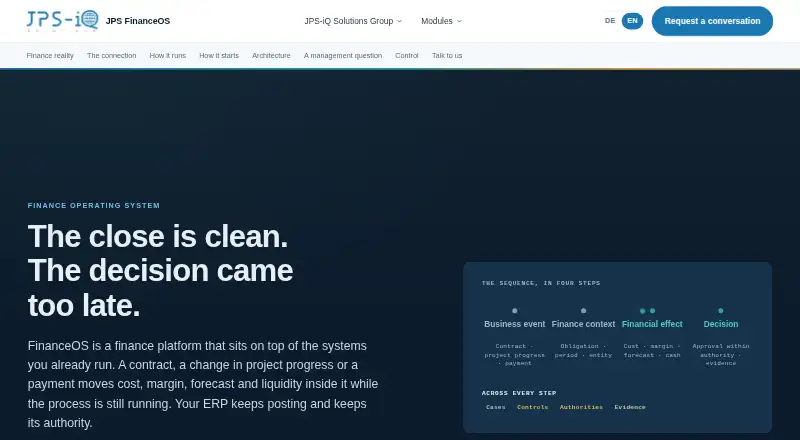
What FinanceOS Treasury & Liquidity is
FinanceOS Treasury & Liquidity is a web finance platform for organisations managing multiple entities, banks, and systems. It sits above existing ERP, accounting, and banking systems, connecting contracts, project progress, and payments with costs, margins, forecasts, and liquidity. Treasury consolidates cash across accounts, entities, and currencies while retaining each figure's source. Liquidity forecasts combine bank movements, receivables, and payables, with manual assumptions visible and attributable. Scenario views show the effects of delayed payment runs, slipped receipts, and drawdowns alongside a base case. The module calculates covenant ratios with their source, headroom, status, and test period, and shows an empty result when financing data is absent. Existing systems retain posting and accounting authority; FinanceOS handles processes between them. NetSuite is its first and deepest connected system-of-record path. Sign-in uses Microsoft Entra ID, access is role-based and entity-scoped, and financial records are append-only. FinanceOS runs on Microsoft Azure in a European region. Pricing is available on request, with no published package tiers.
Good
- Consolidates cash across accounts, entities, and currencies
- Combines bank movements, receivables, and payables in forecasts
- Shows scenario effects beside a base case
- Append-only financial records retain change details
Watch out
- Pricing and package tiers are not published
- Web platform only
- Covenant results are empty when financing data is absent
Who it suits
FinanceOS Treasury & Liquidity suits finance organisations working across several entities, banks, and systems. It is intended for teams that need consolidated cash visibility, liquidity forecasts, scenario analysis, and covenant tracking.
Verdict
FinanceOS connects treasury visibility and forecasting to existing finance systems while leaving posting authority with those systems. Pricing requires a conversation, and covenant results depend on financing data being present.
Plans and prices
From FinanceOS Treasury & Liquidity's own pricing page, checked 1 Oct 2026.
| Plan | Price | What it gives you |
|---|---|---|
| FinanceOS Treasury & Liquidity | Priced on request | Commercial scope is a conversation · no published package matrix |
The facts
Each one read from FinanceOS Treasury & Liquidity's own pages, with the date it was checked.
What it does
- AI governance
- AI explains variances, prioritises work queues and prepares proposals, while approval and posting remain with authorised people.checked 30 Sep 2026
- Auditability
- Financial-object entries are append-only and changes, approvals, rejections and overrides record the person, time and basis.checked 1 Oct 2026
- Audit trail
- Financial records are append-only, and changes, approvals, rejections and overrides retain the person, time and basis.checked 30 Sep 2026
- Bank connectivity
- Bank connectivity ingests statements and movements per institution and reports delivery gaps as gaps.checked 1 Oct 2026
- Cash forecasting
- The liquidity forecast combines bank movements, receivables and payables while keeping manual assumptions visible and attributable.checked 30 Sep 2026
- Cash position
- Balances and movements are consolidated across institutions and entities by currency, with each figure's source retained.checked 1 Oct 2026
- Compliance claims
- JPS-iQ says it does not claim certifications it does not hold and will provide a plain answer about available evidence on request.checked 1 Oct 2026
- Covenants
- The module calculates covenant ratios with source, headroom, status and test period, and shows an empty result when financing data is absent.checked 1 Oct 2026
- ERP authority
- ERP, accounting, banks and operational systems retain posting authority, while FinanceOS handles processes between systems such as approvals, reconciliations, chasing and spreadsheets.checked 30 Sep 2026
- ERP relationship
- FinanceOS sits above existing ERP and accounting systems while those systems retain posting and accounting authority.checked 1 Oct 2026
- Forecasting
- Its liquidity forecast uses bank movements, receivables and payables while keeping manual assumptions visible and attributable.checked 1 Oct 2026
- Hosting
- FinanceOS runs on Microsoft Azure in a European region, with the applicable region stated per tenant in the contract.checked 1 Oct 2026
- Hosting and encryption
- FinanceOS runs on Microsoft Azure in a European hosting region, with encrypted transport and encryption at rest.checked 30 Sep 2026
- Identity
- Sign-in runs through Microsoft Entra ID and the product stores no passwords.checked 1 Oct 2026
- Identity and access
- Sign-in runs through Microsoft Entra ID, FinanceOS stores no passwords, and access is role-based, entity-scoped and subject to server-side segregation-of-duties checks.checked 30 Sep 2026
- Integration model
- FinanceOS translates connected ERP, accounting, banking and document systems into a canonical finance model; NetSuite is the first and deepest connected system-of-record path.checked 30 Sep 2026
- Notable limits
- The product-status page says prices and package tiers are not published, certifications are not claimed, and DPO and cash conversion cycle metrics are not offered.checked 30 Sep 2026
- Product maturity
- Capabilities are classified as Verified in product, Pilot/validation, In active development or Defined capability, and unmarked capabilities are not claimed.checked 30 Sep 2026
- Purpose
- FinanceOS Treasury & Liquidity provides one cash position across bank accounts, entities and currencies, with forecasting and decisions attached.checked 1 Oct 2026
- Support
- Treasury enquiries receive automatic confirmation followed by a personal reply within one working day.checked 1 Oct 2026
- Systems supported
- The platform uses provider adapters for ERP and accounting systems, banking channels and document sources; NetSuite is described as its first and deepest connected system-of-record path.checked 1 Oct 2026
The company
- Headquarters
- Wolfenbüttel, Germanychecked 28 Sep 2026
Where it runs
- Scenarios
- Scenarios show the effects of delayed payment runs, slipped receipts or drawdowns beside the base case.checked 1 Oct 2026
- Scenarios and covenants
- The module models delayed payment runs, slipped receipts and drawdowns, and calculates covenant ratios with source, headroom, status and test period.checked 30 Sep 2026
The full review of FinanceOS Treasury & Liquidity
FinanceOS Treasury & Liquidity is a web-based finance platform built around cash visibility and forecasting across connected systems. It is best suited to finance teams managing multiple entities, banks and systems. Its central strength is connecting treasury workflows without taking posting authority away from the systems that own the books.
Overview
FinanceOS brings bank movements, receivables and payables into a shared liquidity view, then lets finance teams examine assumptions and possible changes against a base case. It sits above existing ERP and accounting systems: those systems retain accounting and posting authority, while FinanceOS handles work between systems, including approvals, reconciliations, chasing and spreadsheets.
That division will appeal to organisations seeking a common view without replacing their systems of record. NetSuite is its first and deepest connected system-of-record path; other connections use provider adapters. The value therefore depends on the systems and data a finance team needs to connect, and covenant calculations return an empty result when financing data is absent.
Key features
Cash position and forecast
The treasury view consolidates balances and movements by institution, entity and currency, retaining the source of each figure. Forecasts combine bank movements with receivables and payables, while manual assumptions remain visible and attributable. That makes it easier to distinguish a working assumption from an imported movement, a useful discipline for teams whose forecast depends on both system data and finance judgment.
Scenarios and covenants
Teams can model delayed payment runs, slipped receipts and drawdowns alongside the base case. Covenant ratios include their source, headroom, status and test period, but a ratio cannot be meaningfully returned when financing data is missing. This is a practical fit for teams that need scenario planning tied to liquidity; it is not a substitute for supplying complete financing inputs.
Connections, controls and governance
Bank statement and movement intake is handled per institution, and delivery gaps are shown as gaps rather than silently filled in. Sign-in runs through Microsoft Entra ID, with role- and entity-scoped access and server-side segregation-of-duties checks. Financial entries are append-only; changes, approvals, rejections and overrides retain the person, time and basis. Tenant data is separated at the data layer, with row-level security and no cross-tenant reporting path.
FinanceOS runs on Microsoft Azure in a European hosting region, with the applicable region stated per tenant in the contract, encrypted transport and encryption at rest. Its AI can explain variances, prioritise work queues and prepare proposals, while authorised people retain approval and posting responsibility. The product distinguishes verified, pilot or validation, active-development and defined capabilities rather than treating all capabilities as equally mature. JPS-iQ does not claim certifications it does not hold.
Pricing
FinanceOS Treasury & Liquidity is paid software with custom pricing; commercial scope is a conversation, not a published package matrix. There are no published tier prices or package comparisons to weigh, so buyers should discuss the scope they need directly with the vendor. The vendor offers a thirty-minute conversation, followed by automatic confirmation and a personal reply within one working day.
Platforms
FinanceOS is available on the web. Its integration model connects ERP and accounting systems, banking channels and document sources, with NetSuite the first and deepest connected system-of-record path.
Who it's for
FinanceOS is aimed at finance organisations coordinating liquidity across several entities, banks and systems. It is a stronger fit for teams that need consolidated cash, attributable forecasting assumptions, scenario analysis, intercompany visibility and funding tracking while leaving accounting authority in their existing systems. A team seeking a tool with public package tiers, or one that expects covenant results without financing data, should look elsewhere.
Pros and cons
Pros
- One sourced cash view: balances and movements are consolidated across institutions, entities and currencies, with each figure's source retained.
- Forecast assumptions stay accountable: manual inputs remain visible and attributable alongside bank movements, receivables and payables.
- Existing systems keep posting authority: FinanceOS coordinates processes between systems instead of claiming ownership of accounting entries.
- Changes have an audit trail: append-only financial records retain who changed, approved, rejected or overrode an item, when and on what basis.
Cons
- Price requires a conversation: custom pricing and no published package matrix make upfront comparison difficult.
- NetSuite has the deepest system-of-record connection: organisations relying on other systems should confirm how their required connections fit the provider-adapter model.
- Covenant output depends on financing inputs: without that data, the result is empty rather than a usable ratio.
- Certifications are not claimed: buyers requiring specific certification evidence should verify their requirements directly with JPS-iQ.
Alternatives
For a wider category comparison, see Liquidity Management Software.
- Kyriba is another paid treasury option, with Android, iOS, web and API platforms and custom pricing available by demo request. Choose it when those platform options matter.
- Fennech Treasury Intelligence is another paid, web-based option.
- PMC Analytics Cash Management is a paid web option with pricing by demo request; consider it if you want to compare another cash-management product on that basis.
- Agicap is paid, offers a free trial but no free plan, and supports Android, iOS, web and API. Its subscription has a minimum 12-month term and an annual offer; choose it if those trial and platform terms suit your evaluation.
- Embat Cash Flow Management offers a tailored modular plan with a proposal based on the use case; consider it if choosing modules is a priority.
- Cash4 is a paid option available on web and API.
- Cashfac Liquidity Management is a paid custom solution available on web, API and self-hosted platforms; consider it if self-hosting matters.
- Cobase Bank Connector is a paid bank-connection option for web, Android and iOS. Its pricing depends on bank connections, account volume, modules and ERP integrations, making it worth comparing when those factors shape the scope.
Verdict
FinanceOS Treasury & Liquidity is a good fit for multi-entity finance teams that need sourced cash visibility, accountable forecasts and scenario analysis across existing systems. Its strongest reason to choose it is that it connects treasury work while leaving posting authority with ERP, accounting and banking systems. Look elsewhere if public package pricing is essential, or if your covenant work cannot be supported with financing data.
Getting started
- Visit the FinanceOS website.
- Arrange a conversation with the vendor about commercial scope.
- Connect relevant ERP, accounting, banking, and document systems.
- Sign in through Microsoft Entra ID.
- Configure role-based access and entity scope.
Limits worth knowing
Pricing and package tiers are not published. Covenant calculations show an empty result when financing data is absent.
Questions
What does FinanceOS Treasury & Liquidity do?
It connects contracts, project progress, and payments with cost, margin, forecast, and liquidity above existing ERP, accounting, and banking systems.
What systems does it connect to?
It uses provider adapters for ERP and accounting systems, banking channels, and document sources. NetSuite is described as its first and deepest connected system-of-record path.
Does FinanceOS replace an ERP or accounting system?
No. Existing ERP, accounting, banking, and operational systems retain posting authority; FinanceOS handles processes between systems.
How is access managed?
Sign-in runs through Microsoft Entra ID. Access is role-based and entity-scoped, with server-side segregation-of-duties checks.
Where is FinanceOS hosted?
It runs on Microsoft Azure in a European region, with the applicable region stated per tenant in the contract.
Is pricing published?
No. Pricing and package tiers are not published; commercial scope is discussed with the vendor.
Alternatives to FinanceOS Treasury & Liquidity
- 1

HighRadius
AndroidiOSWebAPI7.1 - 2

Kyriba
AndroidiOSWebAPI6.9 - 3

ZenTreasury
WebAPI6.8From €799 a month - 4

Agicap
AndroidiOSWebAPI6.6 - 5
Float
Web6.6From $105 a month - 6

Dryrun
Web6.5From $99 a month