
ExifTool
ExifTool is a free, platform-independent Perl library and command-line application for reading, writing, and editing file metadata.
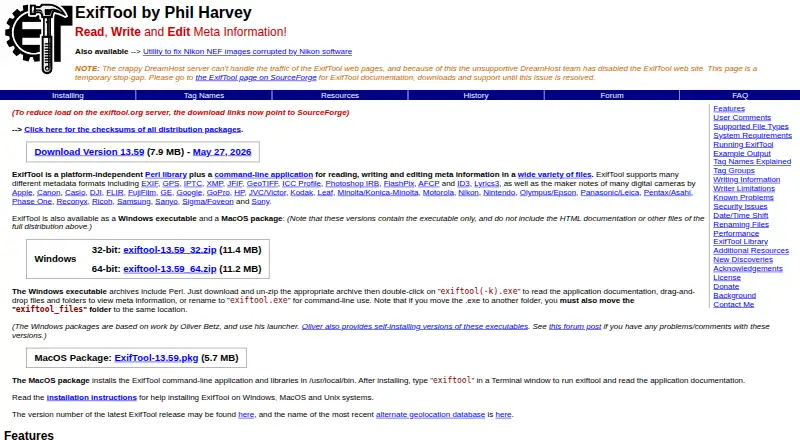
What ExifTool is
ExifTool is a free, platform-independent Perl library and command-line application for reading, writing, and editing file metadata. It handles formats such as EXIF, GPS, IPTC, XMP, JFIF, GeoTIFF, ICC Profile, Photoshop IRB, FlashPix, AFCP, and ID3, along with maker notes from numerous camera manufacturers. The command-line application can read tag values, change or delete them, and copy or move metadata between files. Sources can be file names, directory names, or standard input. ExifTool is available for Linux, macOS, and Windows, and the Perl distribution can be run without installation by extracting it on Mac or Linux; the Windows EXE version can likewise be extracted. A C++ interface lets applications communicate with an external ExifTool process. By default, writing metadata preserves the original file with an `_original` suffix, and ExifTool will not write a metadata type unsupported by the target format. The maker cautions that some options can execute Perl code and that configuration files must contain only trusted code. It is not designed as an image validator, though its extra validation checks focus mainly on JPEG and TIFF.
Good
- Reads, writes, deletes, copies, and moves metadata.
- Supports numerous metadata formats and camera maker notes.
- Accepts files, directories, or standard input.
- Preserves original files by default when writing.
Watch out
- Not designed as an image validator.
- Metadata cannot be written when the target format does not support it.
- Some options can execute Perl code.
Who it suits
ExifTool suits people who need command-line or library-based access to metadata across varied file types. It can also suit developers integrating its capabilities into C++ applications.
Verdict
ExifTool offers broad metadata handling through a free command-line tool and Perl library. Users should take care with executable options and trusted configuration files, and not treat it as a general image validator.
Plans and prices
From ExifTool's own pricing page, checked 30 Sep 2001.
| Plan | Price | What it gives you |
|---|---|---|
| ExifTool | Free | Free software distribution; no paid plans listed |
The facts
Each one read from ExifTool's own pages, with the date it was checked.
What it does
- API
- The full Perl distribution includes ExifTool documentation and API libraries.checked 30 Sep 2001
- Backups
- When writing information, ExifTool preserves the original file by adding `_original` to its file name.checked 30 Sep 2001
- Configuration security
- ExifTool executes user-defined code from an `.ExifTool_config` file in specified locations, and the maker advises ensuring such files contain only trusted code.checked 30 Sep 2001
- Distribution
- The maker offers a full Perl distribution, Windows executables and a macOS package; the Windows and macOS packages omit some files included in the full distribution.checked 30 Sep 2001
- File handling
- The application accepts file names, directory names, or standard input as sources.checked 30 Sep 2001
- Installation
- ExifTool can be run without installation by extracting the Perl distribution on Mac or Linux, or the EXE version on Windows.checked 30 Sep 2001
- Integrations
- The maker provides a C++ interface that communicates with an external ExifTool process and exposes its features to C++ applications.checked 30 Sep 2001
- License
- The author says ExifTool uses the Perl Artistic License, which permits embedding it in a commercial application under stated conditions and does not require a donation.checked 30 Sep 2001
- Limit
- The maker says ExifTool is not designed as an image validator, though it has a `-validate` feature for extra checks mainly on JPEG and TIFF files.checked 30 Sep 2001
- Maintainer
- The official site identifies Phil Harvey as the author.checked 30 Sep 2001
- Metadata formats
- It supports metadata formats including EXIF, GPS, IPTC, XMP, JFIF, GeoTIFF, ICC Profile, Photoshop IRB, FlashPix, AFCP, and ID3.checked 30 Sep 2001
- Original files
- When writing metadata, ExifTool preserves the original file by adding “_original” to its filename by default.checked 30 Sep 2001
- Purpose
- ExifTool is a Perl library and command-line application for reading, writing and editing metadata in many kinds of files.checked 30 Sep 2001
- Read and write
- The command-line application can read metadata, write or delete tag values, and copy or move metadata between files.checked 30 Sep 2001
- Release
- The official site lists ExifTool version 13.58 as available May 5, 2026.checked 30 Sep 2001
- Security
- The version history includes security updates.checked 30 Sep 2001
- Support
- The maker directs users to the ExifTool forum to discuss issues.checked 30 Sep 2001
- Supported write limits
- Metadata is not written when the target file format does not support that metadata type.checked 30 Sep 2001
The company
- Camera maker notes
- It supports maker notes from digital cameras by numerous manufacturers, including Apple, Canon, DJI, Nikon, Panasonic, and Sony.checked 30 Sep 2001
- Camera makers
- Its supported camera maker notes include formats from Apple, Canon, DJI, Nikon, Sony and other manufacturers.checked 30 Sep 2001
- Headquarters
- Canadachecked 23 Sep 2001
The full review of ExifTool
ExifTool is a free Perl library and command-line utility for reading and changing metadata across many file types. It is best suited to people comfortable with command-line workflows or developers integrating metadata handling into software. Its breadth and file operations make it a strong specialist tool, but it is not a general-purpose image validator.
Overview
ExifTool covers a wide range of metadata standards, including EXIF, GPS, IPTC, XMP, JFIF, GeoTIFF, ICC Profile, Photoshop IRB, FlashPix, AFCP and ID3. It also understands camera-specific maker notes from manufacturers such as Apple, Canon, DJI, Nikon, Panasonic and Sony. That reach makes it useful when a workflow spans different cameras or file types rather than only basic photo tags.
The command-line application can inspect metadata, write or delete tag values, and copy or move metadata between files. Sources can be individual filenames, directories or standard input, which suits repeatable and batch-oriented work. Writes are limited by the target format: ExifTool cannot add metadata types a file format does not support.
It is available for Linux, macOS and Windows, as well as for self-hosted use and through an API. The full Perl distribution includes documentation and API libraries; Windows and macOS packages omit some files from that distribution. ExifTool can also be run without installation by extracting the Perl distribution on Mac or Linux, or the EXE version on Windows.
Key features
- Read, edit and transfer tags: One tool handles inspection, tag changes or deletion, and metadata copying or moving. That flexibility is valuable for organizing or transforming metadata, but the command-line approach is less suited to readers seeking a visual editor.
- Broad format and camera coverage: Support for many metadata formats and camera maker notes helps with mixed-source collections and less common metadata fields.
- Batch-oriented input: Directories and standard input join individual files as accepted sources, making it practical to incorporate ExifTool into larger workflows.
- Original-file backup: By default, writing metadata preserves the original under a filename ending in _original. This provides a fallback, though users should account for those extra files in their workflow.
- C++ integration: A provided interface communicates with an external ExifTool process and exposes its features to C++ applications. It offers a route to integration without making the command-line tool a native in-process library.
Pricing
ExifTool is free software: the ExifTool plan costs nothing. There is no paid plan or free trial to weigh against it. The author says the Perl Artistic License permits embedding ExifTool in a commercial application under stated conditions and does not require a donation.
Platforms
ExifTool supports Linux, macOS and Windows, with self-hosted and API use also indicated. Distribution options include a full Perl package, Windows executables and a macOS package. Choose the full distribution when its included documentation and API libraries matter; the platform packages leave out some files.
Who it's for
ExifTool is a good fit for photographers, archivists and developers who need broad metadata access, batch-capable file operations or a library to build on. It is less appropriate for someone who wants a graphical editing experience, or who needs comprehensive image validation: the maker says validation is not its purpose, and its -validate feature provides extra checks mainly for JPEG and TIFF.
Care is warranted when automating it. Some options can execute Perl code, so applications passing filenames should use -- or ensure names do not start with a dash or Unicode minus sign. ExifTool also executes user-defined code from .ExifTool_config files in specified locations; those files should contain only trusted code. For questions and issues, the maker directs users to the ExifTool forum.
Pros and cons
Pros
- Unusually broad metadata coverage: Many standards and camera maker notes are supported, reducing the need to switch tools for different sources.
- Useful file operations: Tag editing, deletion, copying and moving combine with directory input for batch workflows.
- Free and adaptable: The command-line utility, Perl libraries and C++ interface serve both direct use and software integration.
- Default original preservation: Metadata writes retain a copy of the original file under an _original name.
Cons
- Command-line orientation: Its utility is strongest for users comfortable with command-line tools or software integration, not those seeking a visual workflow.
- Security requires attention: Executable options and trusted configuration files create real precautions for automated use.
- Not a general image validator: Its extra validation checks are mainly for JPEG and TIFF, so it is not the right choice for broad validation needs.
- Writes depend on file support: A target format that does not support a metadata type cannot receive it.
Alternatives
For a wider comparison, browse Photo Metadata Editors.
- ExifCleaner is a free desktop app for Linux, macOS and Windows; consider it instead if that platform coverage and desktop-app format better match your preference.
- Photini is free GPL-3.0-or-later software for Linux, macOS and Windows; choose it instead if those platforms and that license are a better fit.
- Exif Pilot offers a free Basic EXIF editor for Windows; it is an option if you want a Windows EXIF editor.
- GeoSetter is free for Windows, requires Internet Explorer 10 or later, and has no usage restrictions; it suits readers who want a Windows-only option under those terms.
- MetaImage is a paid macOS option with a free plan; consider it if you are looking for a macOS alternative with a paid offering.
- Metadata Stripper is a free alternative for Windows, macOS and Linux.
- EXIF Magic is a free option for iOS, macOS and Android.
- FREE Browser is a free, open-source Android alternative.
Verdict
Choose ExifTool if you need free, wide-ranging metadata operations in a command-line or software-integration workflow. Its format coverage, batch-oriented inputs and editing tools are substantial strengths. Look elsewhere if a visual editor or general image validation is central to your needs, and treat its executable options and configuration files with care.
Getting started
- Visit exiftool.org.
- Choose the full Perl distribution, Windows executable, or macOS package.
- On Mac or Linux, extract the Perl distribution to run without installation; on Windows, extract the EXE version.
- Use file names, directory names, or standard input as sources.
- For applications, consider the included API libraries or the C++ interface.
Limits worth knowing
ExifTool writes metadata only when the target file format supports that metadata type. The Windows and macOS packages omit some files found in the full distribution; image validation is not its design focus, though extra checks mainly cover JPEG and TIFF.
Questions
What does ExifTool cost?
ExifTool is free software, listed as free, with no paid plans listed.
Which platforms does it support?
It is available for Linux, macOS, and Windows, and is also listed for API and self-hosted use.
Can it handle camera and location metadata?
Yes. Supported formats include GPS and EXIF, and it supports maker notes from numerous camera manufacturers.
Does ExifTool preserve files when editing metadata?
By default, when writing information it preserves the original by adding `_original` to the filename.
Can every metadata type be written to every file?
No. ExifTool does not write metadata when the target file format does not support that type.
Who maintains ExifTool, and what is its license?
The official site identifies Phil Harvey as its author. ExifTool uses the Perl Artistic License, which permits embedding it in a commercial application under stated conditions.
Alternatives to ExifTool
- 1
FREE Browser
Free planOpen sourceAndroid7.2Free plan - 2
Metadata Stripper
Free planOpen sourceLinuxmacOSWindows7.1Free plan - 3
Exif Lens
Free planiOS6.6From $0.99 a month - 4
Photo Metadata Editor
Free planWindows6.6Free plan - 5

Exif Pilot
Free planWindows6.5€79.95, paid once - 6

EXIF Magic
Free planAndroidiOSmacOS6.4Free plan