ERP5
ERP5 is a free, self-hosted business platform covering CRM, production management, supply chain, product design, accounting, human resources, and e-commerce.
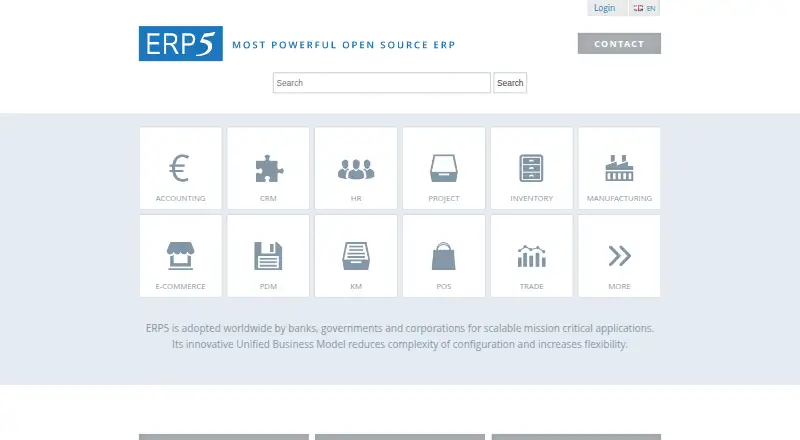
What ERP5 is
ERP5 is a free, self-hosted business platform covering CRM, production management, supply chain, product design, accounting, human resources, and e-commerce. Its listed operational modules include finance, inventory, order management, and manufacturing, with support for multiple entities. ERP5 uses a Unified Business Model to describe its components and has been implemented in industries including banking, government, trade, manufacturing, and aerospace. It can be used and configured in a web browser, and the maker says all browsers are supported. Organizations can download a preconfigured virtual machine for a server, though the maker does not recommend that package for large production environments with many users or for development. For production deployments and complex integrations, the maker recommends SlapOS. ERP5 is written mostly in Python and uses the NEO transactional NoSQL database alongside a relational SQL database, with MariaDB preferred. It provides a HATEOAS JSON API and an MCP service that can expose read-only or read-write tools under the connected user's permissions. The free software is available under GPL v2.
Good
- Free to download and use under GPL v2.
- Covers finance, inventory, orders, and manufacturing.
- Supports multiple entities.
- Provides a HATEOAS JSON API and MCP implementation.
Watch out
- Virtual machine package is not recommended for large production environments.
- Maker recommends SlapOS for production deployments.
- Maker says ERP5 is not a reporting tool.
Who it suits
ERP5 suits organizations seeking a flexible business platform and prepared to supervise deployment or learn the system in depth. Its self-hosting and production-deployment guidance make it a fit for teams planning to manage their own environment.
Verdict
ERP5 brings a wide range of business operations into a self-hosted platform with browser access and APIs. Organizations should account for deployment complexity and the stated limits of the virtual machine package.
Plans and prices
From ERP5's own pricing page, checked 9 Oct 2026.
| Plan | Price | What it gives you |
|---|---|---|
| ERP5 | Free | GPL v2 open-source software · free to download and use |
The facts
Each one read from ERP5's own pages, with the date it was checked.
What it does
- API and MCP
- ERP5 provides a HATEOAS JSON API, and its MCP implementation can expose read-only or read-write services to MCP clients.checked 9 Oct 2026
- Business model
- ERP5 uses a Unified Business Model to describe its components and has been implemented across industries including banking, government, trade, manufacturing and aerospace.checked 9 Oct 2026
- Deployment
- on-premisechecked 20 Sep 2026
- Deployment limit
- The ERP5 VM package is not recommended for large production environments with many users or for development.checked 9 Oct 2026
- Finance module
- Yeschecked 20 Sep 2026
- Intended audience
- The maker describes ERP5 as suitable for organizations needing a flexible, scalable business platform or framework and prepared to supervise deployment or learn ERP5 in depth.checked 9 Oct 2026
- Inventory management
- Yeschecked 20 Sep 2026
- Manufacturing tools
- Yeschecked 20 Sep 2026
- MCP safeguards
- ERP5's MCP service runs tool calls under the connected ERP5 user's permissions and can strip personal data from tool results.checked 9 Oct 2026
- Multi-entity support
- Yeschecked 20 Sep 2026
- Order management
- Yeschecked 20 Sep 2026
- Production deployment
- The maker recommends SlapOS for production environments and complex integrations with other packages.checked 9 Oct 2026
- Product scope
- ERP5 covers CRM, production management, supply chain, product design, accounting, human resources and e-commerce.checked 9 Oct 2026
- Reporting limit
- The maker says ERP5 is not a reporting tool, though it can interface with PALO and other tools.checked 9 Oct 2026
- Security
- ERP5 uses a 5A security model with Author, Auditor, Assignor, Assignee and Associate roles, with permissions configured by module and document.checked 9 Oct 2026
- Self-hosting
- The maker offers a preconfigured ERP5 virtual machine for end users who want an instance running on their server.checked 9 Oct 2026
- Support and documentation
- The maker site provides user, consultant, developer, and internationalisation/localisation documentation.checked 9 Oct 2026
- Technology
- ERP5 is written mostly in Python and uses the NEO transactional NoSQL database and a relational SQL database, with MariaDB preferred.checked 9 Oct 2026
- Web access
- ERP5 can be used and configured through a web browser, and the maker says all browsers are supported.checked 9 Oct 2026
The company
- Founded
- 2001checked 28 Sep 2026
- Headquarters
- Lille, Francechecked 28 Sep 2026
Money
- Free plan
- Yeschecked 20 Sep 2026
The full review of ERP5
Overview
ERP5 is a broad business platform for organizations that need to coordinate finance, production and other operational work. It is best suited to teams able to supervise a deployment or invest in learning the system. Its free, open-source license is a strong starting point, but the recommended production setup is more involved than simply running its virtual machine.
Key features
ERP5 covers CRM, production management, supply chain, product design, accounting, human resources and e-commerce, alongside finance, inventory, order management, manufacturing tools and multi-entity support. Its Unified Business Model describes how system components fit together, and the platform has been implemented in industries from banking and government to trade, manufacturing and aerospace. That breadth makes it relevant to organizations with varied processes; it also makes ERP5 a better fit for teams prepared to oversee deployment and learn the platform in depth than for buyers seeking a narrowly scoped, ready-to-run tool.
ERP5 can be used and configured in a browser, with the maker saying all browsers are supported. Its HATEOAS JSON API and MCP implementation provide ways to connect other software or MCP clients. MCP services can be read-only or read-write; tool calls run under the connected ERP5 user's permissions, and personal data can be stripped from results. ERP5's 5A security model assigns Author, Auditor, Assignor, Assignee and Associate roles, with permissions configured by module and document. This offers fine-grained access control, though it requires organizations to set permissions deliberately.
The maker offers a preconfigured virtual machine for running an instance on an organization's server, but does not recommend that package for large production environments with many users or for development. For production and complex integrations with other packages, it recommends SlapOS. ERP5 is written mostly in Python and uses the NEO transactional NoSQL database alongside a relational SQL database, with MariaDB preferred. The maker also provides documentation for users, consultants, developers and internationalisation/localisation. ERP5 is not a reporting tool, though it can interface with PALO and other tools, so organizations with substantial reporting needs should plan for separate reporting software.
Pricing
ERP5's ERP5 plan costs nothing. It is GPL v2 open-source software, free to download and use, making it an option for organizations able to take responsibility for deployment rather than pay a license fee. There are no paid tiers or seat limits stated for this plan; the practical constraint is the deployment work, including using the recommended SlapOS setup for production environments or complex integrations.
Platforms
ERP5 supports API access, Linux, macOS, Windows, web use and self-hosting. The browser interface can also be configured through the web. The virtual machine is a route to a server-hosted instance, not the recommended choice for large production installations or development.
Who it's for
ERP5 is a strong candidate for organizations seeking a flexible platform across several business functions, particularly when they can supervise implementation and tailor security and integrations. It is less suitable for teams that need a reporting tool in the same product, or that want a simple virtual-machine deployment for a large production environment.
Pros and cons
- Pros: The GPL v2 software is free to download and use, while its broad business scope includes finance, manufacturing, inventory and multi-entity support.
- Pros: Browser access, a HATEOAS JSON API and MCP services offer several ways to use or integrate ERP5; MCP calls can be governed by the connected user's permissions.
- Cons: The preconfigured VM is not recommended for large production environments or development, and SlapOS is recommended for production and complex integrations.
- Cons: ERP5 is not a reporting tool, so teams needing reporting must look to PALO or other tools.
- Cons: The platform is aimed at organizations ready to supervise deployment or learn ERP5 in depth, rather than teams seeking a low-effort setup.
Alternatives
Manufacturing ERP Software and ERP Software are useful starting points for comparing options by category.
Apache OFBiz is another free, open-source, self-hosted option with API, Linux, web and Windows platforms. Consider it when those platform requirements matter and you want an alternative without licensing fees.
Cetec ERP is a paid option with a free trial and API, self-hosted and web platforms. Global Shop Solutions ERP, abas ERP, Epicor Kinetic, Genius ERP and Infor ERP are paid alternatives with custom pricing.
Odoo Manufacturing offers a free One App plan with unlimited users as well as paid plans with custom pricing. Consider it when a free manufacturing-focused app is the priority.
Verdict
Choose ERP5 if your organization needs a flexible, broad business platform and can take charge of deployment, configuration and learning. The free GPL v2 license and wide operational scope are its strongest reasons to choose it. Look elsewhere if you need reporting built in or want to rely on the VM for a large production setup.
Getting started
- Download ERP5, which is free to use under GPL v2.
- Use the preconfigured ERP5 virtual machine to run an instance on your server.
- Access and configure ERP5 through a web browser.
- For a production environment or complex integrations, use the maker-recommended SlapOS deployment approach.
- Consult the maker’s user, consultant, developer or internationalisation and localisation documentation as needed.
Limits worth knowing
The preconfigured virtual machine is not recommended for large production environments with many users or for development. The maker recommends SlapOS for production deployments and complex integrations; ERP5 is not itself a reporting tool.
Questions
Is ERP5 free?
Yes. It is free to download and use under the GPL v2 license.
Where does ERP5 run?
ERP5 is deployed on-premise. The maker offers a preconfigured virtual machine for running an instance on your server, and ERP5 can be used and configured through a web browser.
What modules and business areas does ERP5 cover?
Its scope includes CRM, production management, supply chain, product design, accounting, human resources and e-commerce. Listed modules include finance, inventory, order management and manufacturing.
Is the ERP5 virtual machine suitable for a large production environment?
The maker does not recommend the VM package for large production environments with many users or for development. SlapOS is recommended for production deployments.
Does ERP5 provide an API or MCP support?
ERP5 provides a HATEOAS JSON API. Its MCP implementation can expose read-only or read-write services, with tool calls running under the connected user’s permissions.
Is ERP5 a reporting tool?
No. The maker says ERP5 is not a reporting tool, though it can interface with PALO and other tools.