
ERPNext
ERPNext is an open-source enterprise resource planning system for operating and growing businesses.
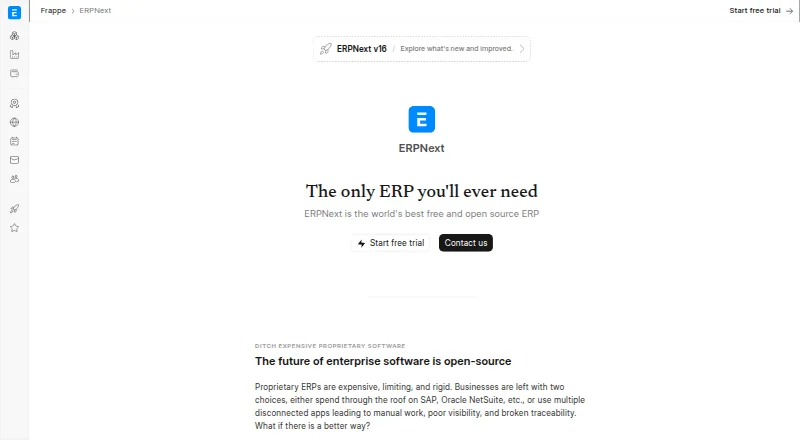
What ERPNext is
ERPNext is an open-source enterprise resource planning system for operating and growing businesses. Its modules cover accounts, invoicing, sales, procurement, stock, manufacturing, projects, point of sale, HR, and payroll. A low-code and no-code builder lets users customize forms, reports, print formats, dashboards, and workflows. For businesses with multiple entities or locations, it supports subsidiaries, branches, and currencies, with consolidated reports and configurable tax compliance. ERPNext exposes records through REST API endpoints for reading, creating, updating, and deleting, subject to permissions. Application controls include OTP or two-factor authentication, IP restrictions, field-level roles and permissions, and an audit trail. The product page describes implementation paths for enterprises, small and medium businesses, freelancers, and DIY users. Frappe says Product Warranty covers bug fixes by its engineers, not functional support; implementation and other services are available through certified partners.
Good
- Self-hosting is available at no product charge.
- Modules include manufacturing, HR, and payroll.
- Supports subsidiaries, branches, and multiple currencies.
- Frappe Cloud Sites start at $5 per month.
Watch out
- Product Warranty does not include functional support.
- Self-hosting requires deploying on your own server.
- Product Warranty is listed with paid hosting plans.
Who it suits
ERPNext suits organizations seeking an open-source system across finance, sales, inventory, manufacturing, and other business functions. Its listed implementation paths include enterprises, small and medium businesses, freelancers, and DIY users.
Verdict
ERPNext combines broad business modules with customization tools and self-hosting options. Compare the responsibilities of self-hosting with Frappe Cloud, and note that Product Warranty covers bug fixes rather than functional support.
Plans and prices
From ERPNext's own pricing page, checked 15 Sep 2026.
| Plan | Price | What it gives you |
|---|---|---|
| Frappe Cloud Sites | $5 a month | Single site hosting · Managed upgrades and backups · Shared-server hosting · billed monthly |
| Frappe Cloud Servers | $20 a month | Virtual machine hosting · Supports multiple sites and benches · billed monthly |
| Self-hosted ERPNext | Free | Self-host on your own server · AGPL-3.0 licensed · No product charge |
| Self-host | Free | Deploy on your own server · Installation scripts · AGPL-3.0 licensed · free and open-source |
| Sites | $5 a month | Single site · Managed upgrades & backups · Scripting & custom apps · Product Warranty · Hosting on shared servers · onwards /mo |
| Servers | $125 a month | Superior Dedicated Server isolation · Advanced features like server snapshots, autoscaling, etc. · Stronger reliability guarantees · Global data centre locations · Product Warranty · onwards /mo |
The facts
Each one read from ERPNext's own pages, with the date it was checked.
What it does
- API
- Frappe automatically exposes ERPNext DocTypes through REST API endpoints for reading, creating, updating and deleting records where permissions allow.checked 28 Sep 2026
- Core modules
- It includes accounts, invoicing, sales, procurement, stock, manufacturing, projects, point of sale, HR and payroll.checked 28 Sep 2026
- Customization
- ERPNext includes a low-code and no-code builder for customizing forms, reports, print formats, dashboards and workflows.checked 28 Sep 2026
- Deployment
- hybridchecked 15 Sep 2026
- Finance module
- Yeschecked 15 Sep 2026
- Global businesses
- ERPNext supports multiple subsidiaries, branches and currencies with consolidated reports and configurable tax compliance.checked 28 Sep 2026
- Implementation
- Frappe works with a global network of 200+ trained and certified partners for implementation, support, customizations and integrations.checked 28 Sep 2026
- Integrations
- Official integration categories include LDAP, Fairlogin, Dropbox, Google Drive, Amazon S3, Plaid, Shopify, WooCommerce, Amazon SP-API, Razorpay, Stripe, Paytm, Exotel and Google services.checked 28 Sep 2026
- Inventory management
- Yeschecked 15 Sep 2026
- Manufacturing tools
- Yeschecked 15 Sep 2026
- Multi-entity support
- Yeschecked 15 Sep 2026
- Order management
- Yeschecked 15 Sep 2026
- Pricing model
- Frappe Cloud uses hosting-based pricing rather than per-user pricing, and the self-hosted software can be run locally without paying Frappe for running or managing it.checked 28 Sep 2026
- Purpose
- ERPNext is a 100% open-source enterprise resource planning solution for operating and growing businesses.checked 28 Sep 2026
- Security
- Frappe says its quality and information security systems are certified to ISO 9001:2015 and ISO 27001:2013, and Frappe Cloud is GDPR compliant.checked 28 Sep 2026
- Support
- Product Warranty provides Frappe engineer support for fixing bugs, but it does not include functional support.checked 28 Sep 2026
- Who it serves
- The product page describes ERPNext as suitable for almost any industry and country, with implementation paths for enterprise businesses, small and medium businesses, freelancers and DIY enthusiasts.checked 28 Sep 2026
Where it runs
- Application controls
- ERPNext and Frappe Framework provide OTP or 2FA, IP restriction, granular field-level roles and permissions, and an advanced audit trail.checked 28 Sep 2026
The company
- Founded
- 2008checked 23 Sep 2026
- Headquarters
- Mumbai, Maharashtra, Indiachecked 23 Sep 2026
Money
- Free plan
- Yeschecked 15 Sep 2026
The full review of ERPNext
Overview
ERPNext is an open-source ERP that brings finance, sales, purchasing, inventory, manufacturing and people operations into one system. It suits businesses that want broad operational coverage and the option to customize or self-host; it is less compelling for teams seeking a turnkey service with functional support included.
Its modules cover accounts, invoicing, sales, procurement, stock, manufacturing, projects, point of sale, HR and payroll. ERPNext is made by ERPNext, founded in 2008 and headquartered in Mumbai, India. Hybrid deployment lets businesses run it on their own servers or use Frappe Cloud.
For readers comparing ERP Software, the central trade-off is flexibility versus responsibility: self-hosting avoids a product charge, but hosting, implementation and configuration still need an owner.
Key features
Broad operational coverage
Accounts and invoicing sit alongside sales, procurement, stock and manufacturing, with projects, point of sale, HR and payroll extending the system into other business functions. Finance, inventory and order management, manufacturing tools and multi-entity support are included. This breadth is useful when an organization wants connected workflows across departments; it may be more system than a business seeking only a narrow finance or stock tool needs.
Adaptable workflows and access controls
A low-code and no-code builder supports customized forms, reports, print formats, dashboards and workflows. That gives businesses room to shape the system around their processes, but customization also makes configuration a real implementation responsibility. OTP or two-factor authentication, IP restrictions, field-level roles and permissions, and an advanced audit trail provide controls for managing access and accountability.
Multiple entities, currencies and integrations
ERPNext supports subsidiaries and branches, multiple currencies, consolidated reports and configurable tax compliance. Those capabilities suit organizations operating across entities or markets. Official integration categories include cloud storage, payment services, e-commerce platforms, identity services and Google services. Frappe also automatically exposes ERPNext DocTypes through REST API endpoints for reading, creating, updating and deleting records where permissions allow, which is useful for connecting systems while keeping access permission-bound.
Support and implementation
Product Warranty covers Frappe engineer support for bug fixes, not functional guidance. Businesses needing help with implementation, support, customizations or integrations can work with Frappe's network of more than 200 trained and certified partners. Buyers should distinguish fixing defects from help deciding how to configure business processes.
Pricing
ERPNext is freemium, with a free self-hosted option and Frappe Cloud plans starting at $5 a month. The free software is licensed under AGPL-3.0 and has no product charge, but the business must deploy it on its own server. That is the lowest-cost route only if it can take responsibility for running the installation.
- Self-hosted ERPNext — free: Self-host on your own server under AGPL-3.0, with no product charge.
- Frappe Cloud Sites — $5 a month, billed monthly: Single-site shared-server hosting with managed upgrades and backups. This is the entry point for a business that wants managed hosting for one site rather than operating its own server.
- Frappe Cloud Servers — $20 a month, billed monthly: Virtual-machine hosting that supports multiple sites and benches.
- Sites — $5 a month onwards: Single-site shared hosting with managed upgrades and backups, scripting and custom apps, and Product Warranty.
- Servers — $125 a month onwards: Dedicated-server isolation, snapshots, autoscaling and other advanced features, stronger reliability guarantees, global data-centre locations and Product Warranty.
The plans differ in hosting model and included management or infrastructure features. Product Warranty is bug-fix support, not functional support. A 14-day trial is available. The published plan terms do not state seat or usage caps.
Platforms
ERPNext supports web and API access, with Linux, macOS and self-hosted deployment options. Frappe Cloud adds hosted deployment; self-hosting gives more control over where the system runs, at the cost of managing that environment.
Who it's for
ERPNext is a strong fit for businesses that need several connected ERP functions, multiple entities or currencies, and configurable workflows. Its self-hosted option also suits technically capable organizations that want open-source software and can run their own server. Frappe Cloud is the more suitable route for teams that want managed upgrades and backups instead of self-hosting.
It is a weaker fit for buyers who need functional support bundled with the product, or who do not want to take on hosting and configuration decisions. Businesses can also use Frappe's certified partner network for implementation and custom work.
Pros and cons
- Pros: A wide module set spans finance, inventory, manufacturing, projects, point of sale, HR and payroll, reducing the need to start with separate systems for each function.
- Pros: Open-source self-hosting carries no product charge, while Frappe Cloud offers managed hosting options from $5 a month.
- Pros: Multi-entity support, multiple currencies, consolidated reporting and configurable tax compliance address the needs of businesses operating across organizational or market boundaries.
- Cons: Self-hosting means the business is responsible for its own server environment.
- Cons: Product Warranty fixes bugs but excludes functional support, so businesses needing process or configuration guidance may need partner assistance.
- Cons: Customization is powerful, but using the builder to adapt forms, reports and workflows requires decisions about how the system should operate.
Alternatives
Odoo ERP is worth comparing for businesses that want to start with one free app and unlimited users, with paid plans for all apps.
Epicor Kinetic is an alternative for buyers who want to choose among cloud packages, platform cores, concurrent-user licenses and industry bundles.
Dolibarr is another free ERP option, with web, Windows, macOS and Linux platforms.
Trimble Viewpoint Vista may suit buyers seeking cloud-hosted or on-premises deployment with pricing handled through sales.
Axelor Open Suite offers a free AGPL community edition for buyers comparing open-source ERP platforms.
Apache OFBiz is another free option, available on web and Windows.
SAP ERP is a paid alternative.
Oracle Fusion Cloud ERP is a paid option with web access and no free plan.
For a sector-specific comparison, see Food Manufacturing Software.
Verdict
Choose ERPNext if your business needs broad, configurable ERP coverage and values open-source self-hosting or a managed Frappe Cloud route. Its strongest case is the combination of extensive modules, customization and multi-entity support. Look elsewhere if functional support must come with the product or if your team is not prepared to manage hosting and configuration.
Getting started
- Open the ERPNext website.
- Choose self-hosting or Frappe Cloud hosting.
- For self-hosting, deploy on your own server using the installation scripts.
- For hosted deployment, choose a Sites or Servers plan.
- Use an implementation path for an enterprise, small or medium business, freelancer or DIY setup.
Limits worth knowing
Self-hosted ERPNext has no product charge under AGPL-3.0. Frappe Cloud Sites start at $5 a month for one site, while Cloud Servers are listed at $20 a month.
Questions
Is ERPNext free?
Self-hosted ERPNext is available at no product charge under the AGPL-3.0 license.
What does ERPNext include?
Its modules cover accounts, invoicing, sales, procurement, stock, manufacturing, projects, point of sale, HR and payroll.
Can ERPNext support multiple companies or locations?
It supports subsidiaries, branches and currencies, with consolidated reports and configurable tax compliance.
Where can ERPNext run?
Listed platforms include API, Linux, macOS, self-hosted and web. Deployment is listed as hybrid.
What integrations are available?
Official integration categories include LDAP, Fairlogin, Dropbox, Google Drive, Amazon S3, Plaid, Shopify, WooCommerce, Amazon SP-API, Razorpay, Stripe, Paytm, Exotel and Google services.
Who makes ERPNext?
The maker is ERPNext, founded in 2008 and headquartered in Mumbai, Maharashtra, India.
Alternatives to ERPNext
- 1
Odoo ERP
Free planOpen sourceAndroidiOSWebAPI9.1From $24.90 a month - 2
Striven
Free planAndroidiOSWebAPI8.6From $35 a month - 3
WP ERP
Free planOpen sourceAndroidiOSWebSelf-hosted8.2From $160 a year - 4

Rootstock ERP
AndroidiOSWebAPI8.1From $100 a month - 5

BUSY
Free planWeb7.9From ₹5,000 a year - 6

abas ERP
AndroidiOSWebAPI7.9From $149 a month