Tryton
Tryton is modular business software for companies of any size, with tools for accounting, sales, inventory, CRM, purchasing, supply chain, manufacturing, shi…
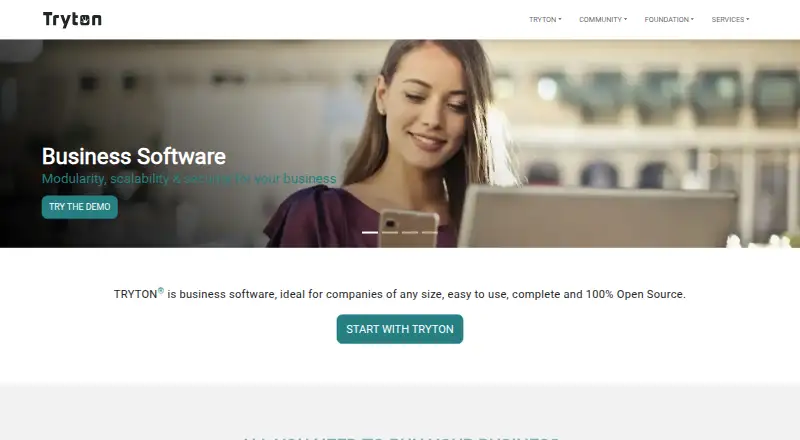
What Tryton is
Tryton is modular business software for companies of any size, with tools for accounting, sales, inventory, CRM, purchasing, supply chain, manufacturing, shipping, project management and subscriptions. It supports finance, inventory, order management, manufacturing and multiple entities. Its three-tier setup combines an application server, a PostgreSQL database and web or desktop clients, while server modules handle business logic. Desktop clients are available for Windows 64-bit, macOS x86-64 and arm64, and Linux Flatpak; web, REST, desktop and console client source releases are also listed. Organizations can deploy on-premise or self-host using a Docker image that includes the server, modules and web client. Tryton is free, with a free plan at no cost. The project issues a new series every six months, supporting series for one year except new major versions, which receive five years of long-term support. A shared demo with example data resets daily, and community forum support is available.
Good
- Free plan at no cost
- Covers accounting, CRM, inventory and manufacturing
- Desktop clients support Windows, macOS and Linux
- Docker image includes server, modules and web client
- Model-, action-, field- and record-level access controls
Watch out
- On-premise deployment requires hosting arrangements
- Desktop support is limited to listed platforms
- Support series generally receive one year
Who it suits
Tryton suits organizations looking for free modular business software with finance, inventory, manufacturing and multi-entity capabilities. It can fit teams prepared to self-host or arrange third-party hosting.
Verdict
Tryton combines a wide set of business functions with self-hosting and third-party hosting options. Check its platform requirements and release-support periods when planning deployment.
Plans and prices
From Tryton's own pricing page, checked 4 Oct 2026.
| Plan | Price | What it gives you |
|---|---|---|
| Tryton | Free | 100% Open Source business software; self-hosted server or third-party hosting |
The facts
Each one read from Tryton's own pages, with the date it was checked.
What it does
- Architecture
- Tryton uses a three-tier architecture with an application server, a PostgreSQL database, a web or desktop client, and server modules for business logic.checked 4 Oct 2026
- Business features
- The site lists financial accounting, sales, inventory and stock, analytic accounting, CRM, purchasing, supply chain, manufacturing, shipping, project management, and subscription management.checked 4 Oct 2026
- Deployment
- on-premisechecked 20 Sep 2026
- Finance module
- Yeschecked 20 Sep 2026
- Foundation
- The Tryton Foundation is a private foundation formed under Belgian law to protect, promote, and develop Tryton as Free Software.checked 4 Oct 2026
- Hosting availability
- The service-provider directory includes providers offering Tryton cloud servers as a rented SaaS service.checked 4 Oct 2026
- Integrations
- The site says third-party integration can automate communication with banks, carriers, and websites, and it lists a large ecosystem of third-party modules.checked 4 Oct 2026
- Inventory management
- Yeschecked 20 Sep 2026
- Manufacturing tools
- Yeschecked 20 Sep 2026
- Multi-entity support
- Yeschecked 20 Sep 2026
- Order management
- Yeschecked 20 Sep 2026
- Public demo
- Tryton provides a public shared demo server with example data that is reset daily.checked 4 Oct 2026
- Purpose
- Tryton is modular business software described as suitable for companies of any size.checked 4 Oct 2026
- Release support
- Tryton releases a series every six months; series are supported for one year, except new major versions, which receive five years of long-term support.checked 4 Oct 2026
- Security controls
- The documentation describes access controls at model, action, field, button, and record-rule levels, based on user group membership.checked 4 Oct 2026
- Self-hosting
- A Docker image includes the server, modules, and web client, and the site describes it as suitable for production deployment.checked 4 Oct 2026
- Source integrity
- Tryton says its source archives are signed using signify with a different key for each series.checked 4 Oct 2026
- Support
- The project directs users to a community support forum and lists service providers offering services such as consulting, development, hosting, and support.checked 4 Oct 2026
- Web and API clients
- The download page lists source releases for the web client and REST client, as well as desktop and console clients.checked 4 Oct 2026
Where it runs
- Desktop platforms
- The desktop client is available for Windows 64-bit, macOS x86-64 and arm64, and Linux Flatpak.checked 4 Oct 2026
The company
- Founded
- 2012checked 28 Sep 2026
- Headquarters
- Liège, Belgiumchecked 28 Sep 2026
Money
- Free plan
- Yeschecked 20 Sep 2026
The full review of Tryton
Tryton is modular business software covering finance, inventory, sales, manufacturing, and other operational work. It suits organizations that want broad business functions in one system and can manage hosting themselves or through a service provider. Its free, open-source model is a strong draw, but deployment and release upkeep call for planning.
Overview
Tryton spans financial and analytic accounting, sales, inventory and stock, CRM, purchasing, supply chain, manufacturing, shipping, project management, and subscription management. That range makes it worth considering when a business wants to coordinate several functions rather than adopt a single-purpose finance tool. The software is described as suitable for companies of any size; in practice, fit depends on whether the organization can select and operate the modules it needs.
Its three-tier design separates business logic in server modules from the PostgreSQL database and the web or desktop client. A Docker image bundles the server, modules, and web client and is described as production-suitable. That gives self-hosting teams a deployment route, while service providers also offer rented Tryton cloud servers for organizations that prefer third-party hosting.
Key features
- Broad business coverage: Finance, inventory, order management, manufacturing, and multi-entity support sit alongside CRM, purchasing, shipping, project work, and subscriptions. Teams can address varied workflows in one modular system, though they still need to determine which modules suit their operations.
- Client choices: The download options include web, REST, desktop, and console clients. The desktop client supports Windows 64-bit, macOS x86-64 and arm64, and Linux through Flatpak, giving teams several ways to access the system across those environments.
- Granular access controls: Controls can be applied to models, actions, fields, buttons, and records according to user group membership. This lets administrators shape access at multiple levels instead of relying only on broad account permissions.
- Integrations and ecosystem: Third-party integrations can automate communication with banks, carriers, and websites, and a large ecosystem of third-party modules expands the available options. Organizations with specific integration needs can also turn to listed service providers for consulting, development, hosting, and support.
- Release and source practices: Tryton publishes a new series every six months. Each series is supported for one year, while new major versions receive five years of long-term support; source archives are signed with signify using a distinct key for each series. Frequent series releases make support-window planning important, particularly for teams running their own deployment.
- Evaluation access: A shared public demo includes example data and resets daily. It offers a way to explore the software, but users should not treat it as a persistent workspace.
Pricing
The Tryton plan costs free and provides 100% open-source business software for a self-hosted server or third-party hosting. The free model avoids a software-plan charge, but self-hosters remain responsible for operating their deployment; choosing a provider may add a separate hosting service.
Platforms
Tryton supports API, Linux, macOS, self-hosted, web, and Windows. The desktop client is available for Windows 64-bit, macOS x86-64 and arm64, and Linux Flatpak. Teams can also use web and REST clients, with a console client among the download options. The combination of client and deployment choices is useful for varied environments, but organizations should confirm that their intended client and hosting approach match their requirements.
Who it's for
Tryton is a strong fit for organizations seeking a broad, modular suite across accounting and operations, especially those that value open-source software and want control over self-hosting or the choice of a service provider. Its access controls and integration ecosystem will matter to teams coordinating users and outside systems. It is less suitable for buyers who want to avoid deployment decisions or release maintenance; its six-month series cadence and one-year standard support period require active planning, unless a new major version's five-year support window is the better fit.
Pros and cons
- Pro — broad functional scope: Accounting, inventory, manufacturing, CRM, supply chain, and other business areas are covered in a single modular product.
- Pro — no software-plan charge: The open-source plan costs nothing and supports self-hosting or third-party hosting.
- Pro — flexible access and deployment: Web, REST, desktop, and console clients pair with self-hosting and provider-hosted SaaS options.
- Con — release upkeep matters: New series arrive every six months and standard series support lasts one year, so administrators must plan upgrades and support coverage.
- Con — self-hosting has operational demands: The Docker image provides a production deployment route, but operating the deployment remains an organizational responsibility.
Alternatives
ERPNext is worth comparing if its freemium model, free trial, and hosted Frappe Cloud Sites option at $5 a month better suit a team seeking managed site hosting with upgrades and backups. Dolibarr is another free, open-source ERP and CRM option for teams choosing between on-premise use and third-party SaaS hosting. Odoo ERP may suit buyers who prefer a free single-app plan with unlimited users or want to consider its broader all-app plans. Epicor Kinetic is a paid alternative for organizations evaluating platform cores, cloud packages, concurrent-user licenses, and industry bundles. Axelor Open Suite is a freemium option for teams looking for an AGPL-licensed community edition with no minimum users. SAP ERP is another paid ERP alternative. Oracle Fusion Cloud ERP is a paid web-based alternative, while Oracle JD Edwards EnterpriseOne is a paid option with web, iOS, and Android platforms.
For category comparisons, browse ERP Software or, for a narrower accounting use case, Gym Accounting Software.
Verdict
Choose Tryton if your organization wants open-source software spanning finance and operations, with the flexibility to self-host or work through a service provider. Its broad modular scope is the main reason to choose it; the need to manage hosting and stay ahead of release-support windows is the main reason to look elsewhere.
Getting started
- Open the Tryton website
- Choose a self-hosted server or third-party hosting
- Install the desktop, web, REST, or console client
- Deploy the Docker image with its server, modules, and web client
- Use the public demo to explore example data
Questions
Is Tryton free?
Tryton is listed as free and described as 100% open source business software. It can run on a self-hosted server or through third-party hosting.
Which platforms are supported?
Tryton supports API, Linux, macOS, self-hosted, web, and Windows environments. Desktop clients cover Windows 64-bit, macOS x86-64 and arm64, and Linux Flatpak.
Can Tryton be hosted as SaaS?
Yes. The service-provider directory includes providers offering Tryton cloud servers as a rented SaaS service.
What business functions does it include?
Modules cover financial and analytic accounting, sales, inventory, CRM, purchasing, supply chain, manufacturing, shipping, projects, subscriptions, and multi-entity operations.
How long are releases supported?
Tryton issues a series every six months. Series are supported for one year, while new major versions receive five years of long-term support.
Is there a demo?
A public shared demo server provides example data and resets that data daily.
Alternatives to Tryton
- 1
Odoo ERP
Free planOpen sourceAndroidiOSWebAPI9.1From $24.90 a month - 2
Striven
Free planAndroidiOSWebAPI8.6From $35 a month - 3

ERPNext
Free planWebAPILinuxmacOS8.2From $5 a month - 4
WP ERP
Free planOpen sourceAndroidiOSWebSelf-hosted8.2From $160 a year - 5

Rootstock ERP
AndroidiOSWebAPI8.1From $100 a month - 6

BUSY
Free planWeb7.9From ₹5,000 a year