Entify
Entify is an open-source workspace for linking records, resolving entities, and deduplicating datasets.
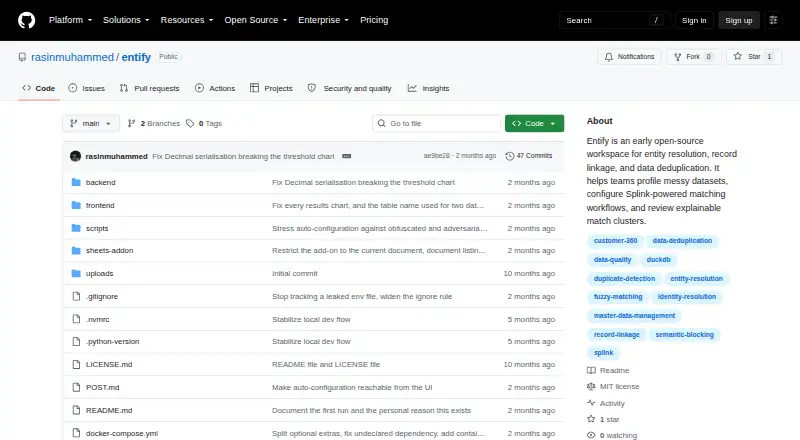
What Entify is
Entify is an open-source workspace for linking records, resolving entities, and deduplicating datasets. It uses Splink 4 and DuckDB to identify matches and present clusters for review. Automatic setup examines likely column types, recommends blocking rules, and explains its choices, which users can change. It reads CSV, TSV, Parquet, JSON, and Excel files, and reports row counts, distinct values, and column completeness. Matching options include exact, Jaro-Winkler, Jaccard, and Levenshtein comparisons. Users can inspect match evidence and threshold analyses, export a merged dataset with source IDs retained, and create PDF audit reports. Its Docker quickstart can run locally without accounts, API keys, or external services; the README says uploaded data stays on the machine. Optional sign-in and shared storage use Clerk and Supabase. Entify is free under an MIT license and can run as a web app, API, or self-hosted software. Uploads have a 100 MB default cap, and the engine is memory-bound beyond roughly 100,000 rows.
Good
- Automatic setup proposes blocking rules and explains decisions.
- Reads five listed tabular and data file formats.
- Exports retain source IDs for traceable merges.
- Local Docker quickstart needs no accounts or API keys.
Watch out
- Uploads have a 100 MB default cap.
- Workloads beyond roughly 100,000 rows are memory-bound.
- The backend API has no authentication.
- A second concurrent run replaces the first result.
Who it suits
Entify is suited to data stewards and teams that need record linkage without specialist experience. It may also suit teams that want to run the workflow locally with Docker.
Verdict
Entify offers guided matching, review, and auditable export for deduplication work. Its upload and memory limits, plus the unauthenticated API, are important deployment constraints.
Plans and prices
From Entify's own pricing page, checked 9 Oct 2026.
| Plan | Price | What it gives you |
|---|---|---|
| Open-source | Free | Early open-source project; uploads capped at 100 MB by default; one resolution result held in memory at a time |
The facts
Each one read from Entify's own pages, with the date it was checked.
What it does
- API security
- The README says the backend API has no authentication and assumes it is bound to localhost.checked 4 Oct 2026
- Automatic setup
- Its auto-configuration reads CSV columns, infers their roles, proposes blocking rules, and explains its decisions.checked 9 Oct 2026
- Concurrency limitation
- Only one resolution result is held in memory at a time, so a second concurrent run replaces the first.checked 9 Oct 2026
- Data formats
- It reads CSV, TSV, Parquet, JSON, and Excel files.checked 4 Oct 2026
- Deployment
- It can run locally with Docker or with Python 3.11+ and Node 20+; the README identifies FastAPI, Splink 4, DuckDB, and Next.js in its stack.checked 9 Oct 2026
- Export
- Its merge export produces one surviving record per entity and retains source IDs so merges can be traced or undone.checked 9 Oct 2026
- File formats
- It reads CSV, TSV, Parquet, JSON, and Excel files.checked 9 Oct 2026
- Integrations
- Optional sign-in and shared storage use Clerk authentication and Supabase persistence.checked 9 Oct 2026
- Intended users
- The project describes itself as intended to make record linkage usable by data stewards and teams without specialist record-linkage expertise.checked 4 Oct 2026
- License
- The repository lists an MIT license.checked 4 Oct 2026
- Limits
- Uploads have a 100 MB cap, and the README describes the engine as memory-bound beyond roughly 100,000 rows.checked 4 Oct 2026
- Local operation
- The README says the default Docker quickstart requires no accounts, API keys, or external services, and uploaded data stays on the machine.checked 9 Oct 2026
- Matching
- It supports exact, Jaro-Winkler, Jaccard, and Levenshtein comparisons, with semantic blocking available as an optional extra.checked 9 Oct 2026
- Matching engine
- It uses Splink 4 and DuckDB to match records and review explainable clusters.checked 4 Oct 2026
- Optional semantic blocking
- Semantic blocking is optional and requires an additional install that downloads roughly 600 MB of Torch dependencies.checked 4 Oct 2026
- Profiling
- It reports row counts, distinct values, and completeness for each column.checked 9 Oct 2026
- Purpose
- Entify is an early open-source workspace for entity resolution, record linkage, and data deduplication.checked 9 Oct 2026
- Review and audit
- It offers score and threshold analysis, match evidence charts, and PDF audit reports.checked 9 Oct 2026
- Review and export
- Users can inspect match evidence and threshold analyses, export deduplicated data, and generate a PDF audit report.checked 4 Oct 2026
- Scale limitation
- Uploads are read fully into memory with a 100 MB default cap, and the README says workloads past roughly 100,000 rows need a DuckDB file backend and job queue.checked 9 Oct 2026
- Security limitation
- The API has no authentication and assumes it is bound to localhost; the README warns against exposing it to untrusted callers as-is.checked 9 Oct 2026
- Target users
- The README describes the project as intended to make record linkage usable by people who do not already understand blocking rules and match weights.checked 9 Oct 2026
The full review of Entify
Overview
Entify is a free, open-source tool for finding and resolving duplicate records in messy datasets. It best suits data stewards and small teams who want guided record matching without having to design the process from scratch. Its explainable review and traceable exports are useful strengths, though its modest workload ceiling and local-only security assumption shape where it belongs.
Key features
Entify profiles columns by row count, distinct values, and completeness, then proposes likely column types and blocking rules with explanations users can override. That guidance makes a specialist workflow more approachable while preserving control over matching decisions. Under the hood, Splink 4 and DuckDB support exact, Jaro-Winkler, Jaccard, and Levenshtein comparisons.
Reviewers can inspect match evidence, score and threshold analyses, and charts before deciding which clusters to merge. The merge export keeps one surviving record per entity and retains source IDs, making changes traceable or reversible; PDF audit reports provide a record of the work. CSV, TSV, Parquet, JSON, and Excel support covers common data exchange needs.
Semantic blocking is available as an optional add-on, but installing it downloads roughly 600 MB of Torch dependencies. That extra footprint makes it a poor fit for teams that only need the standard comparison methods.
Pricing
Entify is open source under the MIT license. Its Open-source plan costs nothing, with uploads capped at 100 MB by default and only one resolution result held in memory at a time. There is no paid tier in the plan information; teams that need larger uploads or concurrent runs will need to account for the engineering work those limits imply.
Platforms
Entify is available as a web application, an API, or self-hosted software. The Docker quickstart runs locally without accounts, API keys, or external services, and uploaded data stays on the machine. Python 3.11+ and Node 20+ are also supported for local deployment. Optional sign-in and shared storage use Clerk and Supabase.
The API has no authentication and assumes it is bound to localhost. It should not be exposed to untrusted callers as-is. Uploads are read fully into memory, and the README describes the engine as memory-bound beyond roughly 100,000 rows; larger workloads call for a DuckDB file backend and job queue. A second concurrent resolution run replaces the first result, so this is not a shared service for parallel team jobs without additional work.
Who it's for
Entify is a sensible starting point for data stewards and teams new to record linkage who want suggestions, explanations, and a review step rather than opaque automatic merges. It also suits developers comfortable with local deployment who need a free, auditable workflow for modest datasets. Organizations handling larger files, concurrent workloads, or untrusted API traffic should choose a system with the capacity and access controls their deployment requires.
Pros and cons
- Pros: Guided setup explains proposed columns and blocking rules, which lowers the learning burden while allowing overrides.
- Pros: Evidence review, threshold analysis, source-ID retention, and PDF reports make merge decisions easier to inspect and trace.
- Pros: Local Docker operation needs no external services, and the MIT license allows open-source use.
- Cons: The 100 MB upload cap and memory-bound behavior around 100,000 rows constrain dataset size.
- Cons: Only one result can remain in memory, so concurrent runs overwrite one another.
- Cons: The unauthenticated API is unsafe to expose to untrusted callers without additional protections.
- Cons: Optional semantic blocking adds a roughly 600 MB Torch installation.
Alternatives
Choose Tilores if a local deployment handling up to 100,000 records and support for person and company matching better fit the job. DupeCatcher is a free option for readers who want its Android, iOS, or web availability and all features included. For research use with small or medium-sized files, Python Record Linkage Toolkit is another free, self-hosted choice.
Plauti Deduplicate offers a free Salesforce version, with a trial or custom pricing for the full edition. pyJedAI is a free research project from the University of Athens' AI team. Splink is a free MIT-licensed Python package for Linux and self-hosted use. AWS Entity Resolution is a paid data service billed per 1,000 records processed, with provider licensing or subscriptions costing extra. Koalify has a free sandbox or demo option and a Pro plan at $25 a month, billed annually.
See our Data Deduplication Software ranking for more options.
Verdict
Entify is a strong fit for data stewards and small teams who want guided, explainable deduplication with an audit trail and local operation. Its free MIT-licensed package makes that workflow accessible, but the memory ceiling and single-result behavior limit scale, while the unauthenticated API rules out exposing it to untrusted traffic as-is. Choose it for modest, locally run jobs; look elsewhere for larger datasets, concurrent runs, or an API that needs to face external users.
Getting started
- Open the Entify GitHub repository.
- Run the Docker quickstart locally, or use Python 3.11+ and Node 20+.
- Upload a CSV, TSV, Parquet, JSON, or Excel dataset.
- Review the suggested column types, blocking rules, and matching results.
- Inspect evidence and thresholds, then export deduplicated data or a PDF audit report.
Limits worth knowing
Uploads are capped at 100 MB by default, and the README describes the engine as memory-bound beyond roughly 100,000 rows. Only one resolution result is held in memory; another run replaces it. Optional semantic blocking requires an additional install that downloads roughly 600 MB of Torch dependencies.
Questions
How much does Entify cost?
It is free and open source under an MIT license.
Can Entify run locally?
Yes. Its Docker quickstart runs locally without accounts, API keys, or external services, and uploaded data stays on the machine.
Which data formats can it read?
It supports CSV, TSV, Parquet, JSON, and Excel files.
Does it require sign-in or shared storage?
No for the Docker quickstart or demo mode. Optional sign-in and shared storage use Clerk authentication and Supabase persistence.
Does Entify have an API?
Yes, but the backend API has no authentication and assumes it is bound to localhost. The README warns against exposing it to untrusted callers as-is.
Alternatives to Entify
- 1

Zingg
Free planOpen sourceAPILinuxmacOSSelf-hosted7.4Free plan - 2

Tilores
Free planWebAPILinuxmacOS7.2Free plan - 3

Workbooks
AndroidiOSWeb6.9From $47 a month - 4

DataMatch Enterprise
WebAPILinuxSelf-hosted6.8 - 5
Senzing Entity Resolution
WebAPILinuxmacOS6.7From $58,560 a year - 6
DupeCatcher
Free planAndroidiOSWeb6.6Free plan