Senzing Entity Resolution
Senzing Entity Resolution turns fragmented records into entities and identifies relationships that can support fraud, compliance, and AI systems.
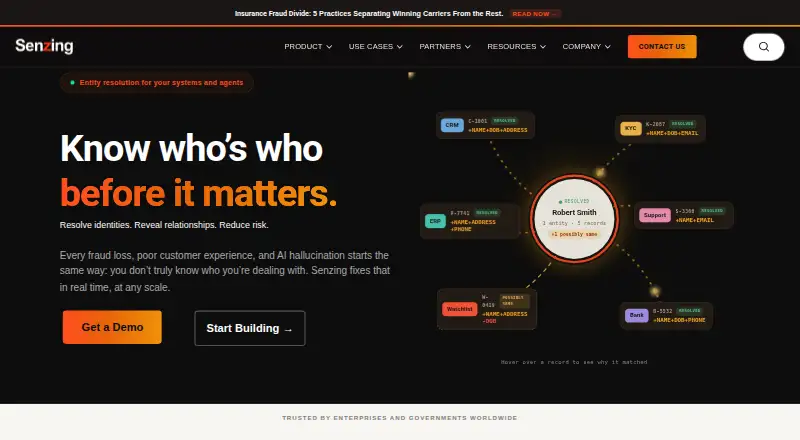
What Senzing Entity Resolution is
Senzing Entity Resolution turns fragmented records into entities and identifies relationships that can support fraud, compliance, and AI systems. Its engine is described as real-time, self-tuning, self-correcting, and relationship-aware, without custom training or tuning. Senzing says it starts in under one second and scales from tens to billions of records within a customer's infrastructure. Resolution decisions can include an audit trail explaining why records matched, the features involved, and a confidence score. The company says the software runs inside customer infrastructure and that data does not flow to Senzing, Inc. Deployment options include bare metal, Docker, Kubernetes, private cloud, AWS, Azure, and air-gapped environments. Integrations include Python, Java, C#, Rust, Node.js, and an MCP server. It is also available through AWS Marketplace and Microsoft Marketplace, processing JSON requests and responses in real time. The SDK download includes a free license for 500 source records; the AWS Marketplace free trial covers 250,000. A listed paid subscription costs $58,560 a year for 10M DSRs, based on upfront payment for the full term, and includes support.
Good
- Runs within customer infrastructure.
- Resolution decisions include an explanatory audit trail.
- Supports deployment in air-gapped environments.
- SDK evaluation license covers 500 source records.
- Paid subscriptions include support.
Watch out
- SDK license covers only 500 source records.
- Paid plan costs $58,560 a year.
- Full-term payment is required upfront for listed pricing.
Who it suits
Senzing suits organizations in financial services, healthcare, public sector, insurance, and technology that need entity resolution for fraud, compliance, or AI systems. It is also intended for agentic AI use.
Verdict
Senzing focuses on resolving records while retaining processing within the customer's infrastructure and documenting match decisions. The free evaluation licenses have record limits, and the listed 10M DSR subscription requires a substantial upfront annual payment.
Plans and prices
From Senzing Entity Resolution's own pricing page, checked 4 Oct 2026.
| Plan | Price | What it gives you |
|---|---|---|
| Senzing Subscription Pricing — 10M DSRs | $58,560 a year | 10M DSRs · support included at no additional charge · $58,560 per year; prices are based on upfront payment for the full term. |
The facts
Each one read from Senzing Entity Resolution's own pages, with the date it was checked.
Money
- AWS trial limit
- The AWS Marketplace free trial provides a free license for 250,000 source records.checked 4 Oct 2026
What it does
- Cloud marketplaces
- Senzing is available through AWS Marketplace and Microsoft Marketplace and processes JSON requests and responses in real time.checked 4 Oct 2026
- Data privacy
- Senzing says its software runs in the customer’s infrastructure and data does not flow to Senzing, Inc.checked 4 Oct 2026
- Deployment
- The maker lists bare metal, Docker, Kubernetes, private cloud, AWS, Azure, and air-gapped deployment options.checked 4 Oct 2026
- Evaluation license
- The SDK download includes a free license for 500 source records, and the maker says an evaluation license is needed to try more than 500 records.checked 4 Oct 2026
- Explainability
- The homepage says resolution decisions include an audit trail showing why records matched, the features involved, and a confidence score.checked 4 Oct 2026
- Integrations
- Senzing lists Python, Java, C#, Rust, Node.js, and an MCP server for connecting the engine to applications and AI agents.checked 4 Oct 2026
- Purpose
- Senzing resolves fragmented records into entities and reveals relationships between them for fraud, compliance, and AI systems.checked 4 Oct 2026
- Resolution
- The engine is described as real-time, self-tuning, self-correcting, and relationship-aware, without requiring custom training or tuning.checked 4 Oct 2026
- Scale and speed
- Senzing says the engine boots in under one second and scales from tens to billions of records inside the customer’s infrastructure.checked 4 Oct 2026
- Support
- Senzing says support is included with paid subscriptions at no additional charge and is free.checked 4 Oct 2026
- Supported databases
- The v4 requirements list AWS Aurora PostgreSQL, AWS RDS for PostgreSQL, Azure SQL, Microsoft SQL Server, MySQL, Oracle, PostgreSQL, and SQLite, with record-count notes for MySQL and SQLite.checked 4 Oct 2026
- Supported operating systems
- The v4 requirements list Amazon Linux, Debian, macOS on Apple Silicon, Red Hat, Ubuntu LTS, and Windows x86-64.checked 4 Oct 2026
- Who it serves
- The maker describes use across financial services, healthcare, public sector, insurance, technology, and agentic AI.checked 4 Oct 2026
The company
- Founded
- 2017checked 28 Sep 2026
The full review of Senzing Entity Resolution
Senzing Entity Resolution links fragmented records into entities and relationships for fraud, compliance and AI systems. It suits teams that need entity matching inside their own infrastructure, especially where auditability and data control matter. Its strongest case is a real-time, relationship-aware engine; its clearest trade-off is a paid subscription priced around a substantial annual commitment.
Overview
Senzing is built to identify when records refer to the same entity and to surface relationships among those entities. The maker describes the engine as self-tuning and self-correcting, without custom training or tuning—a useful distinction for organizations that need matching without building a bespoke model first.
Decisions come with an audit trail identifying why records matched, which features contributed and a confidence score. That makes the results more reviewable for compliance and operational workflows than a match output without an explanation. Senzing also says processing stays in the customer's infrastructure and data does not flow to the company, a strong fit for sensitive datasets.
Key features
- Real-time, relationship-aware resolution: The engine is designed to resolve records and reveal links between entities, supporting use in fraud, compliance and AI systems. Fuzzy matching and duplicate prevention are also included.
- Scale within customer infrastructure: Senzing says it can scale from tens to billions of records and boots in under one second. These are maker claims, but they point to a product intended for both small evaluations and large operational datasets.
- Auditable matching: Match explanations, contributing features and confidence scores help teams inspect decisions rather than treating identity resolution as a black box.
- Flexible deployment and integration: Deployment options include bare metal, Docker, Kubernetes, private cloud, AWS, Azure and air-gapped environments. Integrations include Python, Java, C#, Rust, Node.js and an MCP server for applications and AI agents.
- Marketplace access: AWS Marketplace and Microsoft Marketplace availability, with real-time JSON requests and responses, gives teams another way to connect the engine to existing cloud workflows.
Version 4 requirements cover Amazon Linux, Debian, macOS on Apple Silicon, Red Hat, Ubuntu LTS and Windows x86-64. Supported databases include AWS Aurora PostgreSQL, AWS RDS for PostgreSQL, Azure SQL, Microsoft SQL Server, MySQL, Oracle, PostgreSQL and SQLite; MySQL and SQLite have record-count notes in the requirements.
Pricing
Senzing is paid software, with free evaluation routes rather than a general free plan for ongoing use. The SDK download includes a free license for 500 source records; trying more than 500 requires an evaluation license. The AWS Marketplace free trial provides a license for 250,000 source records, a substantially larger evaluation ceiling for teams that can use that route.
Senzing Subscription Pricing — 10M DSRs: $58,560 a year, billed $58,560 per year. The price is based on upfront payment for the full term and includes 10M DSRs and support at no additional charge. This is a defined capacity and a significant annual outlay, so it is better suited to organizations with a clear production requirement than to exploratory projects. Support is included with paid subscriptions at no additional charge and is free.
Platforms
Senzing supports API, Linux, macOS, self-hosted, web and Windows environments. Its range of deployment models, operating systems and database options makes it adaptable to varied infrastructure, including air-gapped installations. Teams should still check the supported v4 operating-system and database requirements against their intended setup, particularly the record-count notes for MySQL and SQLite.
Who it's for
The product is aimed at organizations working with fragmented identity data in financial services, healthcare, public sector, insurance and technology, as well as teams building agentic AI systems. Its combination of relationship awareness, decision-level explanations and customer-side processing is most compelling where records are sensitive and matches need to be reviewable. It is a less natural fit for readers seeking a free, ongoing service or an inexpensive entry point at large scale.
Pros and cons
Pros
- Data remains in the customer's infrastructure: A meaningful advantage for sensitive or tightly controlled data.
- Explainable match decisions: Audit trails, contributing features and confidence scores support review and accountability.
- Broad deployment and language options: From air-gapped environments to cloud marketplaces, plus several programming-language integrations, it can fit different technical estates.
- Large evaluation option: The AWS trial license covers 250,000 source records, well beyond the SDK's 500-record license.
Cons
- Production pricing is a major commitment: The 10M DSR subscription costs $58,560 a year and requires upfront payment for the full term.
- The SDK evaluation is tightly capped: Its 500-source-record license is too small for meaningful larger-scale evaluation without obtaining another evaluation license.
- Infrastructure fit requires checking: Database and operating-system support is specific, and MySQL and SQLite carry record-count notes.
Alternatives
Splink is the better starting point for teams wanting a free, open-source Python package installable through pip or conda, rather than a paid subscription. Zingg offers a free open-source community option for batch probabilistic matching across millions of records; consider it when that batch-oriented approach fits better.
Data Ladder is worth considering when cleansing, fuzzy matching, name verification and standardization libraries are central to the requirement. Quantexa Entity Resolution is another paid, API, self-hosted and web-based option. Tamr may suit teams comparing a subscription with volume-based golden-record fees and API capacity priced per data product.
Informatica Identity Resolution is a paid option for Linux, self-hosted and Windows environments, licensed or subscribed per CPU core and requiring a separately licensed or subscribed Identity Resolution Population. Precisely Data Matching and Entity Resolution is another paid option spanning Linux, self-hosted, web and Windows. Verato Universal MPI offers API and web access, with a Starter plan for referential matching and duplicate resolution.
For broader browsing, see Identity Resolution Software, Data Deduplication Software and Customer Data Quality Software.
Verdict
Senzing is a strong choice for organizations that need explainable, relationship-aware entity resolution while keeping processing and data inside their own infrastructure. Its deployment breadth and integration options reinforce that case, but the 10M DSR plan's upfront annual price makes it difficult to justify without a defined production-scale need. Choose it when privacy, auditability and scale outweigh cost; look elsewhere if a free ongoing option or a lower-commitment route is the priority.