
EJBCA
EJBCA is open-source PKI and Certificate Authority software for managing certificates, registration, enrollment, and validation.
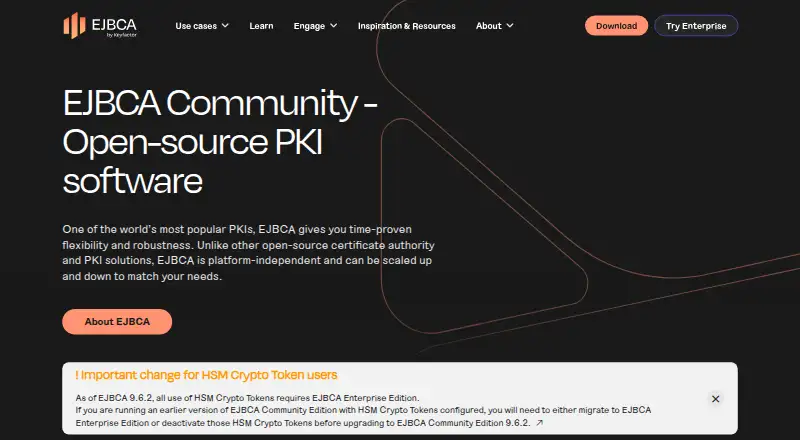
What EJBCA is
EJBCA is open-source PKI and Certificate Authority software for managing certificates, registration, enrollment, and validation. A single installation can serve multiple separated PKIs through its CA, RA, and VA modules. Certificate validation uses OCSP and CRL, while enrollment options include CMP, SCEP, EST, ACME, SOAP API, and REST APIs. Community Edition can be deployed with Helm, as a container, or from source, and Helm or Ansible playbooks can automate installation and configuration. EJBCA is presented for internal PKIs, DevOps workflows, industrial environments, IoT devices, and national eIDs. Community is free under LGPL version 2.1 or later for learning, testing, and prototyping, but is not intended for production because it lacks audit, compliance, SLA, high availability, and security capabilities needed for production workloads. Enterprise adds advanced PKI functionality, deployment options, and professional support with an SLA. A 30-day Enterprise trial is available through AWS or Azure marketplaces; Enterprise pricing requires contacting Keyfactor.
Good
- One installation can support multiple separated PKIs.
- Certificate validation includes OCSP and CRL.
- Deployment supports Helm, containers, or source.
- Helm and Ansible can automate configuration.
- Community Edition is free and open source.
Watch out
- Community Edition is not intended for production.
- Community lacks audit, compliance, SLA, and high availability.
- Enterprise pricing requires contacting Keyfactor.
Who it suits
EJBCA suits teams managing PKI for internal systems, DevOps, industrial environments, IoT devices, or national eIDs. Community is for learning, testing, and prototyping; production users should consider its stated limitations and Enterprise support offering.
Verdict
EJBCA Community provides a free route to PKI learning and prototyping, with several deployment and enrollment options. Its stated production limitations make the edition choice an important consideration.
Plans and prices
From EJBCA's own pricing page, checked 14 Oct 2026.
| Plan | Price | What it gives you |
|---|---|---|
| EJBCA Community Edition | Free | open-source · learning, testing and prototyping · non-production |
| EJBCA Enterprise Cloud trial | Free | 30 days · AWS or Azure Marketplace · usage-based charges after trial |
| EJBCA Enterprise trial | Free | Enterprise edition functionality · 30-day free trial on AWS or Azure marketplaces |
| EJBCA PKI SaaS | £62,065 a year | public cloud · ACME, SCEP, CMP and EST · 24x7x365 support · £62,065 a licence a year |
| EJBCA Enterprise | Priced on request | advanced PKI · enterprise support and SLA · appliance, cloud and SaaS deployment options |
The facts
Each one read from EJBCA's own pages, with the date it was checked.
What it does
- Algorithms
- Supported cryptography includes RSA, ECDSA, Ed25519, Ed448 and post-quantum ML-DSA, ML-KEM, SLH-DSA and composite algorithms.checked 14 Oct 2026
- API security
- The certificate-management REST service is disabled by default and uses client-certificate authentication when enabled.checked 14 Oct 2026
- Automation
- Official materials provide Helm charts and Ansible playbooks for automated deployment and configuration.checked 14 Oct 2026
- Certificate validation
- EJBCA supports certificate validation through OCSP and CRL functionality.checked 8 Oct 2026
- Deployment
- Community Edition can be deployed with Helm, as a container, or from source; the download page links Docker Hub, Artifact Hub, and GitHub.checked 8 Oct 2026
- Deployment choices
- Documented deployment types are SaaS, AWS and Azure cloud, software appliance, hardware appliance, container set and software stack.checked 14 Oct 2026
- Documentation
- The official documentation includes concepts, installation, operations, integration guides, tutorials, troubleshooting, release notes and supported-version information.checked 14 Oct 2026
- Enrollment protocols
- Documented enrollment protocols include ACME, EST, Microsoft auto-enrollment and SCEP.checked 14 Oct 2026
- Integrations
- The comparison lists HSM and crypto-token support, including PKCS#11-based and REST API-based key vault integration, AWS CloudHSM, and AWS KMS.checked 8 Oct 2026
- Intended users
- EJBCA is presented for securing industrial environments, IoT devices, national eIDs, DevOps workflows, and internal PKIs.checked 8 Oct 2026
- Kubernetes requirements
- The container deployment documentation requires Kubernetes 1.32 or newer and Helm 3 or newer, plus a supported database and HSM for non-ephemeral production instances.checked 14 Oct 2026
- Licence
- EJBCA Community is open source under LGPL version 2.1 or later; dependencies use licenses including Apache 2.0, BSD, MIT and EPL.checked 14 Oct 2026
- License
- EJBCA Community is released under LGPL version 2.1 or later.checked 8 Oct 2026
- Limit: administration
- G2 reviewers say initial configuration and administration can be difficult for organizations with limited PKI experience.checked 14 Oct 2026
- Limit: installation
- A SourceForge reviewer reported installation errors while deploying EJBCA 6 with Ant.checked 14 Oct 2026
- Limit: operations and reporting
- G2 reviewers cite weak log visualization, cumbersome OCSP configuration, limited reporting and insufficient troubleshooting or training material.checked 14 Oct 2026
- Limit: user interface
- G2 reviewers report a complicated, inconsistent and user-unfriendly interface despite extensive configuration options.checked 14 Oct 2026
- Management protocols
- EJBCA provides CMP, a certificate-management REST interface and SOAP web services for certificate administration.checked 14 Oct 2026
- Notable news: investment
- Keyfactor announced a strategic growth investment of more than $1 billion led by Summit Partners on 6 July 2026.checked 14 Oct 2026
Where it runs
- Application servers
- EJBCA targets JEE 10 compliant servers, while the actively documented and supported platforms are WildFly and JBoss EAP.checked 14 Oct 2026
The company
- Company facts
- LinkedIn lists Keyfactor as privately held, founded in 2001, headquartered in Independence, Ohio, with 501–1,000 employees.checked 14 Oct 2026
- Company legal name
- Crunchbase lists Keyfactor's legal name as Certified Security Solutions Inc., also known as CSS.checked 14 Oct 2026
- Company relationship
- EJBCA is a registered trademark owned by PrimeKey Solutions AB, a wholly owned subsidiary of Keyfactor Inc.checked 8 Oct 2026
- Founded
- 2001checked 23 Sep 2026
The full review of EJBCA
EJBCA is open-source PKI and Certificate Authority software for organizations that need to issue, manage, and validate certificates across separate trust domains. It is best suited to infrastructure, IoT, industrial, identity, and DevOps teams comfortable operating self-hosted security services. Community Edition is a strong learning and prototyping platform, while production deployments call for the Enterprise edition and its accompanying safeguards and support.
Overview
One EJBCA installation can contain multiple secure, independent PKIs built from certificate authority (CA), registration authority (RA), and validation authority (VA) modules. That arrangement is valuable when business units, device fleets, or environments must keep their trust relationships separate without maintaining entirely unrelated installations. OCSP and certificate revocation lists (CRLs) provide status checking, and revocation workflows are part of the platform.
The project has existed since 2001. EJBCA Community is released under LGPL version 2.1 or later. The EJBCA trademark belongs to PrimeKey Solutions AB, a wholly owned subsidiary of Keyfactor Inc.
Key features
Enrollment and validation
Community and Enterprise support enrollment through CMP, SCEP, EST, ACME, SOAP API, and REST APIs. The protocol range makes EJBCA adaptable to device provisioning, infrastructure automation, and application-led issuance instead of forcing every workflow through one interface. OCSP and CRL support means the system also handles post-issuance status validation, not merely certificate creation.
Deployment and automation
Community Edition can run through Helm, as a container, or from source. Helm and Ansible playbooks can automate installation and configuration, which suits teams integrating PKI into repeatable infrastructure processes. Linux, web, API, and self-hosted operation are supported; this is infrastructure software rather than a desktop certificate manager.
Keys, integrations, and audit
The Enterprise and Community comparison includes HSM and crypto-token integrations, PKCS#11 and REST API key-vault integration, AWS CloudHSM, and AWS KMS. The comparison also identifies Common Criteria certification and audit logging to file, database, or syslog, while several advanced security and compliance capabilities are Enterprise features. That distinction matters for regulated or externally audited deployments.
Pricing
| Plan | Price | What it includes |
|---|---|---|
| EJBCA Community Edition | free | Free open-source basic PKI functionality for learning, testing, and prototyping; not intended for production use. |
| EJBCA Enterprise trial | free | 30-day free trial through AWS or Azure marketplaces with Enterprise edition functionality. |
| EJBCA Enterprise | Custom pricing | Advanced PKI functionality, multiple deployment options, and a support agreement with an SLA. |
Community is the sensible starting point for students, developers, and teams proving a PKI design, but its lack of production-grade audit, compliance, SLA, high availability, and security capabilities rules it out for critical live workloads. The 30-day marketplace trial is a practical way to assess Enterprise features before requesting a commercial quote. Enterprise is the appropriate purchase when availability commitments, professional support, or stronger compliance controls are requirements. Plans indicate automatic renewal, so trial and subscription terms should be checked before committing.
Platforms
EJBCA supports API, Linux, web, and self-hosted operation. Community deployment is available through Helm, containers, or source, with Docker Hub, Artifact Hub, and GitHub distribution paths. This breadth favors platform and security engineers managing their own runtime; readers seeking a turnkey hosted certificate service should look elsewhere.
Who it's for
Choose EJBCA Community for PKI education, lab environments, architecture work, and prototypes involving internal certificates, IoT devices, industrial systems, national eID concepts, or DevOps workflows. Choose Enterprise when those workloads move into production and require SLA-backed support, high availability, audit and compliance capabilities, or the advanced security functions reserved for that edition. It is a poor fit for users who need a simple consumer-facing certificate purchase or a fully managed service with no PKI operations burden.
Pros and cons
Pros
- Multiple independent PKIs in one installation help separate trust domains cleanly.
- CMP, SCEP, EST, ACME, SOAP, and REST enrollment cover a broad mix of device and automation workflows.
- Helm, containers, source deployment, and Ansible automation fit established infrastructure practices.
- OCSP, CRLs, and revocation workflows cover certificate lifecycle operations beyond issuance.
- The free LGPL Community edition provides a substantial environment for learning and prototyping.
Cons
- Community is explicitly unsuitable for production because key audit, compliance, SLA, availability, and security capabilities are absent.
- Community support is limited to best-effort GitHub Discussions, unlike Enterprise's professional SLA-backed support.
- Self-hosting places deployment and operational responsibility on the adopting team.
- Advanced compliance and security features require moving to custom-priced Enterprise.
Alternatives
Public Key Infrastructure Software and Certificate Management Software provide broader category comparisons.
- OpenCA PKI is another free, open-source PKI management option for Linux, macOS, self-hosted, and web environments.
- step-ca suits teams wanting a free, focused open-source authority with a single configured intermediate CA and offline root CA.
- Let's Encrypt is the better choice when free, publicly trusted Domain Validation certificates are the goal rather than operating an internal PKI.
- OpenXPKI offers a fully functional free Community Edition with Debian packages, example configuration, documentation, and mailing-list support.
- SecureW2 Cloud NAC is a paid, quote-based alternative for organizations seeking a broad device and network-access platform.
- XiPKI is a free open-source option for Linux, macOS, self-hosted, and API deployments.
- EZCA targets buyers who prefer a paid service with a free trial and a $200-per-CA monthly Basic plan.
- Boulder is free open source, but production use requires separate implementation and security work.
Verdict
EJBCA Community is a compelling free route for teams learning PKI or building a serious prototype, especially when multiple PKIs and varied enrollment protocols matter. Select Enterprise for production systems that need support, availability, auditability, and advanced security controls. Look elsewhere if you want a managed certificate service or a lightweight authority without the responsibility of self-hosting.
Getting started
- Open the EJBCA website
- Choose Community Edition or the Enterprise trial
- Deploy Community using Helm, a container, or source code
- Use Docker Hub, Artifact Hub, or GitHub for Community downloads
- Automate installation and configuration with Helm or Ansible playbooks
- Use the 30-day Enterprise trial through AWS or Azure marketplaces
Limits worth knowing
Community Edition is free for learning, testing, and prototyping but is not intended for production because it lacks audit, compliance, SLA, high availability, and required security capabilities. The Enterprise trial lasts 30 days; Enterprise pricing requires contacting Keyfactor.
Questions
Is EJBCA free?
EJBCA Community Edition costs nothing and is open source. Enterprise has a 30-day free trial, while Enterprise pricing requires contacting Keyfactor.
Which platforms does EJBCA support?
The listed platforms are API, Linux, self-hosted, and web.
What enrollment protocols are supported?
Listed protocols include CMP, SCEP, EST, ACME, SOAP API, and REST APIs.
Can EJBCA run multiple PKIs?
Yes. One installation can support multiple secure, separated, independent PKIs through CA, RA, and VA modules.
What support is available?
Enterprise includes professional support with an SLA. Community users can use GitHub Discussions on a best-effort basis.
Alternatives to EJBCA
- 1

Certify The Web
Free planWebAPILinuxmacOS7.7From $59 a year - 2

KeyTalk CKMS
AndroidiOSWebAPI7.7From €5 a month - 3
Let's Encrypt
Free planOpen sourceWebAPILinuxmacOS7.6Free plan - 4

ManageEngine Key Manager Plus
Free planWebAPILinuxSelf-hosted7.6From $475 a year - 5

GeoTrust
Free planWebAPILinuxWindows6.9From $2 a month - 6

ServiceNow Event Management
WebAPILinuxWindows6.5