step-ca
step-ca is an online Certificate Authority for managing X.509 and SSH certificates with automated issuance and renewal.
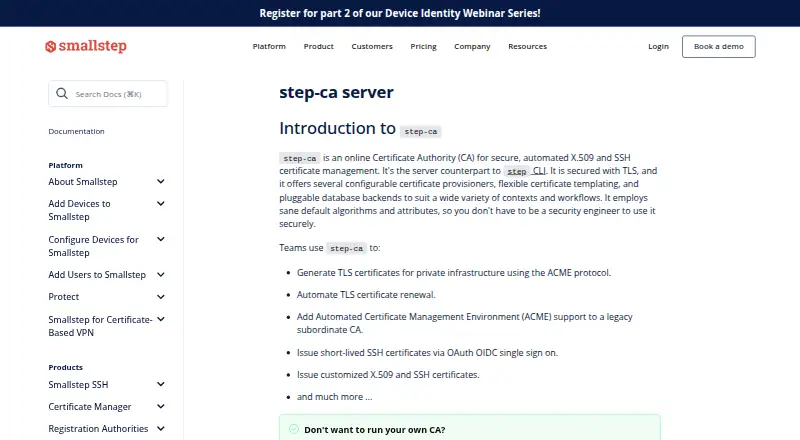
What step-ca is
step-ca is an online Certificate Authority for managing X.509 and SSH certificates with automated issuance and renewal. It issues X.509 certificates for TLS, mutual TLS authentication, document signing, and authentication, as well as SSH certificates for users and hosts. Provisioners can authorize issuance through ACME challenges, OIDC tokens, cloud instance identity documents, and short-lived JWK tokens. Templates can customize names and identifiers, restrict domains or key sizes, and create longer certificate chains. For signing-key protection, step-ca integrates with cloud key-management services, HSMs, TPM 2.0, and YubiKey PIV. Its designed architecture uses an offline root CA and a configured intermediate CA to issue end-entity certificates. Installation options include macOS, Windows, Linux, Kubernetes, and Docker. The open-source software is free, with community support through Discord and dedicated support contracts available from Smallstep. Documented limitations include limited active revocation, no certificate history or metrics, and no ACME External Account Binding.
Good
- Issues both X.509 and SSH certificates.
- Supports automated issuance and renewal.
- Integrates with HSMs and cloud key-management services.
- Offers installation options for macOS, Windows, Linux, Kubernetes, and Docker.
- Free and open source.
Watch out
- Active revocation is limited.
- No certificate history or metrics.
- No ACME External Account Binding.
- Open-source support is community-provided.
Who it suits
step-ca is positioned for DevOps teams managing certificates for VMs, containers, APIs, databases, Kubernetes workloads, and people. It may suit teams building a private CA with automated certificate workflows.
Verdict
step-ca provides a free private certificate authority with automation, identity-based provisioners, and multiple key-protection integrations. Its documented gaps include limited active revocation and missing certificate history and metrics, so check those limitations against your requirements.
Plans and prices
From step-ca's own pricing page, checked 30 Sep 2026.
| Plan | Price | What it gives you |
|---|---|---|
| step-ca (open source) | Free | single configured intermediate CA · offline root CA · authority-wide issuance policies · no Certificate Transparency integration · no ACME EAB |
| step-ca open source | Free | self-hosted two-tier CA · passive revocation · single intermediate CA |
| Smallstep Platform | Priced on request | ACME device attestation · SSH · certificate Wi-Fi · VPN/ZTNA · workload identity · certificate authority |
The facts
Each one read from step-ca's own pages, with the date it was checked.
What it does
- ACME server
- step-ca provides a private ACME server compatible with ACMEv2 clients and common HTTP-01, DNS-01 and TLS-ALPN-01 challenges.checked 14 Oct 2026
- API and SDK
- The project includes a Go wrapper and a command-line client, while a seamless infrastructure-as-code API is listed as a commercial-product feature.checked 14 Oct 2026
- Architecture
- step-ca is designed around a two-tier PKI with one offline root CA and one configured intermediate CA issuing end-entity certificates.checked 30 Sep 2026
- Automated renewal
- The system automates certificate enrollment and renewal and uses passive revocation for short-lived certificates.checked 14 Oct 2026
- Binary architectures
- Precompiled Linux binaries are published for amd64, arm64, armv6, armv7, mips, mips64, ppc64le and 386.checked 14 Oct 2026
- Certificate automation
- step-ca supports automated certificate issuance, renewal and passive revocation for clients, servers and Kubernetes workloads.checked 30 Sep 2026
- Database backends
- State storage supports embedded Badger and BoltDB plus MySQL and PostgreSQL key-value backends.checked 14 Oct 2026
- Databases
- Its configurable database backends include Badger, BoltDB, MySQL and PostgreSQL.checked 30 Sep 2026
- Documentation depth
- Official materials include command references, configuration, provisioners, templates, production guidance, renewal, revocation, integrations and tutorials.checked 14 Oct 2026
- Funding
- Crunchbase lists a private Series A and seven investors, including boldstart ventures and Upside Partnership.checked 14 Oct 2026
- Independent technical assessment
- DEV.co characterizes deployment complexity as moderate and documentation as strong, while noting that root-key protection remains the operator’s responsibility.checked 14 Oct 2026
- Installation
- Official installation options cover macOS Homebrew, Windows Winget or Scoop, Linux packages and binaries, Kubernetes and Docker.checked 30 Sep 2026
- Integrations
- Documented integrations include Kubernetes cert-manager, Envoy SDS, ACME clients, OIDC providers, PKCS#11, Google Cloud KMS, AWS KMS and YubiKey PIV.checked 14 Oct 2026
- Key algorithms
- Supported certificate key types include RSA, ECDSA and EdDSA, with configurable lifetimes.checked 14 Oct 2026
- Key protection
- It integrates with Google Cloud KMS, AWS KMS, Azure Key Vault, PKCS#11 HSMs, TPM 2.0 and YubiKey PIV for CA signing-key protection.checked 30 Sep 2026
- License
- The certificates repository is distributed under the Apache-2.0 license.checked 14 Oct 2026
- Limitations
- The project documents limited active revocation, limited legacy-protocol and device-attestation options, no certificate history or metrics, no dynamic SCEP and no ACME External Account Binding.checked 30 Sep 2026
- Limit: CA hierarchy
- Open-source step-ca supports one configured intermediate CA and does not support multiple issuing CAs or a single-tier PKI.checked 14 Oct 2026
- Limit: CLI-oriented workflow
- A self-hosted user describes issuing, downloading and revoking certificates through SSH and the CLI and seeks a phone-friendly interface.checked 14 Oct 2026
- Limit: data export
- There is no built-in easy data-export API, and embedded databases must be stopped before scripted export.checked 14 Oct 2026
- Limit: pricing
- G2 reviewers describe pricing as concerning or above budget, including a complaint that it is not free after 50 endpoints.checked 14 Oct 2026
- Limit: protocols
- The project documents limited legacy protocol support, no dynamic SCEP for Intune or Jamf and no ACME External Account Binding.checked 14 Oct 2026
The company
- Company facts
- LinkedIn lists Smallstep as privately held, founded in 2016, headquartered in San Francisco and employing 11–50 people.checked 14 Oct 2026
- Company legal name
- Crunchbase lists the legal entity as Smallstep Labs, Inc.checked 14 Oct 2026
The full review of step-ca
step-ca is a self-hosted private certificate authority for teams automating certificate use across infrastructure and people. It suits DevOps groups that can manage their own PKI and want a free, flexible issuing service. Its strongest case is broad X.509 and SSH coverage; its weaker fit is any environment that depends on active revocation or certificate-history reporting.
Overview
Its two-tier design keeps an offline root CA separate from the configured intermediate that issues end-entity certificates. That is a sensible foundation for routine automated issuance, but the free plan allows one configured intermediate, which constrains teams that need several independent issuing authorities.
step-ca issues X.509 certificates for TLS, mutual TLS, document signing and authentication, alongside SSH certificates for users and hosts. Single sign-on can provide short-lived SSH user certificates. It also automates issuance, renewal and passive revocation for clients, servers and Kubernetes workloads. The distinction between passive and active revocation matters: teams with demanding certificate-response workflows should not assume this replaces a fuller revocation system.
Key features
Provisioners authorize certificate issuance through ACME challenges, OIDC tokens, cloud instance identity documents from AWS, GCP and Azure, or short-lived JWK tokens. This range gives infrastructure teams several ways to tie issuance to existing identity and deployment processes rather than relying on a single credential model.
Templates can add custom SANs or OIDs, restrict domains or key sizes, and create longer certificate chains. Those controls are useful when certificate policy varies by workload, but step-ca still lacks certificate history and metrics, leaving teams without those built-in views for auditing issuance or monitoring activity.
For signing-key protection, integrations include Google Cloud KMS, AWS KMS, Azure Key Vault, PKCS#11 HSMs, TPM 2.0 and YubiKey PIV. The wider ecosystem covers ACME, SCEP, OIDC, cloud identity, Kubernetes cert-manager, Nebula and Envoy SDS. Configurable database backends include Badger, BoltDB, MySQL and PostgreSQL. The project also documents no dynamic SCEP and no ACME External Account Binding, and has limited legacy-protocol and device-attestation options; organizations relying on those specific capabilities should consider another fit.
Pricing
step-ca (open source): free. The plan includes one configured intermediate CA, an offline root CA and authority-wide issuance policies. It is a strong starting point for teams comfortable operating open-source infrastructure, with no paid tier or per-seat, quota, trial or renewal terms stated for this plan. It does not include Certificate Transparency integration or ACME EAB. Community support is provided through Discord; dedicated support contracts are available from Smallstep.
Platforms
step-ca supports API, Linux, macOS, Windows and self-hosted deployment. Official installation routes cover macOS Homebrew, Windows Winget or Scoop, Linux packages and binaries, Kubernetes and Docker. Its hybrid deployment model suits teams placing certificate services alongside their infrastructure, while the range of install paths supports both conventional hosts and containerized environments.
Who it's for
DevOps teams managing private certificates for VMs, containers, APIs, databases, Kubernetes pods and people are the clearest audience. It is particularly appropriate when automated issuance and renewal, cloud identity provisioners, and protected CA signing keys matter more than built-in history or metrics. Teams needing active revocation, extensive legacy protocol support, device attestation, dynamic SCEP or ACME EAB should assess those gaps before adopting it.
Pros and cons
- Pros: Free open-source plan combines X.509 and SSH issuance with automation across clients, servers and Kubernetes workloads.
- Pros: Multiple identity provisioners and KMS, HSM, TPM and YubiKey integrations support varied infrastructure and key-protection needs.
- Pros: Templates and configurable databases offer useful policy and deployment flexibility.
- Cons: One configured intermediate CA limits the free plan for organizations needing multiple issuing authorities.
- Cons: Limited active revocation and no certificate history or metrics weaken response and operational visibility.
- Cons: No Certificate Transparency integration or ACME EAB, alongside limited legacy-protocol and device-attestation options.
Alternatives
Public Key Infrastructure Software is the broader category to browse if step-ca's operating model or feature gaps do not match your needs.
SecureW2 Cloud NAC is a paid alternative with Android, iOS, web and desktop platform coverage; choose it if you want to compare a product sold through a quote process that asks about solution type, organization type and device count.
XiPKI is another free, open-source option with API, Linux, macOS and self-hosted platform support; consider it if you want to evaluate a different open-source PKI project.
EZCA suits buyers seeking a paid service with a free trial and a stated Basic plan at $200 a month, described as FIPS 140-3 Level 2 HSM-backed CAs.
Entrust Certificate Manager is a paid alternative for readers considering another certificate-management provider.
KeyTalk CKMS is worth comparing for readers considering paid key-management software with a free trial and a stated S/MIME on-premise plan at €5 a month per user.
HashiCorp Nomad offers a freemium option; consider it if you are comparing certificate-related needs alongside a product with self-managed and customizable enterprise plans.
Keyfactor Platform is a paid alternative with a free trial; its certificate lifecycle automation plan states no per-certificate fees and a deployment tested for more than 500 million certificates.
SSL.com Certificate Lifecycle Management is another freemium option to compare for API and web use.
Verdict
Choose step-ca if your team wants a free, self-hosted private CA that automates X.509 and SSH issuance and can integrate with existing identity and key-protection systems. Its focused two-tier model and broad integration range are compelling for infrastructure automation. Look elsewhere if active revocation, certificate history, metrics, multiple configured intermediates or the missing protocol features are central requirements.
Getting started
- Open the step-ca documentation site.
- Choose an installation route: macOS Homebrew, Windows Winget or Scoop, Linux packages or binaries, Kubernetes, or Docker.
- Configure an offline root CA and one intermediate CA for issuing end-entity certificates.
- Select a database backend such as Badger, BoltDB, MySQL, or PostgreSQL.
- Configure provisioners and certificate policies for your issuance workflow.
Limits worth knowing
The free plan provides a single configured intermediate CA and offline root CA, with authority-wide issuance policies. It has no Certificate Transparency integration or ACME External Account Binding; the project also documents limited active revocation and no certificate history or metrics.
Questions
How much does step-ca cost?
The open-source plan is free.
What certificate types does step-ca issue?
It issues X.509 certificates for TLS, mutual TLS, document signing, and authentication, as well as SSH certificates for users and hosts.
Which platforms and installation routes are available?
Options cover macOS Homebrew, Windows Winget or Scoop, Linux packages and binaries, Kubernetes, and Docker.
Does step-ca support ACME and SCEP?
Yes. ACME and SCEP are included in its integration ecosystem.
What is included in the free plan?
The plan includes one configured intermediate CA, an offline root CA, and authority-wide issuance policies.
Who provides support?
The open-source community provides support through Discord. Smallstep offers dedicated support contracts.
Alternatives to step-ca
- 1

EJBCA
Free planOpen sourceWebAPILinuxmacOS8.2From £62,065 a year - 2

KeyTalk CKMS
AndroidiOSWebAPI7.7From €5 a month - 3
Let's Encrypt
Free planOpen sourceWebAPILinuxmacOS7.6Free plan - 4
OpenCA PKI
Free planOpen sourceWebLinuxmacOSSelf-hosted7.4Free plan - 5
EZCA
AndroidiOSWebAPI7.0From $200 a month - 6
Google Cloud Secret Manager
Free planWeb6.5From $0.02 a month