DutyDuke
DutyDuke is an open-source HR management platform for small and mid-sized companies.
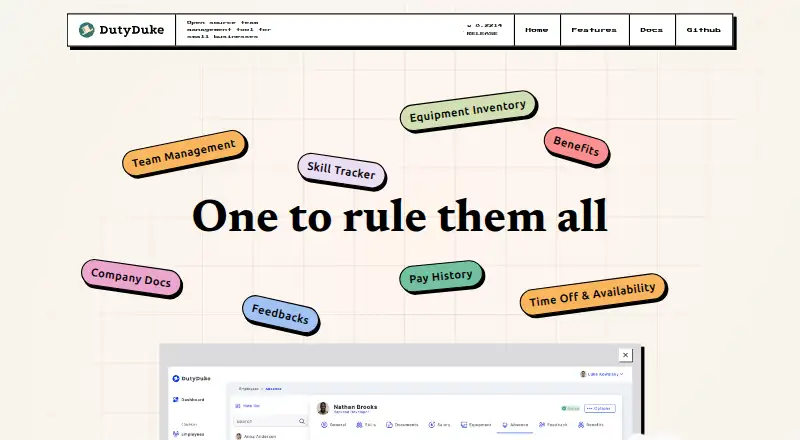
What DutyDuke is
DutyDuke is an open-source HR management platform for small and mid-sized companies. It can be used on the web or self-hosted, with a free plan listed as free. Employee records can hold skills, education, work history, documents, equipment, benefits, feedback, salary history, and absence information. The platform supports leave requests, approval workflows, a calendar, and iCal export. It also tracks company documents by version and deadline, and equipment by inventory and assignment. Additional tools cover benefit plans, performance feedback sessions, and PDF exports of employee profiles as CVs. Employee self-service, role-based permissions, and API access are available. Email notifications use configurable SMTP. Documentation describes field-level encryption for sensitive information, JWT authentication, and role-based access control. One setup constraint is that users cannot register themselves: an owner account must first be created with a command-line script.
Good
- Free open-source plan listed as free.
- Employee records cover skills, history, documents, and absences.
- Leave requests include approval workflows and iCal export.
- Role-based permissions and API access are available.
Watch out
- Self-registration is unavailable.
- The initial owner account requires a command-line script.
Who it suits
DutyDuke suits small and mid-sized companies seeking self-hosted or web-based HR tools. It may also suit teams that need employee self-service, leave workflows, and equipment or document tracking.
Verdict
DutyDuke brings employee records, leave handling, documents, and equipment into one HR platform. The initial account setup requires a command-line step.
Plans and prices
From DutyDuke's own pricing page, checked 2 Oct 2026.
| Plan | Price | What it gives you |
|---|---|---|
| Free open-source | Free | Free to use, extend, and contribute on GitHub |
The facts
Each one read from DutyDuke's own pages, with the date it was checked.
What it does
- Documents and equipment
- It includes company document management with version and deadline tracking, plus equipment inventory and assignment tracking.checked 2 Oct 2026
- Employee management
- Employee profiles can include skills, education, employment history, documents, equipment, benefits, feedback, salary history, and absence tracking.checked 2 Oct 2026
- Integrations
- Email notifications use configurable SMTP, and production configuration can point to providers such as Amazon SES, SendGrid, or Mailgun.checked 2 Oct 2026
- Notable limit
- Self-registration is unavailable; the initial owner account must be created through a command-line script.checked 2 Oct 2026
- Other HR features
- It supports benefit plans, performance feedback sessions, and PDF export of employee profiles as CVs.checked 2 Oct 2026
- Purpose
- DutyDuke is an open-source HR management platform for small and mid-sized companies.checked 2 Oct 2026
- Security
- The documentation describes field-level encryption for sensitive data, JWT authentication, and role-based access control.checked 2 Oct 2026
- Security configuration
- The maker advises using unique JWT and encryption keys per environment, strong production passwords, and TLS for production SMTP.checked 2 Oct 2026
- Support
- The maker invites users to contact Bitnoise at [email protected] with DutyDuke questions.checked 2 Oct 2026
- Time off
- The app supports leave requests, approval workflows, a calendar view, and iCal export.checked 2 Oct 2026
The company
- Founded
- 2009checked 28 Sep 2026
- Headquarters
- Poznań, Polandchecked 28 Sep 2026
- Maker
- DutyDuke was created by Bitnoise, which describes itself as a Poland-based software house.checked 2 Oct 2026
The full review of DutyDuke
DutyDuke is an open-source HR platform for small and mid-sized companies that want employee records, leave, documents and equipment in one self-hosted system. It suits organizations with technical staff who can manage deployment and configuration. The zero-price plan is compelling, but the command-line account bootstrap makes it less suitable for teams expecting instant, hosted signup.
Overview
Bitnoise, a Poland-based software house, created DutyDuke in 2009. The platform combines employee self-service, role-based permissions and API access, so staff can handle some of their own information while administrators control what each role can see or change. Its open-source license allows companies to use, extend and contribute to the project on GitHub, which is valuable when customization and ownership matter more than vendor-managed convenience.
That control also places operational responsibility on the customer. Self-registration is unavailable: the initial owner account must be created with a command-line script. A company without someone comfortable with that setup may be better served by a hosted HR product with a conventional web onboarding flow.
Key features
Employee records
Profiles can hold skills, education, employment history, documents, equipment, benefits, feedback, salary history and absence information. Bringing those categories into one record gives HR a broader view of each employee than a collection of disconnected spreadsheets. PDF export can turn a profile into a CV, while employee self-service reduces the need for administrators to enter every update themselves. Role-based access is important for sensitive salary and personnel data, although the organization must configure permissions appropriately.
Leave and absence
Employees can submit leave requests through approval workflows, and a calendar view makes absences easier to coordinate. iCal export extends that schedule into compatible calendar tools. This is a practical set for teams that need a traceable request process and shared visibility rather than merely a balance counter.
Documents and equipment
Company document management includes version and deadline tracking, helping teams distinguish current policies from older files and keep time-sensitive items visible. Equipment inventory and assignment tracking connect assets to the people using them, which is useful when laptops or other issued equipment must be accounted for during an employee’s tenure.
Additional HR controls
Benefit plans and performance-feedback sessions cover two recurring HR processes beyond core records and leave. Configurable SMTP handles email notifications and can be pointed at services such as Amazon SES, SendGrid or Mailgun. API access supports integration work for teams that need to connect DutyDuke with other systems.
Security
The platform documents field-level encryption for sensitive data, JWT authentication and role-based access control. Production guidance calls for separate JWT and encryption keys per environment, strong passwords and TLS for production SMTP. These controls are meaningful for a self-hosted deployment, but they also mean security configuration is part of the customer’s job rather than a turnkey service.
Pricing
| Plan | Price | What it includes |
|---|---|---|
| Free open-source | free | Free to use, extend and contribute on GitHub |
There is one plan and no per-seat charge stated. That makes DutyDuke particularly attractive to small and mid-sized companies that can provide their own hosting and administration. The trade-off is not a feature tier but responsibility: deployment, account initialization, security keys, passwords, TLS and ongoing operation remain with the organization. Support questions can be sent to Bitnoise at [email protected].
Platforms
DutyDuke is offered as self-hosted software with a web interface. It is suited to organizations that want control over where HR data runs; it is not presented as a native Android, iOS or desktop application.
Who it's for
Choose DutyDuke if your small or mid-sized company wants a broad HR foundation, needs to keep employee, leave, document and equipment data together, and has the technical capacity to host and secure open-source software. Its free licensing and API are strong reasons for an organization that values extensibility.
Look elsewhere if your priority is a managed service, a polished signup journey or vendor-owned infrastructure. The command-line creation of the first owner account is a concrete barrier for nontechnical administrators.
Pros and cons
Pros
- Broad employee profiles: skills, history, compensation, benefits, feedback, documents, equipment and absences can live together.
- Useful leave workflow: requests, approvals, a calendar and iCal export support both HR review and schedule visibility.
- Operational tracking: document versions and deadlines plus equipment assignments cover tasks often left to separate tools.
- Open and extensible: the free GitHub model, API access and configurable SMTP suit teams that want to adapt their system.
- Documented security controls: encryption, JWT authentication and role-based permissions provide a security foundation for self-hosting.
Cons
- Technical onboarding: no self-registration means the initial owner must be created through a command-line script.
- Self-hosting overhead: the customer must handle deployment and production security configuration, including keys, passwords and TLS.
- Limited platform reach: the offering is web and self-hosted rather than a stated mobile-native suite.
Alternatives
IceHrm is the closer open-source alternative if you also want attendance, clock-in/out, payroll, projects and timesheets, with Android, iOS, API, self-hosted and web platforms plus a free trial.
Zoho People is a better fit for a hosted cross-platform service; its free plan covers five users and it offers web, iOS and Android access.
SovoHR suits very small teams wanting a hosted web product, with a free Starter plan for one employee and paid tiers beginning at £19.99 a month.
Efalia HR ECM is an option for organizations that need a paid HR content-management deployment across a wider range of platforms.
Employment Hero is a paid, mobile-capable alternative with plans organized around AI video-interview volumes.
Leapsome is better for paid performance and compensation workflows, including a Compensation plan priced at €3 per employee per month.
MHR iTrent is a paid HR option sold through a demo-led process.
Sesame HR is a paid hosted alternative with mobile apps, a free trial and annual plans requiring at least 15 employees.
For a wider comparison of document-focused products, see the HR Document Management Software ranking.
Verdict
DutyDuke is a strong choice for a technically capable small or mid-sized company that wants a free, adaptable HR system covering records, leave, documents and equipment in one place. Its open-source model and breadth are the main reasons to choose it. Look elsewhere if command-line onboarding and self-managed security are unacceptable, because a hosted alternative will provide a simpler operational path.
Alternatives to DutyDuke
- 1

Zoho People
Free planAndroidiOSWebAPI8.3From $1.25 a month - 2

Employment Hero
AndroidiOSWebAPI7.8 - 3
IceHrm
Free planAndroidiOSWebAPI7.6From $12 a month - 4

Deputy
AndroidiOSWeb7.4From $5 a month - 5

SovoHR
Free planWebSelf-hosted7.3From £19.99 a month - 6
Leapsome
AndroidiOSWebAPI7.2From €3 a month