dplyr
dplyr is a free R package for manipulating data frames and tibbles through code.
What dplyr is
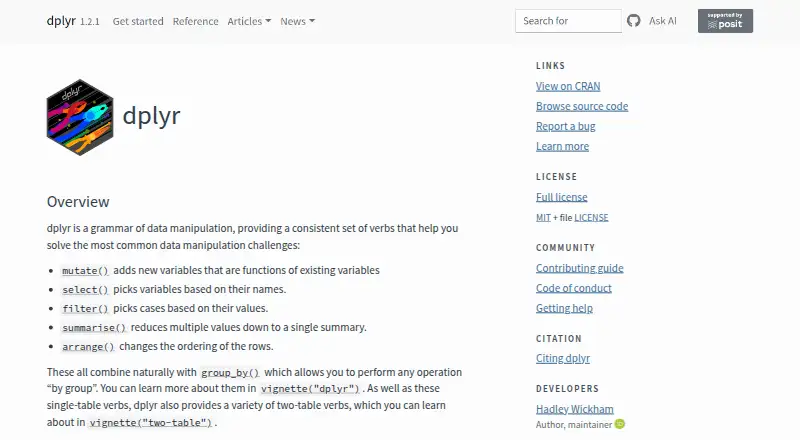
dplyr is a free R package for manipulating data frames and tibbles through code. Its core verbs cover common transformations: mutate() adds variables, select() chooses variables by name, filter() keeps cases by value, summarise() calculates summaries, and arrange() orders rows. Combine these operations with group_by() to work by group, or use two-table verbs to work with pairs of datasets. The across() helper applies operations across multiple columns, while rowwise() supports work performed a row at a time. The programming guide covers data masking, tidy selection, and using dplyr in functions or loops. For other data environments, dbplyr translates dplyr code into SQL for relational databases. The documented alternative backends also include Arrow for larger-than-memory data, dtplyr and duckplyr for large in-memory datasets, and sparklyr for very large datasets stored in Apache Spark. dplyr runs on Linux, macOS, and Windows and uses the MIT license. The CRAN package requires R version 4.1.0 or later. Installation guidance covers CRAN and a development version from GitHub using pak. The project directs bug reports to GitHub and questions or discussion to the Posit community forum.
Good
- Free package with an MIT license.
- Core verbs cover common data transformations.
- group_by() enables grouped operations.
- dbplyr translates code to SQL.
- Runs on Linux, macOS, and Windows.
Watch out
- Requires R version 4.1.0 or later.
- Transformations use a code-based interface.
- The development version is installed from GitHub.
Who it suits
dplyr suits people learning data transformation in R, as well as users who need code-based operations on data frames or tibbles. Its documented backends are relevant to users working with databases or larger datasets.
Verdict
dplyr offers a consistent set of R operations for transforming one or more datasets, with documented options for grouped work and alternative backends. Check the R version requirement and whether its code-based workflow matches your needs.
Plans and prices
From dplyr's own pricing page, checked 7 Oct 2026.
| Plan | Price | What it gives you |
|---|---|---|
| dplyr | Free | R package for data manipulation · MIT license |
The facts
Each one read from dplyr's own pages, with the date it was checked.
What it does
- Column operations
- The articles explain repeating an operation across multiple columns with across().checked 7 Oct 2026
- Core operations
- Its core verbs include mutate(), select(), filter(), summarise(), and arrange().checked 7 Oct 2026
- Data backends
- The documentation lists Arrow, dbplyr, dtplyr, duckplyr, and sparklyr as alternative backends.checked 7 Oct 2026
- Database backend
- dbplyr works with data stored in relational databases and translates dplyr code to SQL.checked 7 Oct 2026
- Database integration
- dbplyr translates dplyr code to SQL for data stored in a relational database.checked 7 Oct 2026
- Development version
- The development version can be installed from GitHub using pak.checked 7 Oct 2026
- Grouped data
- group_by() lets users perform operations by group.checked 7 Oct 2026
- Grouping
- The core verbs combine with group_by() to perform operations by group.checked 7 Oct 2026
- Installation
- The documentation provides instructions to install dplyr from CRAN or install its development version from GitHub.checked 7 Oct 2026
- Intended users
- The documentation recommends dplyr to people learning data transformation in R for Data Science.checked 7 Oct 2026
- Joins
- dplyr includes two-table verbs for working with pairs of data frames.checked 7 Oct 2026
- License
- The dplyr site identifies its license as MIT.checked 7 Oct 2026
- Multiple tables
- dplyr provides two-table verbs for working with multiple datasets.checked 7 Oct 2026
- Other backends
- The site lists Arrow for larger-than-memory data, dtplyr for large in-memory datasets, duckplyr for large in-memory datasets, and sparklyr for very large datasets stored in Apache Spark.checked 7 Oct 2026
- Programming
- The programming guide covers data masking and tidy selection, and programming with functions or for loops.checked 7 Oct 2026
- Purpose
- dplyr is a grammar of data manipulation with verbs for common data manipulation tasks.checked 7 Oct 2026
- Row operations
- The articles describe rowwise() for performing operations by row, including simulations and modelling within dplyr verbs.checked 7 Oct 2026
- R requirement
- The CRAN listing says dplyr depends on R version 4.1.0 or later.checked 7 Oct 2026
- Support
- The project directs bug reports to GitHub and questions or discussion to the Posit community forum.checked 7 Oct 2026
- Transformations
- Its core verbs add variables, select variables by name, filter cases by value, summarize values, and order rows.checked 7 Oct 2026
Where it runs
- Windows and macOS downloads
- CRAN lists Windows binaries and macOS binaries for dplyr.checked 7 Oct 2026
Alternatives to dplyr
- 1

Bruin for Customer Success
Free planOpen sourceWebAPIExtensionLinux8.2$0.01 usage-based - 2

Cube
Free planOpen sourceWebAPILinuxSelf-hosted7.9From $40 a month - 3

Apache Beam
Free planOpen sourceWebAPILinuxmacOS7.7Free plan - 4

Apache Hop
Free planOpen sourceWebAPILinuxmacOS7.7Free plan - 5

Coalesce Catalog
Free planWebAPIExtension7.5From $150 a month - 6

dbt Semantic Layer
Free planWebAPIExtension7.5From $100 a month