DPDFNet
DPDFNet is a free, open-source model for enhancing noisy single-channel speech in recordings, live streams, and edge-device applications.
What DPDFNet is
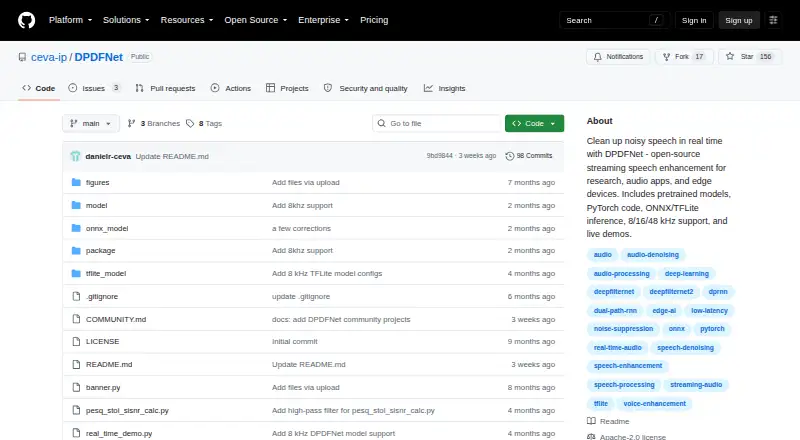
DPDFNet is a free, open-source model for enhancing noisy single-channel speech in recordings, live streams, and edge-device applications. It supports offline processing and streaming, with pretrained variants for 8, 16, and 48 kHz audio. The project extends DeepFilterNet2 with dual-path encoder blocks and an always-on fine-tuning approach designed to reduce over-attenuation. The repository includes PyTorch code and ONNX and TFLite inference models, plus command-line, Python, and stateful streaming interfaces. Streaming buffers about 20 ms before the first enhanced output and adds about 10 ms of delay for later blocks. A hosted Gradio demo and audio examples are linked from the project page. Community integrations include sherpa-onnx, OBS Studio, VST3 and LADSPA plugins, Core ML ports, and WebAssembly. The software is provided under Apache License 2.0 and costs nothing; no commercial pricing or usage limits are stated. Model files are not bundled in the source repository, so users download checkpoints or ONNX and TFLite models using provided commands.
Good
- Supports offline and streaming speech enhancement.
- Pretrained variants cover 8, 16, and 48 kHz audio.
- Provides PyTorch, ONNX, and TFLite options.
- Includes command-line, Python, and streaming interfaces.
- Apache License 2.0 software is free.
Watch out
- Model files are not bundled in the repository.
- Streaming buffers about 20 ms before first output.
- Subsequent streaming blocks add about 10 ms delay.
Who it suits
DPDFNet suits developers and audio-software builders seeking speech enhancement for recordings, streaming, or edge-device applications. Its multiple inference interfaces and listed integrations offer several ways to incorporate it.
Verdict
DPDFNet offers several model formats and interfaces for noisy single-channel speech, including streaming use. Users need to download model files separately and should consider the stated streaming delays.
Plans and prices
From DPDFNet's own pricing page, checked 8 Oct 2026.
| Plan | Price | What it gives you |
|---|---|---|
| Open-source DPDFNet | Free | Apache-2.0 licensed code and models; no commercial pricing or usage limits stated |
The facts
Each one read from DPDFNet's own pages, with the date it was checked.
What it does
- Architecture
- It extends DeepFilterNet2 with dual-path encoder blocks and an always-on fine-tuning approach designed to reduce over-attenuation.checked 8 Oct 2026
- Deployment
- The project page reports real-time deployment of DPDFNet-4 on Ceva-NeuPro-Nano edge NPUs, using int8 weights and int16 activations in the benchmark setup.checked 8 Oct 2026
- Evaluation
- The paper describes an evaluation set of long, low-SNR recordings in 12 languages across everyday noise scenarios.checked 8 Oct 2026
- Inference formats
- The repository includes PyTorch code and ONNX and TFLite inference models.checked 8 Oct 2026
- Integrations
- The maker's community directory lists integrations including sherpa-onnx, OBS Studio, VST3 and LADSPA plugins, Core ML ports, and a WebAssembly implementation.checked 8 Oct 2026
- Interfaces
- The project documents a command-line interface, Python API, and stateful streaming API.checked 8 Oct 2026
- License
- The repository provides the software under the Apache License 2.0.checked 8 Oct 2026
- Live demo
- The repository links to a hosted Gradio demo and a project page with audio examples.checked 8 Oct 2026
- Purpose
- DPDFNet is a causal, single-channel speech-enhancement model for cleaning noisy speech in recordings, live streams, and edge-device applications.checked 8 Oct 2026
- Sample rates
- Pretrained model variants support 8, 16, and 48 kHz audio.checked 8 Oct 2026
- Streaming latency
- The streaming API buffers about 20 ms before its first enhanced output and adds about 10 ms of delay for subsequent blocks.checked 8 Oct 2026
- Support
- The repository directs users to open an issue or submit a pull request to add a DPDFNet integration to its community directory.checked 8 Oct 2026
- Use requirements
- The repository says model files are not bundled in the source repository and provides commands to download checkpoints and ONNX or TFLite models from Hugging Face.checked 8 Oct 2026
The company
- Founded
- 1999checked 28 Sep 2026
- Headquarters
- Rockville, Maryland, USAchecked 28 Sep 2026
The full review of DPDFNet
DPDFNet is a speech-enhancement model for reducing noise in single-channel audio, from recordings to live streams and edge deployments. It is best suited to developers who can work with model files and integration code. Its main draw is a choice of inference formats and interfaces; its main cost is the setup required before use.
Overview
Built on DeepFilterNet2, DPDFNet adds dual-path encoder blocks and an always-on fine-tuning approach intended to limit over-attenuation. That makes preservation of speech while suppressing noise a central design goal, rather than treating stronger noise removal as an end in itself. It is a focused model, not a finished consumer audio-editing application.
Pretrained variants cover 8, 16 and 48 kHz audio. The repository includes PyTorch code alongside ONNX and TFLite inference models, giving developers options for different runtimes. The practical trade-off is setup: model files are separate downloads from Hugging Face, not part of the source repository.
Key features
Command-line, Python and stateful streaming interfaces support different integration patterns. For streaming, the API buffers about 20 ms before its first enhanced output and adds about 10 ms of delay for later blocks. Those figures give teams a concrete starting point for evaluating latency-sensitive pipelines, but applications with tighter delay budgets may need another approach.
A hosted Gradio demo and project audio examples let prospective users hear the model before integrating it. The maker's community directory includes integrations such as OBS Studio, sherpa-onnx, VST3 and LADSPA plugins, Core ML ports and WebAssembly. These broaden potential routes into existing workflows, though the project remains model-centered rather than a single packaged tool.
The project page reports real-time deployment of DPDFNet-4 on Ceva-NeuPro-Nano edge NPUs, with int8 weights and int16 activations in the benchmark setup. The paper evaluates long, low-SNR recordings in 12 languages across everyday noise scenarios. These details indicate attention to edge use and varied noisy speech, but do not guarantee performance for every device or recording condition.
Pricing
Open-source DPDFNet: free. The Apache-2.0 licensed code and models have no stated commercial pricing or usage limits. This is the right fit for developers who want to integrate or deploy the model without a subscription; the trade-off is handling model downloads and implementation themselves.
Platforms
DPDFNet supports Android, iOS, Linux, macOS and Windows, as well as API and self-hosted use. Its PyTorch, ONNX and TFLite formats and community integrations give technically equipped teams several deployment paths, but platform availability does not remove the need to configure the model and obtain its files.
Who it's for
Choose DPDFNet if you are building a speech pipeline, need single-channel noise reduction, and can work with code or an integration. Its streaming interface and edge deployment focus make it relevant to live and embedded applications, subject to the stated buffering delays and your own latency requirements. It is a poor fit for someone seeking a ready-to-use editor or a turnkey workflow with bundled models.
Pros and cons
- Pros: PyTorch, ONNX and TFLite options accommodate multiple inference setups.
- Pros: Command-line, Python and streaming interfaces cover batch and live integration needs.
- Pros: Apache-2.0 licensing and no stated commercial pricing or usage limits suit independent deployment.
- Cons: Model files must be downloaded separately, adding a setup step before use.
- Cons: Streaming introduces about 20 ms before the first output and about 10 ms on subsequent blocks, which may not suit the tightest latency budgets.
- Cons: Its model-and-interface approach expects technical integration rather than providing a complete consumer editing experience.
Alternatives
AI Speech Enhancement Software is the broader category for comparing tools across this field.
For a cloud-oriented alternative with a free allowance, Auphonic offers 2 hours per month on its free plan, AI-based audio algorithms and a jingle in free productions; credits do not stack. It is a better fit when a monthly production allowance matters more than integrating an open-source model.
LALAL.AI is another option, with an always-free Starter plan capped at 10 minutes in the Relaxed Queue and 200 MB per file; full downloads are unavailable. Choose it when you want a hosted service and can work within preview-oriented free access rather than deploying a model.
Riverside Magic Audio suits users who want audio enhancement within a recording service: its free plan includes 2 hours of multi-track recordings as a one-off, up to 720p video, a Riverside watermark and 44.1 kHz audio.
CrystalSound is an option for users looking for a freemium alternative across desktop platforms; its Starter plan is free.
Denoise is a mobile alternative for Android and iOS. Its free tier allows importing and denoising with full before-and-after listening, while saving or exporting requires Pro.
AudioEnhancerMAX is another free alternative across Android, Linux, macOS, web and Windows.
Chatterbox TTS is a free, MIT-licensed open-source model option for research and development, though it is a different category of audio tool.
DeepFilterNet is a free, open-source alternative for Linux, macOS and Windows; choose it if you want a related model without DPDFNet's particular additions and interfaces.
Verdict
DPDFNet is a strong choice for developers who want an open-source speech-enhancement model with several inference formats, integration interfaces and streaming support. Its Apache-2.0 license and lack of stated usage limits are compelling for self-managed deployment. Look elsewhere if you need an immediately usable editing app, bundled model files or lower streaming delay.
Getting started
- Open the DPDFNet GitHub repository
- Download checkpoints and ONNX or TFLite models using its commands
- Choose PyTorch, ONNX, or TFLite inference
- Use the command-line, Python, or stateful streaming API
- Connect an available integration such as OBS Studio, VST3, LADSPA, or WebAssembly
Limits worth knowing
The source repository does not bundle model files, so checkpoints and ONNX or TFLite models must be downloaded separately. Streaming introduces about 20 milliseconds of initial buffering and about 10 milliseconds of delay for subsequent blocks.
Questions
Is DPDFNet free to use?
Yes. The project is open source under the Apache License 2.0, with a listed price of no cost.
Which audio sample rates are supported?
Pretrained model variants support 8, 16, and 48 kHz audio.
What interfaces are available?
The repository documents command-line, Python, and stateful streaming APIs. It also includes PyTorch code and ONNX and TFLite inference models.
Are model files included?
No. The repository provides commands to download checkpoints and ONNX or TFLite models from Hugging Face.
Can DPDFNet run in real time?
The project reports real-time DPDFNet-4 deployment on Ceva-NeuPro-Nano edge NPUs in a benchmark setup using int8 weights and int16 activations.
Which platforms are supported?
DPDFNet is listed for Android, iOS, Linux, macOS, Windows, API, and self-hosted deployments.
Alternatives to DPDFNet
- 1

LALAL.AI
Free planAndroidiOSWebAPI8.3From €6.75 a month - 2
Auphonic
Free planAndroidiOSWebAPI8.1From $11 a month - 3
Denoise
Free planAndroidiOS7.8From $2.99 a month - 4

Krisp AI Meeting Assistant
AndroidiOSExtensionmacOS7.8From $8 a month - 5
DeepFilterNet
Free planOpen sourceAPILinuxmacOSSelf-hosted7.6Free plan - 6
ElevenLabs
Free planWebAPI7.6From $6 a month