
Auphonic
Auphonic is a web service for automated audio post-production across podcasts, broadcasts, interviews, audiobooks, lectures and other audio or video projects.
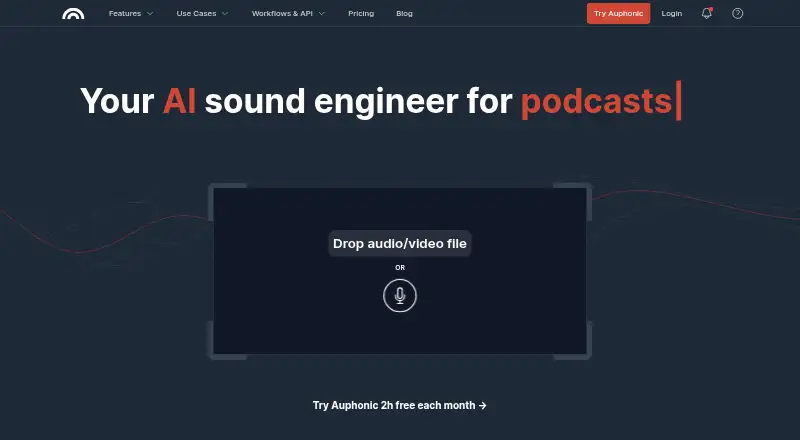
What Auphonic is
Auphonic is a web service for automated audio post-production across podcasts, broadcasts, interviews, audiobooks, lectures and other audio or video projects. Its processing can reduce noise and reverb, adjust levels, filter and enhance recordings, meet loudness specifications, and remove filler words, coughs and silence. Multitrack processing creates mixdowns with automatic ducking, noise gates and mic-bleed removal. It also offers multilingual speech-to-text, automatic shownotes and chapters, and a shareable transcript editor. Common audio and video formats, waveform audiograms, metadata, chapters and styled burned-in subtitles are supported. Integrations include storage, publishing and automation services, and workflows can use an API, CLI, watch folders or batch productions. The free plan is free and provides two hours monthly, but free multitrack productions must be under 20 minutes and exclude several transcription and automation features. Paid plans list monthly processing allowances; billing has a three-minute minimum per production.
Good
- Reduces noise and reverb and adjusts audio levels.
- Multitrack mixdowns include ducking and mic-bleed removal.
- Offers multilingual transcription, shownotes and chapters.
- API, CLI and integrations support automated workflows.
Watch out
- Free multitrack productions must be under 20 minutes.
- Free accounts exclude multilingual speech recognition and shownotes.
- Billing has a three-minute minimum per production.
- Audio productions are deleted after 21 days.
Who it suits
Auphonic suits podcast and broadcast producers, interviewers, educators and audiobook creators who want automated audio processing or multitrack mixdowns. It also fits teams seeking speech-to-text or API and CLI automation.
Verdict
Auphonic combines audio cleanup, multitrack processing and transcription features with workflow automation. Check the free plan's production and feature limits, as well as the billed audio-duration minimum.
Plans and prices
From Auphonic's own pricing page, checked 14 Oct 2026.
| Plan | Price | What it gives you |
|---|---|---|
| Auphonic Free | Free | 2 hours processed audio per month · AI algorithms · free productions include Auphonic jingle · free |
| S Recurring | $11 a month | 9 hours per month · no jingle · credits reset monthly · $11/month |
| Auphonic S | $13 a month | 9 h/month · credits reset monthly · unused credits do not roll over · monthly |
| M Recurring | $24 a month | 21 hours per month · no jingle · credits reset monthly · $24/month |
| Auphonic M | $30 a month | 21 h/month · credits reset monthly · unused credits do not roll over · monthly |
| L Recurring | $49 a month | 45 hours per month · no jingle · credits reset monthly · $49/month |
| Auphonic L | $64 a month | 45 h/month · credits reset monthly · unused credits do not roll over · monthly |
| XL Recurring | $99 a month | 100 hours per month · no jingle · credits reset monthly · $99/month |
| Auphonic S | $132 a year | 9 h/month · yearly billing saves 20% · $132.00 per year (= $11.00/month, billed annually) |
| Auphonic XL | $136 a month | 100 h/month · credits reset monthly · unused credits do not roll over · monthly |
| Auphonic XXL | $290 a month | 250 h/month · credits reset monthly · unused credits do not roll over · monthly |
| Auphonic M | $300 a year | 21 h/month · yearly billing saves 20% · $300.00 per year (= $25.00/month, billed annually) |
| Auphonic L | $624 a year | 45 h/month · yearly billing saves 20% · $624.00 per year (= $52.00/month, billed annually) |
| Auphonic XL | $1,356 a year | 100 h/month · yearly billing saves 20% · $1,356.00 per year (= $113.00/month, billed annually) |
| Business | Priced on request | priority processing · priority support · team accounts · custom contracts · Custom |
The facts
Each one read from Auphonic's own pages, with the date it was checked.
What it does
- API
- Auphonic exposes a REST API with Simple API and full JSON API options for scripts, workflows and third-party applications.checked 14 Oct 2026
- API and automation
- Auphonic offers a developer API, CLI, watch folders, batch productions and external-service integrations for automated workflows.checked 1 Oct 2026
- API specification
- The API documentation links to an interactive ReDoc reference generated from an OpenAPI specification.checked 14 Oct 2026
- Audio processing
- Its algorithms provide noise and reverb reduction, intelligent leveling, filtering and enhancement, loudness specifications, and automatic cutting of filler words, coughs and silence.checked 1 Oct 2026
- Authentication
- API authentication supports API keys, HTTP Basic Authentication and OAuth 2.0, with OAuth recommended for third-party applications serving multiple accounts.checked 14 Oct 2026
- Automatic publishing
- Auphonic can publish output files automatically to supported hosting and storage services.checked 14 Oct 2026
- CLI
- Auphonic distributes CLI version 1.1.8 as dependency-free static binaries for Linux, macOS and Windows.checked 14 Oct 2026
- Data hosting
- Auphonic says its primary processing servers are in Germany and that EU media can remain in EU-restricted storage.checked 14 Oct 2026
- Data retention
- Productions and associated media are permanently deleted after 21 days for audio and API productions and 7 days for video productions.checked 1 Oct 2026
- Documentation depth
- The help center documents web productions, presets, multitrack, batch processing, watch folders, algorithms, API endpoints, webhooks and integrations.checked 14 Oct 2026
- Encoding and metadata
- Outputs can be encoded to formats such as MP3, Opus, AAC/MP4, Ogg Vorbis, ALAC, FLAC and WAV with metadata and chapter support.checked 14 Oct 2026
- Filtering and enhancement
- The service includes filtering and enhancement algorithms, including automatic frequency optimization.checked 14 Oct 2026
- Independent test result
- AI Demos found Auphonic strong on steady noise but less reliable on transient sounds, with processed outputs sometimes sounding louder and slightly robotic.checked 14 Oct 2026
- Integrations
- Documented integrations include FTP, SFTP, Dropbox, Google Drive, OneDrive, Amazon S3, WebDAV, Zoom, Zapier, n8n, YouTube, Libsyn, Spreaker, Blubrry, SoundCloud, Captivate, Hindenburg, Adobe, Acast, RSS.com and Scrybecast.checked 14 Oct 2026
- Intelligent Leveler
- The Intelligent Leveler balances speakers, music and speech automatically.checked 14 Oct 2026
- Legal name
- Crunchbase identifies the legal entity as Auphonic GmbH.checked 14 Oct 2026
Money
- Billing limit
- Billing uses processed audio duration with a minimum charge of 3 minutes per production.checked 1 Oct 2026
- Free limits
- Free accounts support multitrack productions under 20 minutes but do not include multilingual speech recognition, automatic shownotes and chapters, watch folders or batch productions.checked 1 Oct 2026
Where it runs
- CLI platforms
- The free Auphonic CLI provides static binaries for Linux, macOS and Windows.checked 1 Oct 2026
The company
- Company founded
- LinkedIn lists Auphonic as founded in 2013.checked 14 Oct 2026
- Company headquarters
- LinkedIn lists headquarters in Graz, Steiermark, Austria.checked 14 Oct 2026
- Company size
- LinkedIn lists Auphonic as having 11–50 employees.checked 14 Oct 2026
- Founded
- 2013checked 23 Sep 2026
- Headquarters
- Graz, Austriachecked 23 Sep 2026
The full review of Auphonic
Auphonic suits podcasters, broadcasters and other spoken-word producers who need more than basic noise cleanup, especially when processing recurring or multitrack work. Its broad mix of audio, transcription and workflow tools is a strong fit for production pipelines, but free users give up several useful features and must work around short retention windows.
Overview
Auphonic is a batch-processing service for polishing audio and video productions, from interviews and lectures to podcasts and audiobooks. It combines sound treatment, mixing, speech tools and delivery integrations rather than focusing on a single cleanup task. That breadth helps when several production steps need to fit into one workflow; it is less compelling for someone who only wants a quick fix to one recording.
Founded in 2013 and headquartered in Graz, Austria, Auphonic stores data primarily on servers in Germany. Productions and related media are permanently deleted after 21 days for audio and API productions, and after 7 days for video productions. EU users' media remains in EU jurisdiction. Auphonic says it complies with the EU General Data Protection Regulation worldwide; paying customers can request a Data Processing Agreement. The retention window is worth factoring into workflows that need longer-term access to source or output files.
Key features
Audio processing and multitrack
Auphonic can reduce noise and reverb, level and filter recordings, enhance audio, and target loudness specifications. It can also cut filler words, coughs and silence automatically. Those tools can reduce routine cleanup, although automatic cutting is best treated as an editing aid rather than a substitute for decisions about what should remain in a recording.
For multitrack productions, it builds optimized mixdowns using automatic ducking, noise gates and mic-bleed removal. That makes it more useful for recordings made with several microphones than a single-track denoiser. Billing is based on processed audio duration, with a minimum charge of 3 minutes per production, so very short jobs may count as more than their actual length.
Speech, video and delivery
Multilingual speech recognition supports transcripts, automatic shownotes and chapters, with a shareable transcript editor. Auphonic uses a self-hosted multilingual Whisper model as well as external recognition services. It also supports common audio and video formats, waveform audiograms, metadata and chapters, plus burned-in styled subtitles. Together, those features suit producers who want to handle more of a spoken-word release in one place; the free tier excludes multilingual recognition, shownotes and chapters.
Integrations include FTP and SFTP, Dropbox, Google Drive, OneDrive, Amazon S3, YouTube, Libsyn, Spreaker, SoundCloud, PodBean, Zapier, n8n and several speech-recognition providers. A developer API, CLI, watch folders and batch productions support automated workflows. The free CLI has static binaries for Linux, macOS and Windows.
Pricing
Auphonic is freemium, with a free plan and a free trial. The free plan costs nothing and includes 2 h/month, AI-based audio algorithms and a jingle in free productions; credits do not stack. Free accounts can process multitrack productions under 20 minutes, but do not get multilingual speech recognition, automatic shownotes and chapters, watch folders or batch productions. That makes the free option useful for limited experiments or short multitrack work, not a full test of the paid workflow features.
Paid subscriptions scale by monthly audio allowance. Auphonic S costs $11 a year (billed monthly equivalent when billed yearly) for 9 h/month; M costs $25 a year (billed monthly equivalent when billed yearly) for 21 h/month; L costs $52 a year (billed monthly equivalent when billed yearly) for 45 h/month; and XL costs $113 a year (billed monthly equivalent when billed yearly) for 100 h/month. Yearly billing saves 20%. These tiers suit producers who can estimate a steady workload and do not need the largest quota.
Auphonic XXL costs $290 a month (billed monthly) for 250 h/month. Credits reset monthly and unused credits do not roll over, so this tier fits heavier, predictable volume better than uneven workloads. Free plans include basic support; monthly and one-time plans include standard support, while yearly and business plans include priority support.
Platforms
Auphonic is available on the web and through an API, with platform support for Linux, macOS and Windows. Its CLI is free and provides static binaries for all three desktop operating systems.
Who it's for
Auphonic is a strong choice for podcasters, radio and broadcast producers, educators, interviewers and audiobook creators who need consistent audio processing, multitrack mixing or repeatable delivery. It is particularly appealing when transcription, chapters, subtitles or automation are part of the same production process. Someone seeking only desktop voice isolation or a single quick denoise pass may prefer a more focused tool.
Pros and cons
- Pros: Noise and reverb reduction, leveling, loudness targeting and automatic cuts cover several common cleanup jobs.
- Pros: Multitrack mixdowns add ducking, noise gates and mic-bleed removal for more complex recordings.
- Pros: Transcription, shownotes, chapters, subtitles and broad service integrations can connect processing with publishing workflows.
- Cons: Free accounts lack multilingual recognition, shownotes, chapters, watch folders and batch productions, limiting their usefulness for a complete workflow.
- Cons: Audio and API productions are deleted after 21 days, and video productions after 7 days, so users must manage their own longer-term copies.
- Cons: The 3-minute minimum per production can make very short jobs count for more processed duration than their runtime.
Alternatives
For a broader category comparison, browse AI Speech Enhancement Software or AI Podcast Editing Software.
LALAL.AI is another freemium option with broad platform support; its free Starter plan limits users to 10 minutes in a relaxed queue, a 200 MB upload limit per file and previews without full downloads. Choose Riverside Magic Audio if its free offer of 2 hours of multitrack recordings, up to 720p video and 44.1 kHz audio suits your needs, bearing in mind that free output carries a Riverside watermark. CrystalSound is an alternative with Linux, macOS and Windows support. For mobile denoising, Denoise runs on Android and iOS; its free tier lets users import and denoise and hear the full before-and-after, but saving or exporting requires Pro. AudioEnhancerMAX is a free alternative available on Android, Linux, macOS, web and Windows. DeepFilterNet is a free, open-source option for Linux, macOS and Windows. Adobe Enhance Speech is web-based and free for audio-only, one-file-at-a-time enhancement, with a 30-minute and 500 MB per-file maximum and a daily hour limit. NoiseTorch-ng is a free Linux option for PulseAudio or PipeWire users.
Verdict
Choose Auphonic if you produce spoken-word audio regularly and want cleanup, multitrack processing, speech tools and automation in one service. Its strongest case is the range of production tasks it brings together; its main drawbacks are the free tier's feature exclusions, short media retention and billing minimum. For an occasional single-track cleanup, a narrower denoising tool may be a better fit.
Getting started
- Open the Auphonic website
- Choose the Auphonic Free plan or a paid monthly plan
- Upload an audio or video production through the web service
- Connect storage, publishing or automation services if needed
- Run productions through the web interface, API, CLI or batch tools
Limits worth knowing
Auphonic Free provides 2 h/month, and free multitrack productions must be shorter than 20 minutes. Free accounts omit multilingual speech recognition, automatic shownotes and chapters, watch folders and batch productions; free credits do not stack.
Questions
Is there a free plan?
Yes. Auphonic Free costs nothing and includes 2 h/month with AI-based audio algorithms; free productions include a jingle.
What do paid plans cost?
Monthly plans are 13.00 USD for 9 h, 30.00 USD for 21 h, 64.00 USD for 45 h, 136.00 USD for 100 h and 290.00 USD for 250 h.
Which platforms are supported?
Auphonic is available through the web, API, Linux, macOS and Windows. Its free CLI has static binaries for Linux, macOS and Windows.
Does it support video and subtitles?
Yes. It supports common audio and video formats, waveform audiograms, metadata, chapters and burned-in styled subtitles.
How is usage billed?
Billing is based on processed audio duration, with a minimum charge of 3 minutes per production.
How long are productions retained?
Audio and API productions are deleted after 21 days, while video productions are deleted after 7 days.
Alternatives to Auphonic
- 1

LALAL.AI
Free planAndroidiOSWebAPI8.3From €6.75 a month - 2

Denoise
Free planAndroidiOS7.8From $2.99 a month - 3

Krisp AI Meeting Assistant
AndroidiOSExtensionmacOS7.8From $8 a month - 4
DeepFilterNet
Free planOpen sourceAPILinuxmacOSSelf-hosted7.6Free plan - 5

ElevenLabs
Free planWebAPI7.6From $6 a month - 6

Riverside Magic Audio
Free planAndroidiOSWebmacOS7.5From $24 a month