DidTheyReadIt
DidTheyReadIt is an email tracking service that notifies senders when a tracked message is opened.
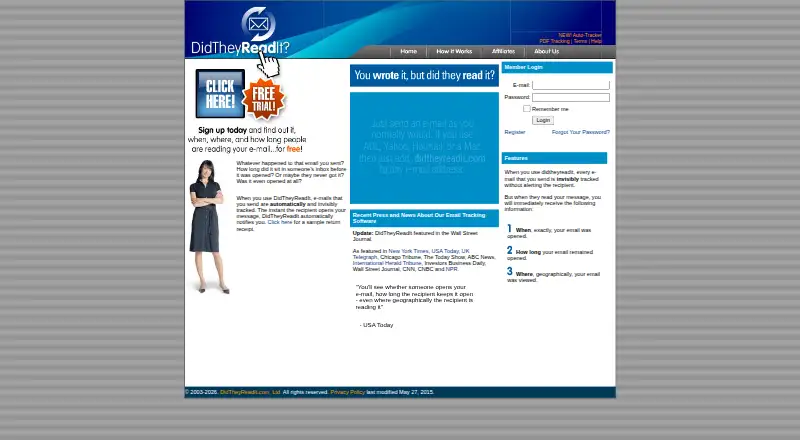
What DidTheyReadIt is
DidTheyReadIt is an email tracking service that notifies senders when a tracked message is opened. Receipts can show when it was opened, how long it remained open, and the reader’s approximate location. To set up tracking, users add .DidTheyReadIt.com to the recipient address; instructions cover Outlook, Thunderbird, Gmail, Yahoo, Hotmail, Mac users, and other email clients. An optional Auto-Tracker is described as a Windows beta with email-program and browser plugins. A paid PDF add-on creates trackable copies and reports when and where they are opened. For messages sent to several recipients, tracking applies to the message rather than identifying each person; location may offer a clue. Location is approximate and based on the reader’s IP address, and the service notes that AOL users may appear to be in Virginia. Its privacy policy says messages sent through its online services are not saved, copied, or otherwise stored. Free trial accounts are advertising-supported and may receive offers from DidTheyReadIt and third-party marketing partners. The service is aimed at individuals and businesses who want to know whether recipients read their email.
Good
- Receipts report opening time and duration
- Tracking setup covers several email clients
- Paid PDF add-on reports when and where files open
Watch out
- Multi-recipient tracking cannot identify each opener
- Reader location is approximate
- Free trial accounts are advertising-supported
- Auto-Tracker is described as a Windows beta
Who it suits
DidTheyReadIt may suit individuals and businesses seeking open notifications for sent email. It can also track PDF copies through a paid add-on.
Verdict
DidTheyReadIt provides open notifications and receipt details, but multi-recipient tracking does not identify each person. Its approximate location reporting and advertising-supported trial accounts are also worth considering.
Plans and prices
From DidTheyReadIt's own pricing page, checked 14 Oct 2001.
| Plan | Price | What it gives you |
|---|---|---|
| Free Subscription | Free | trial period and message allowance may vary · advertising supported |
| Annual Subscription | — | auto-renews unless cancelled · annually |
| Quarterly Subscription | — | 500 email messages per month · auto-renews unless cancelled · every 3 months |
| Semi-Annual Subscription | — | 500 email messages per month · auto-renews unless cancelled · every 6 months |
The facts
Each one read from DidTheyReadIt's own pages, with the date it was checked.
What it does
- Account restriction
- Each account can use only one sending email address for tracked messages.checked 14 Oct 2001
- Address-based tracking
- Users can track mail by appending .DidTheyReadIt.com to each recipient address.checked 14 Oct 2001
- API and SDK documentation
- The published help page documents email-address routing and desktop plug-ins but contains no public API or SDK reference.checked 14 Oct 2001
- Background tracker
- A separate background tracker is documented for Windows 2000/XP standard mail accounts, excluding Exchange, AOL and webmail.checked 14 Oct 2001
- Data handling
- The privacy policy says the service does not save, copy or otherwise store the email messages sent through it.checked 14 Oct 2001
- Desktop tracker
- The optional Auto-Tracker is described as a Windows beta release and offers email-program and browser plugins.checked 9 Oct 2001
- Domain age
- A domain-information listing reports didtheyreadit.com was registered on September 10, 2003 and currently lacks detected HTTPS support.checked 14 Oct 2001
- Email clients
- Setup instructions cover Outlook, Thunderbird, Gmail, Yahoo, Hotmail, Mac users, and other email clients.checked 9 Oct 2001
- Email tracking
- The service invisibly tracks sent email and notifies the sender when a recipient opens it.checked 9 Oct 2001
- Exchange compatibility
- The help documentation says the Outlook plug-in works with Microsoft Exchange.checked 14 Oct 2001
- Firefox extension licence
- The Firefox Web Plugin source is released under GNU GPL v3 only.checked 14 Oct 2001
- Firefox extension status
- The latest listed Firefox plug-in version is 2.91, released May 7, 2019, and supports Firefox 42 and later.checked 14 Oct 2001
- Forward detection
- The company says its service can show whether a message was forwarded.checked 14 Oct 2001
- Historic pricing
- A PC World article reported a $50 annual subscription and ten free messages in the trial.checked 14 Oct 2001
- Intended users
- The company describes the service as useful to individuals and businesses who want to know whether recipients read their email.checked 9 Oct 2001
- Licence
- AlternativeTo lists the commercial service as proprietary rather than open source.checked 14 Oct 2001
- Limit: abandonment complaint
- The Software Advice review described the website as defunct and alleged that paid renewal did not activate the account.checked 14 Oct 2001
- Limit: delays and compatibility
- The same G2 review mentioned delays in results and compatibility problems across email systems.checked 14 Oct 2001
- Limit: failed upgrade and support
- A Capterra reviewer reported receiving only the ten free emails, being unable to upgrade after payment, and getting no response from support.checked 14 Oct 2001
- Location accuracy
- Reader location is approximate and based on the reader’s IP address; the site notes that AOL users appear to be in Virginia.checked 9 Oct 2001
The company
- Company legal name
- The official terms identify the provider as DidTheyReadIt.com, Ltd.checked 14 Oct 2001
- Headquarters
- The company says it is based in Houston, Texas and has branch offices worldwide.checked 14 Oct 2001
- Historic company
- An independent 2016 article said Rampell Software created DidTheyReadIt in 2003 and described quarterly pricing beginning at $25.checked 14 Oct 2001
Money
- Free account advertising
- The privacy policy says free trial accounts are advertising-supported and may receive offers from DidTheyReadIt and third-party marketing partners.checked 9 Oct 2001
The full review of DidTheyReadIt
DidTheyReadIt is an email-opening tracker for individuals and businesses that need a signal after sending. It fits people working across mainstream mail clients, especially when prompt alerts and receipt timing matter. The service is most useful for one-to-one follow-up; group messages and privacy-sensitive trials require more caution.
Overview
Tracking starts by adding .DidTheyReadIt.com to the recipient address, after which the message is sent through the user’s normal mail workflow. The service monitors the sent email invisibly and sends an alert when it is opened. Receipts can include the opening time, how long the message stayed open, and a broad geographic estimate.
Those signals can help a salesperson decide when to follow up or help an individual confirm that a time-sensitive note was seen. They are not definitive proof of a particular reader’s action. A message addressed to several people is tracked as one item, so DidTheyReadIt cannot say which recipient opened it except by using location clues. The location estimate comes from the reader’s IP address and can be wrong; AOL readers may appear in Virginia. Treat geography as an indication, not identification.
DidTheyReadIt says messages sent through its online services are not saved, copied, or otherwise stored. Trial accounts are advertising-supported and may receive promotional offers from DidTheyReadIt and outside marketing partners, which is an important trade-off for users evaluating the service with a free account.
Key features
Opening notifications and receipt data
Open tracking, real-time alerts, and attachment tracking provide immediate awareness that a message or file was accessed. Timestamps and time-open data add context for follow-up decisions, although neither metric confirms that the recipient read every word.
Broad email-client coverage
Instructions cover Outlook, Thunderbird, Gmail, Yahoo, Hotmail, Mac users, and other clients. That breadth makes the address-based setup practical for mixed-device contacts. The optional Auto-Tracker is a Windows beta with email-program and browser plugins, so it is better viewed as an experimental convenience than a settled cross-platform workflow.
Trackable PDFs
A paid PDF add-on creates trackable copies and reports when and where they are opened. It is a sensible extension for proposals, forms, or documents, but it adds cost beyond ordinary email tracking.
Pricing
The Free Subscription costs nothing account, with trial duration and message limits that may vary. Because the account is advertising-supported, the no-cost option is best for occasional evaluation rather than predictable business use.
Semi-Annual and Quarterly subscriptions have custom pricing and are billed every six months or every three months respectively; each includes 500 email messages per month. They suit senders with a recurring, moderate volume who prefer a shorter commitment than an annual term. The Annual Subscription also uses custom pricing and bills annually, making it the natural fit for longer-term use, though its published plan summary does not state a monthly message quota.
Every paid tier should be checked against your expected sending volume before purchase. The six-month and quarterly options explicitly cap usage at 500 messages per month, while the free account’s changing limits make it unsuitable for dependable forecasting.
Platforms
DidTheyReadIt is offered through an extension, macOS, web, and Windows support. Gmail and Outlook are identified for email-client support, while the setup guidance also addresses Thunderbird, Yahoo, Hotmail, and other clients. The Auto-Tracker is specifically a Windows beta, so Mac users should rely on the standard address-based method.
Who it's for
Choose DidTheyReadIt if you need a lightweight confirmation that an individual email or PDF was opened and want timing information for follow-up. It can serve independent professionals and businesses that send through several common clients without requiring a single mailbox platform.
Look elsewhere when recipient-level attribution in group mail is essential, when approximate IP geography would create false confidence, or when an advertising-supported trial conflicts with your communications policy.
Pros and cons
- Pros: Real-time opening alerts make follow-up timing actionable.
- Pros: Receipts include open time and duration, not merely a binary status.
- Pros: Client instructions span Outlook, Gmail, Thunderbird, Yahoo, Hotmail, Mac, and other mail software.
- Pros: The paid PDF add-on extends tracking to document opens.
- Cons: Multi-recipient messages are not attributed to individual recipients.
- Cons: IP-based location is approximate and can misplace readers, including AOL users shown in Virginia.
- Cons: Free trials may deliver advertising and third-party partner offers.
- Cons: Auto-Tracker remains a Windows beta, limiting its reliability as a universal desktop solution.
Alternatives
For a wider sales-tool shortlist, see Sales Email Tracking Software.
Mailbutler Smart Assistant is the better pick if you want a freemium assistant across Android, iOS, Linux, macOS, web, Windows, and extensions, accepting visible Mailbutler branding on its free plan.
Choose ReadNotify when a free account with unlimited duration and 20 tracked emails per month is more useful than DidTheyReadIt’s variable trial limits.
Boomerang suits Gmail or G Suite users who also want scheduling and reminders; its Basic plan includes 10 message credits monthly.
Pick Mixmax for sequence-oriented outreach, with a free allowance of 20 tracked emails and up to 50 sequence recipients each month.
Mail Track for Gmail is aimed at Gmail users seeking unlimited tracked emails and real-time read receipts on its free plan.
Mailsuite, Right Inbox, and Yesware are alternative email-tracking products with their own free or freemium tiers.
Verdict
DidTheyReadIt is a good choice for one-to-one senders who value instant open alerts, receipt timing, and broad mail-client compatibility, with optional PDF monitoring. Choose another service if you need reliable person-by-person reporting for group emails, precise location evidence, or a trial without advertising.
Alternatives to DidTheyReadIt
- 1

Mailbutler Smart Assistant
Free planAndroidiOSWebExtension8.2From $7 a month - 2
Boomerang
Free planAndroidiOSWebAPI8.1From $4.98 a month - 3

LeadBoxer
Free planAndroidiOSWebAPI8.1From €8.25 a month - 4
Mixmax
Free planWebAPIExtensionLinux8.0From $29 a month - 5

ReadNotify
Free planAndroidiOSWebExtension8.0From $2 a month - 6

RevenueGrid
AndroidiOSWebExtension7.3From $30 a month