DataCleaner
DataCleaner is a free, open-source data quality tool for profiling, validating, and cleansing data.
What DataCleaner is
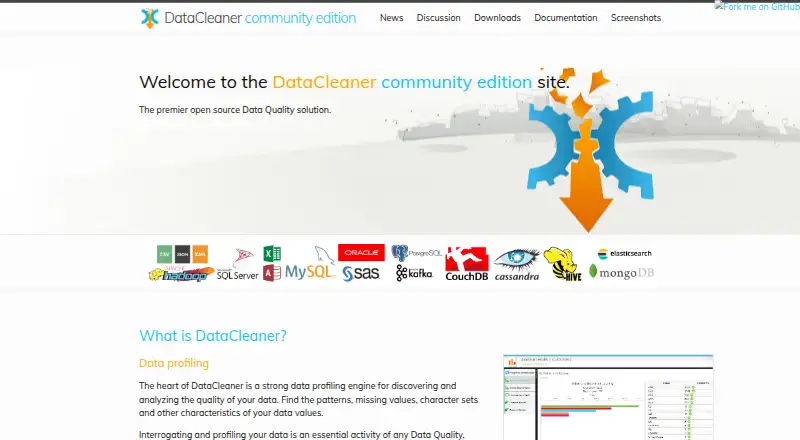
DataCleaner is a free, open-source data quality tool for profiling, validating, and cleansing data. Its profiling engine can surface patterns, missing values, character sets, and other properties of data values. It works with CSV files, Excel spreadsheets, relational databases, and NoSQL databases. Users can define cleansing rules through search and replace, regular expressions, pattern matching, or custom transformations, and check values against internal or external reference data. The project lists Apache Hadoop, Apache Spark, Pentaho Data Integration, and Apache MetaModel among its integrations or connectivity options. Developers can embed DataCleaner in other applications or create plugins, while the project describes community-built extensions and shared content. It supports batch processing, visual workflows, standardization, validation, enrichment, and scheduled runs, with desktop deployment for Linux, macOS, and Windows. The code is licensed under LGPL. The downloads page lists community edition 5.9.0 as the latest release; release news lists version 5.8.1 dated February 9, 2022 and says it runs on Java versions 9 through 17.
Good
- Free and open source under LGPL.
- Profiles patterns, missing values, and character sets.
- Handles CSV, Excel, relational, and NoSQL sources.
- Supports custom cleansing rules and reference data.
- Offers scheduled runs and visual workflows.
Watch out
- Latest listed release is community edition 5.9.0.
- Release news lists version 5.8.1 dated February 9, 2022.
Who it suits
DataCleaner suits people who need to profile and clean data from files or databases, including developers who want to embed it or build plugins. It is available for Linux, macOS, and Windows.
Verdict
DataCleaner provides data profiling and configurable cleansing across a range of file and database sources. Its open-source community edition is free, with extensions and integrations described by the project.
Plans and prices
From DataCleaner's own pricing page, checked 15 Oct 2026.
| Plan | Price | What it gives you |
|---|---|---|
| Community edition | Free | Open-source desktop toolkit · profiling, cleansing and enrichment · Windows, macOS and Linux downloads |
| DataCleaner community edition | Free | Open source · LGPL |
The facts
Each one read from DataCleaner's own pages, with the date it was checked.
What it does
- Analyzers
- Reference documentation lists completeness, character-set, date/time, number, pattern, referential-integrity, uniqueness, value-distribution and machine-learning analyzers.checked 15 Oct 2026
- Cleansing
- Users can build cleansing rules using search and replace, regular expressions, pattern matching, or custom transformations.checked 30 Sep 2026
- Code execution
- Developer documentation explains how to configure, build, execute and retrieve results from DataCleaner jobs through code.checked 15 Oct 2026
- Command line
- The reference manual documents command-line execution, parameterized jobs and runtime configuration overrides.checked 15 Oct 2026
- Data profiling
- Its profiling engine identifies patterns, missing values, character sets and other characteristics of data.checked 15 Oct 2026
- Data sources
- It handles CSV files, Excel spreadsheets, relational databases, and NoSQL databases.checked 30 Sep 2026
- Datastore connectors
- Documentation covers JDBC databases, CSV, fixed-width files, Excel, XML, Elasticsearch, MongoDB and CouchDB datastores.checked 15 Oct 2026
- Data wrangling
- The application supports cleansing workflows using reference data, search-and-replace rules, regular expressions, pattern matching and custom transformations.checked 15 Oct 2026
- Deployment model
- Downloads are supplied as desktop archives for Windows, macOS and Linux, with source tags also available.checked 15 Oct 2026
- Discussion and support
- Community discussion posts are powered by GitHub issues and use the Discussion or Question label.checked 30 Sep 2026
- Documentation depth
- The documentation archive includes reference versions 5.7.0, 5.4.0 and 5.2, covering end-user, configuration, CLI, integration and developer topics.checked 15 Oct 2026
- Ecosystem
- The project describes community driven extensions, integrations, and shared content.checked 30 Sep 2026
- Extensibility
- The developer guide covers extension tutorials, packaging, annotated components, single-JAR extensions and embedding DataCleaner.checked 15 Oct 2026
- File and database inputs
- The official site says it handles CSV, Excel, relational databases and NoSQL databases.checked 15 Oct 2026
- Integrations
- The project advertises Apache Hadoop, Apache Spark, Pentaho Data Integration and Apache MetaModel integrations.checked 15 Oct 2026
- Java compatibility
- The 5.8.1 release announcement says the software runs on Java versions 9 through 17.checked 15 Oct 2026
- Java support
- The release news states DataCleaner 5.8.1 runs on Java versions 9 through 17.checked 30 Sep 2026
- Latest listed release
- The downloads page identifies DataCleaner community edition 5.9.0 as the latest release.checked 15 Oct 2026
- Licence
- The community edition code is licensed under the GNU Lesser General Public License.checked 15 Oct 2026
- License
- The site states that the code is licensed under the Lesser General Public License (LGPL).checked 30 Sep 2026
- Limit: independent review coverage
- SoftwareReviews lists only 3 reviews and marks the product as having insufficient data for results.checked 15 Oct 2026
- Limit: scope expectations
- The same survey notes that users might expect more pure cleansing functionality from a product named DataCleaner.checked 15 Oct 2026
- Limit: SourceForge support
- SourceForge's category scores rate support at 3 out of 5, below ease, features and design.checked 15 Oct 2026
The company
- Company ownership history
- The survey states that DataCleaner was developed by Human Inference, later moved through Neopost and Quadient, and from 2019 was associated with EDM Media Group.checked 15 Oct 2026
The full review of DataCleaner
DataCleaner is a desktop tool for examining and cleaning data held in files and databases. It suits users who want configurable, batch-oriented quality work and can benefit from extending an open-source application. Its strongest case is the combination of profiling and flexible cleansing rules; its desktop deployment is a poor fit for cloud-first workflows.
Overview
DataCleaner brings data discovery and cleanup together. Its profiling engine surfaces patterns, missing values, character sets, and other characteristics of values, giving users a basis for deciding what needs attention before writing cleansing rules.
The community edition is open source under the LGPL, and the project describes community-built extensions, integrations, and shared content. The downloads page identifies version 5.9.0 as the latest community release; the news page dates version 5.8.1 to February 9, 2022. Teams that prioritize a clearly current release cadence should weigh that history before adopting it.
Key features
DataCleaner works with CSV files, Excel spreadsheets, relational databases, and NoSQL databases. That breadth is useful for teams cleaning data across files and database types, rather than within a single source format. Processing is batch-oriented, so it is suited to scheduled data-quality runs, not a live, per-record service.
Users can build cleansing rules with search and replace, regular expressions, pattern matching, or custom transformations. Standardization and validation support repeatable cleanup, while enrichment and internal or external reference data can help check values against the real world. Visual workflows make those operations configurable without limiting the tool to a fixed set of cleanup rules.
The project names Apache Hadoop, Apache Spark, Pentaho Data Integration, and Apache MetaModel as integrations or connectivity options. Developers can also embed the application in other software and build plugins for specific use cases. These extension paths make it more adaptable for technical teams, though they are less compelling for buyers seeking a managed, cloud-based product.
Pricing
DataCleaner community edition: free. The plan is open source under the LGPL and includes the profiling and cleansing capabilities described above. It is the natural starting point for individuals and teams comfortable with a desktop deployment and community-led development. No paid tier is needed to access the community edition.
Platforms
DataCleaner supports Linux, macOS, and Windows, with desktop deployment. The release news states that version 5.8.1 runs on Java versions 9 through 17. Scheduled runs are supported, but the product's batch processing model remains the key constraint for workflows that require continuous, real-time handling.
Who it's for
DataCleaner is a strong fit for data practitioners who need to profile and clean varied file and database sources, define their own rules, and schedule repeatable batch work without a software license fee. Its extensibility also suits developers who want to embed data-quality functions or create plugins. Look elsewhere if your priority is cloud-first delivery or a service centered on live processing.
Pros and cons
- Broad source coverage: CSV, Excel, relational databases, and NoSQL databases can be handled in one desktop tool.
- Flexible rule building: Search and replace, regular expressions, pattern matching, and custom transformations accommodate different cleanup needs.
- Extensible and free: The LGPL community edition supports integrations, plugins, and embedding without a subscription price.
- Batch and desktop focused: Its processing and deployment model will not suit teams seeking cloud-first or real-time data-quality service.
- Release history merits scrutiny: The latest listed release is 5.9.0, while the news page dates 5.8.1 to February 9, 2022; teams that depend on frequent updates may prefer another option.
Alternatives
OpenRefine is another free, open-source desktop option, licensed under BSD 3-clause; consider it if that licensing and its listed desktop installation better suit your needs.
Melissa Data Quality is worth considering if you want address verification, including a free plan with 250 records per month and CASS and DPV certification.
BlueData offers a freemium option with listed limits of one web user, one mobile user, 1 GB of storage, and 500 submissions per month; consider it if those limits fit your use case.
Plauti Deduplicate has a free version for Salesforce through AppExchange, with full-edition features requiring a trial or custom pricing; choose it if that Salesforce-specific offering is a closer fit.
Infosys Data Workbench, Informatica Product 360, Oracle WebCenter Content, and Ataccama ONE are alternatives to evaluate if you are considering paid products.
Browse more options in Data Cleansing Software and Data Preparation Software.
Verdict
Choose DataCleaner if you want a free, extensible desktop application for profiling and rule-based batch cleansing across files and databases. Its source coverage and configurable transformations are the clearest reasons to pick it. Look elsewhere if cloud-first or real-time delivery matters more, or if a more current release cadence is essential.
Getting started
- Open the DataCleaner website
- Choose the community edition download for Linux, macOS, or Windows
- Install the desktop application
- Connect a CSV, Excel, relational database, or NoSQL source
- Create profiling and cleansing workflows
- Schedule batch runs if needed
Limits worth knowing
The community edition is free at no cost and is licensed under LGPL. The listed deployment is desktop, and the Java 9–17 compatibility statement applies to version 5.8.1.
Questions
Is DataCleaner free?
Yes. The community edition is listed as free, with a free plan.
Which operating systems are supported?
DataCleaner is available for Linux, macOS, and Windows.
What data sources can it process?
It handles CSV files, Excel spreadsheets, relational databases, and NoSQL databases.
Can developers extend DataCleaner?
Yes. Developers can embed it in other applications and build plugins for specific use cases.
What license does it use?
The code is licensed under the Lesser General Public License (LGPL).
Alternatives to DataCleaner
- 1
Microsoft Planner
Free planAndroidiOSWebAPI7.9Free plan - 2
EasyMorph
Free planWebAPISelf-hostedWindows7.7From $600 a year - 3

AWS Glue DataBrew
WebAPI7.2 - 4
Microsoft Project
Free planWebAPIWindows7.2Free plan - 5
qsv
Free planWebLinuxmacOSWindows6.9From $99.99 a month - 6

Alteryx Designer
WebAPImacOSWindows6.8From $250 a month