Dapr
Dapr is an open-source runtime for building applications with durable workflows and distributed services.
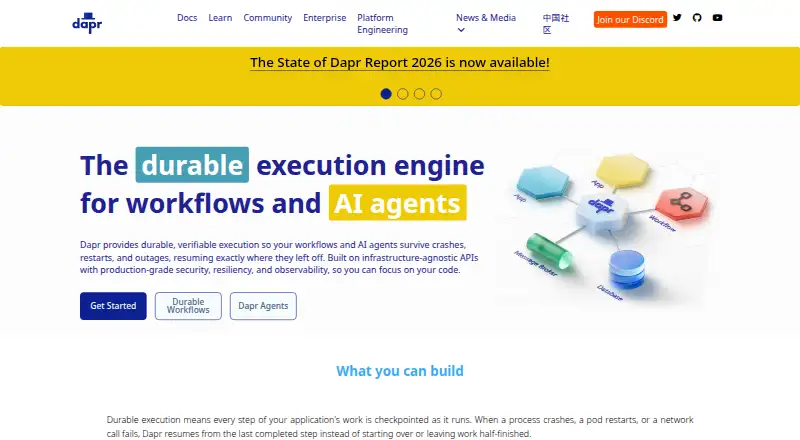
What Dapr is
Dapr is an open-source runtime for building applications with durable workflows and distributed services. Its execution model is designed to help workflows and AI agents continue after crashes, restarts, or outages. Workflows can manage long-running stateful processes with retries, timers, human approvals, and sagas; AI agents can use checkpointed plans to recover from failures. For communication between services, Dapr provides HTTP or gRPC invocation with discovery, tracing, and error handling. Its APIs also cover pub/sub, state, actors, jobs, secrets, configuration, bindings, locks, and cryptography. Dapr runs as a sidecar process or container, keeping its runtime out of application code. It supports Kubernetes and self-hosted deployments on Windows, Linux, macOS, and physical or virtual machines. Security features include encrypted communication using mTLS, access policies, and certificate rotation. Stable SDKs are available for .NET, Python, Java, Go, PHP, and JavaScript. Dapr is free and open source.
Good
- Durable workflows include retries, timers, and human approvals.
- Service invocation includes discovery and distributed tracing.
- Security features include mTLS and automatic certificate rotation.
- Stable SDKs cover six programming languages.
- Supports Kubernetes and self-hosted deployments.
Watch out
- C++ and Rust SDKs are still in development.
Who it suits
Dapr suits developers and organizations building distributed applications, durable workflows, or AI agents. It can be deployed on Kubernetes or self-hosted across cloud and edge environments.
Verdict
Dapr combines workflow, service communication, and other distributed application APIs behind a sidecar model. Its free open-source option and self-hosted deployment may suit teams that want to run it themselves; managed cloud plans have listed starting prices.
Plans and prices
From Dapr's own pricing page, checked 1 Oct 2026.
| Plan | Price | What it gives you |
|---|---|---|
| Cloud Free | Free | development and non-critical workloads · durable workflows · native integrations · workflow visualizers |
| Dedicated Cloud | $1,199 a month | single-tenant · fully managed · compute, storage and networking included · 99.95% availability with Select and Premium support · Starting price · first 14 days free |
| BYOC | $1,599 a month | data plane in your cloud · control plane in Diagrid cloud · data sovereignty and localization · 99.95% availability · Starting price · first 14 days free |
| Enterprise Server | Priced on request | on-premises · air-gapped and disconnected environments supported · namespace isolation · Priced for your deployment |
The facts
Each one read from Dapr's own pages, with the date it was checked.
What it does
- AI agents
- Dapr enables AI agents to reason, call tools, and recover from failure with checkpointed plans.checked 1 Oct 2026
- APIs
- Dapr provides APIs for state management, secrets, bindings, actors, configuration, distributed locks, cryptography, jobs and conversations.checked 1 Oct 2026
- Building blocks
- Dapr provides APIs for workflow, service invocation, pub/sub, state, actors, jobs, secrets, configuration, bindings, distributed locks, and cryptography.checked 1 Oct 2026
- CLI
- The Dapr CLI runs applications with sidecars, reviews sidecar logs, and lists services in self-hosted and Kubernetes environments.checked 1 Oct 2026
- Component model
- Dapr components decouple APIs from underlying resources so implementations such as RabbitMQ and Kafka can be changed through component configuration without changing application code.checked 1 Oct 2026
- Deployment
- Dapr applications run on Kubernetes or self-hosted on virtual or physical machines across cloud and edge environments.checked 1 Oct 2026
- Frameworks
- Dapr has integrated frameworks including ASP.NET Core, Spring Boot, Flask and Express, and Dapr Agents is a Python framework for durable LLM-powered agents.checked 1 Oct 2026
- Hosting
- Dapr can run self-hosted on Windows, Linux or macOS and on Kubernetes or clusters of physical or virtual machines.checked 1 Oct 2026
- Integrations
- Official integrations include AWS, Azure, KEDA, GitHub Actions, the Dapr Kubernetes Operator, Kratix Marketplace, and Argo CD.checked 1 Oct 2026
- Microservices
- Service-to-service calls include service discovery, mTLS, retries, and distributed tracing through one API.checked 1 Oct 2026
- Observability
- Dapr emits metrics, logs and traces and supports W3C Trace Context and OpenTelemetry.checked 1 Oct 2026
- Open source origin
- Microsoft announced Dapr as an open source project on October 16, 2019.checked 1 Oct 2026
- Project status
- Dapr was accepted into CNCF incubation in 2021 and became a graduated CNCF project on October 30, 2024.checked 1 Oct 2026
- Pub/sub
- Dapr supports the publish-subscribe pattern between applications.checked 1 Oct 2026
- Purpose
- Dapr provides durable, verifiable execution so workflows and AI agents survive crashes, restarts, and outages.checked 1 Oct 2026
- Resiliency
- Dapr supports configurable retries, back-offs, circuit breakers, and timeouts.checked 1 Oct 2026
- SDK languages
- Stable SDKs are available for .NET, Python, Java, Go, PHP, and JavaScript; C++ and Rust SDKs are in development.checked 1 Oct 2026
- Security
- Dapr uses automatically enabled mutual TLS between sidecars, App IDs, namespace isolation and policy-based access controls for services, topics, components and secrets.checked 1 Oct 2026
- Security controls
- Dapr supports App IDs, namespaces, access policies, topic scoping, mTLS, API tokens, and automatic certificate rotation.checked 1 Oct 2026
- Service invocation
- Service invocation provides HTTP or gRPC communication with service discovery, distributed tracing and error handling.checked 1 Oct 2026
- Sidecar architecture
- Dapr exposes HTTP and gRPC APIs as a sidecar container or process, so application code does not include Dapr runtime code.checked 1 Oct 2026
- Support
- Diagrid pricing lists portal, email and Slack support, unlimited support calls, onboarding support and tiered response times for commercial offerings.checked 1 Oct 2026
- Workflow
- Dapr workflows support long-running, stateful processes with retries, timers, human approvals, and sagas.checked 1 Oct 2026
The company
- Founded
- 2019checked 28 Sep 2026
The full review of Dapr
Dapr is an open-source runtime that puts workflow and distributed-application APIs behind HTTP or gRPC sidecars. It is best suited to teams building services or durable workflows across varied infrastructure; its breadth and self-hosting flexibility come with the work of operating and configuring the runtime.
Its strongest case is combining service communication, state, messaging, and failure recovery behind a consistent API. Teams wanting a fully managed deployment can choose Diagrid cloud plans, but those start at substantial monthly prices.
Overview
Dapr’s sidecar model keeps its runtime out of application code: an app talks to a local sidecar, which exposes APIs for service invocation, pub/sub, state, secrets, actors, jobs, configuration, bindings, distributed locks, and cryptography. The component model can let teams switch underlying resources such as RabbitMQ and Kafka through configuration rather than rewriting application code.
That breadth is useful when a system needs several distributed-application capabilities, but it also makes Dapr a runtime to adopt and operate, not a narrow workflow library. Its APIs use HTTP or gRPC, and stable SDKs cover .NET, Python, Java, Go, PHP, and JavaScript. C++ and Rust SDKs remain in development.
Key features
Durable workflows and agents
Workflows support long-running stateful processes, retries, timers, human approvals, and sagas, with versioning and audit logs. Checkpointed plans let AI agents recover after failures, a useful distinction for processes that must survive crashes or restarts. Dapr Agents is a Python framework for durable LLM-powered agents.
Service communication and resilience
Service invocation combines discovery, HTTP or gRPC calls, tracing, and error handling behind one API. Security is on by default, with mTLS encrypting communication in transit; access policies, topic scoping, API tokens, namespaces, App IDs, and certificate rotation add controls. Configurable retries, back-offs, circuit breakers, and timeouts help applications handle transient failures, though teams still need to decide how those policies fit their workloads.
Operations and integrations
Dapr emits metrics, logs, and traces, supports W3C Trace Context and OpenTelemetry, and offers a CLI for running apps with sidecars, inspecting logs, and listing services. Official integrations include AWS, Azure, KEDA, GitHub Actions, the Dapr Kubernetes Operator, Kratix Marketplace, and Argo CD. Integrated frameworks include ASP.NET Core, Spring Boot, Flask, and Express.
Pricing
Dapr itself is open source and free. Diagrid’s cloud plans add managed deployment options; their starting prices make sense chiefly when the included operating model and support justify the spend.
| Plan | Price | What it includes |
|---|---|---|
| Cloud Free | free | Development and non-critical workloads, durable workflows, native integrations, and workflow visualizers. |
| Dedicated Cloud | $1,199 a month | Starting price; first 14 days free. Single-tenant, fully managed service with compute, storage, and networking included; 99.95% availability with Select and Premium support. |
| BYOC | $1,599 a month | Starting price; first 14 days free. Data plane in your cloud and control plane in Diagrid cloud, with data sovereignty and localization and 99.95% availability. |
| Enterprise Server | Custom pricing | On-premises deployment, including air-gapped and disconnected environments, with namespace isolation; priced for your deployment. |
Cloud Free is aimed at development and non-critical use, rather than a stated production service. Dedicated Cloud includes managed infrastructure and support but starts at $1,199 a month; BYOC starts at $1,599 a month and keeps the data plane in your cloud while relying on Diagrid’s cloud control plane. Both cloud plans offer a 14-day free period. Enterprise Server is the fit for isolated on-premises environments, with custom pricing.
Platforms
Dapr runs on Linux, macOS, and Windows, either self-hosted on virtual or physical machines or on Kubernetes. That range suits teams deploying across cloud and edge environments, though choosing self-hosting means taking responsibility for the runtime. Dapr was announced as an open-source project in 2019, entered CNCF incubation in 2021, and graduated in 2024.
Who it's for
Dapr fits teams that want a shared API for workflows and service capabilities across microservices, especially when deployment portability, resilience controls, or durable processes matter. It is less compelling for teams seeking only a single-purpose workflow product, or those unwilling to operate a sidecar-based runtime. Diagrid enterprise support for open-source Dapr is offered across three tiers with commitments covering response times, security patching, architecture reviews, and training.
Pros and cons
- Pro: A broad API set and component model can reduce dependence on individual infrastructure implementations.
- Pro: Durable workflows include timers, retries, approvals, sagas, versioning, and audit logs, supporting processes that need to recover and continue.
- Pro: Default mTLS, tracing, and configurable resilience mechanisms bring security and operational capabilities into the same runtime.
- Con: Self-hosting across machines or Kubernetes leaves runtime operations to the team.
- Con: C++ and Rust SDKs are still in development, so teams using those languages lack the stable SDK status available for the six supported languages.
- Con: Managed cloud is costly at its stated starting prices, and BYOC still places the control plane in Diagrid cloud.
Alternatives
For a process-orchestration shortlist, see Process Orchestration Software.
- Bonita offers a free plan with 150 process instances per month and no time limit; consider it when that stated allowance fits your process volume.
- Camunda has a free self-managed development plan for local development and testing; choose it when that use case is the priority.
- Decisions lists low-code design and standard agentic AI and agent-builder capabilities; consider it when those are central requirements.
- Temporal offers a usage-based Pay-As-You-Go plan at $50 a month, with no base monthly fee and $150 in free credits for 90 days; it may suit readers looking for that usage-based model.
- Inngest has a free plan with 5 seats, 50k executions, 500k events ingested, and 24-hour trace history; consider it when those caps fit.
- Cloudflare Workflows is included with the Workers Free plan, subject to usage limits including 100,000 shared daily requests; it may suit readers already choosing that plan.
- Vercel’s free Hobby plan is for personal, non-commercial use and includes stated CDN, transfer, and function-invocation quotas; choose it when that use case and platform fit.
- AWS Step Functions offers a Free Tier that does not automatically expire after the 12-month AWS Free Tier term; consider it when that distinction matters.
Verdict
Choose Dapr if you need durable workflows alongside service communication and other distributed-application APIs, and want to run the same sidecar-based runtime on Kubernetes or your own machines. Its component model, resilience features, and deployment options are the main reasons to adopt it. Look elsewhere if you need a narrower tool or cannot justify operating the runtime or paying the starting prices for managed cloud.
Getting started
- Open https://dapr.io/.
- Choose the free open-source runtime or a cloud plan.
- Run applications with the Dapr CLI and sidecars in self-hosted or Kubernetes environments.
- Use a stable SDK for .NET, Python, Java, Go, PHP, or JavaScript.
- Connect supported integrations such as AWS, Azure, KEDA, GitHub Actions, or Argo CD.
Limits worth knowing
The Cloud Free plan is for development and non-critical workloads. Dedicated Cloud starts at $1,199 a month and BYOC starts at $1,599 a month; each lists a first 14 days free.
Questions
Is Dapr free?
Dapr is free and open source. Its Cloud Free plan is for development and non-critical workloads.
Which platforms can run Dapr?
Dapr supports API use and runs on Windows, Linux, macOS, and Kubernetes, as well as self-hosted environments.
Which languages have stable SDKs?
Stable SDKs are available for .NET, Python, Java, Go, PHP, and JavaScript. C++ and Rust SDKs are in development.
What does Dapr provide for workflows?
Dapr workflows support long-running stateful processes with retries, timers, human approvals, and sagas.
Alternatives to Dapr
- 1

Joget
Free planOpen sourceAndroidiOSWebAPI8.8Free plan - 2
Flowable
Free planOpen sourceAndroidiOSWebAPI8.7From $99 a month - 3

Inngest
Free planOpen sourceWebAPILinuxmacOS8.3From $99 a month - 4

Camunda
Free planWebAPILinuxmacOS7.6Free plan - 5

Google Cloud Workflows
Free planWebAPI7.5From $0.01 a month - 6
Nintex Automation CE
AndroidiOSWebAPI7.4