DaeBuild
DaeBuild is a paid CRM for real estate builders and developers, covering pre-sales and post-sales from lead capture through unit handover.
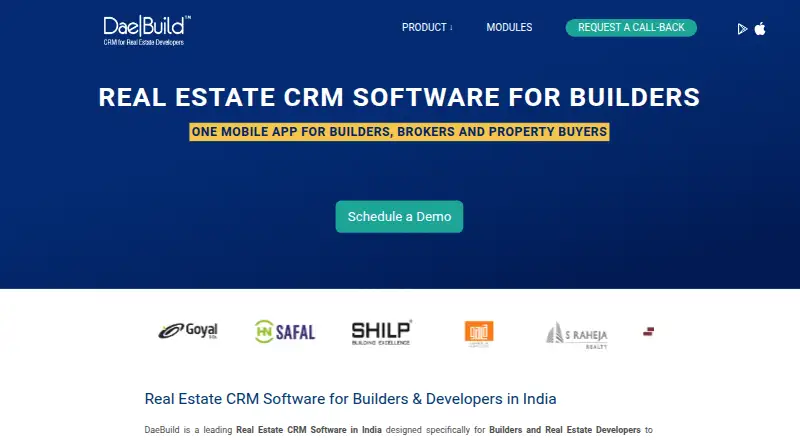
What DaeBuild is
DaeBuild is a paid CRM for real estate builders and developers, covering pre-sales and post-sales from lead capture through unit handover. It can run in the cloud or on premises, with web, Android, and iOS access. Lead tools capture and route prospects, track follow-ups and site visits, and provide sales-pipeline reporting. Sales and inventory functions monitor units, booking approvals, revenue, cash-flow projections, agreements, and possession. Customer accounts include payment schedules, payment history, automatic invoices, receipts, reminders, and document access. The system generates sales deeds, agreements, demands, and possession letters. Listed integration categories include social media, cloud telephony, WhatsApp Business API, chatbots, property portals, Google Ads, landing pages, and websites. DaeBuild lists permission-based access and daily backups, with storage on an office or host server. Builder, customer, and channel-partner apps are available; Android requires a DaeBuild account.
Good
- Covers pre-sales through unit handover
- Available cloud-hosted or on premises
- Tracks inventory, payments, and possession
- Generates real estate documents
- Provides daily backups and permission-based access
Watch out
- Pricing is available only on request
- Android builder app requires a DaeBuild account
- Implementation requires scheduling a demo or callback
Who it suits
DaeBuild suits small and large real estate developers managing lead, sales, inventory, customer-account, and handover processes. It supports organizations choosing cloud-hosted or on-premises deployment.
Verdict
DaeBuild links real estate lead management with inventory, customer payments, documents, and post-sales work. Request a demonstration to assess deployment, integrations, and account requirements.
The facts
Each one read from DaeBuild's own pages, with the date it was checked.
What it does
- Account requirement
- The builder app page states that a DaeBuild account is required to use the Android app.checked 12 Oct 2026
- Automated follow-up
- Yeschecked 20 Sep 2026
- Backups
- The product page states that DaeBuild has a daily data backup and retrieval system.checked 13 Oct 2026
- Compliance
- The customer management page describes its accounting system as GST compliant.checked 12 Oct 2026
- Customer accounts
- Customer account tools include payment schedules, payment history, automatic invoicing, receipts, reminders, and document access.checked 12 Oct 2026
- Deployment
- The CRM is offered as a cloud-hosted or on-premises platform.checked 13 Oct 2026
- Document generation
- The CRM can generate real estate documents including sales deeds, agreements, demands, and possession letters.checked 12 Oct 2026
- Documents
- The legal document module can generate ready-to-print sales deeds, agreements for sale, and demand letters.checked 13 Oct 2026
- Email marketing
- Yeschecked 20 Sep 2026
- Hosting
- The CRM is offered as a cloud-hosted or on-premises platform.checked 12 Oct 2026
- Integrations
- Listed integration categories include Facebook and Instagram, cloud telephony, WhatsApp Business API, chatbots, property portals, Google Ads, landing pages, and websites.checked 13 Oct 2026
- Intended users
- The CRM is designed for real estate builders and developers and connects them with channel partners and property buyers.checked 13 Oct 2026
- Inventory and sales
- The sales module tracks unit inventory, booking approvals, revenue, cash flow projections, agreements, and possession.checked 12 Oct 2026
- Lead management
- The pre-sales module captures leads from marketing platforms, distributes them to sales teams, and supports follow-ups and site visit scheduling.checked 13 Oct 2026
- Lead routing
- Yeschecked 20 Sep 2026
- Privacy
- The website privacy policy says visitors may submit personal information voluntarily and provides an email address for requesting deletion of records.checked 13 Oct 2026
- Product
- DaeBuild is a CRM for real estate developers covering pre-sales and post-sales processes.checked 13 Oct 2026
- Published pricing
- The pages reviewed direct prospects to schedule a demo or request a callback and do not state plan prices.checked 13 Oct 2026
- Purpose
- DaeBuild is a CRM for real estate builders and developers that manages pre-sales and post-sales activities from lead capture through unit handover.checked 12 Oct 2026
The company
- Company history
- Daemon Information Systems says it began offering internet-based solutions in Ahmedabad in 1998.checked 12 Oct 2026
- Founded
- 1998checked 23 Sep 2026
- Headquarters
- Ahmedabad, Gujarat, Indiachecked 23 Sep 2026
Where it runs
- Mobile app
- Yeschecked 20 Sep 2026
- Mobile apps
- DaeBuild offers Android and iOS apps for builders, customers, and channel partners, with features including lead registration, account access, payment updates, and construction updates.checked 13 Oct 2026
The full review of DaeBuild
DaeBuild is a real-estate CRM for builders and developers that carries work from lead capture through booking, payments, documents and possession. It suits organisations that need sales, inventory and post-sales administration in one system, especially those weighing cloud hosting against an on-premises installation. The main trade-off is a broad, specialised workflow sold through a quote rather than published plans.
Overview
DaeBuild combines pre-sales and post-sales operations instead of stopping at contact management. It captures and routes enquiries, records follow-ups and site visits, and reports on the sales pipeline. Once a unit is booked, the same environment can track approvals, inventory, revenue, projected cash flow, agreements and possession.
Deployment is available as a cloud-hosted or on-premises platform. A hosted setup favours teams that want the vendor to provide the operating environment, while an office-server option gives developers more control over where the system and data reside. DaeBuild is made by a company founded in 1998 and headquartered in Ahmedabad, Gujarat, India.
Key features
Lead and sales operations
Automated follow-up and lead routing address the gap between an enquiry and a site visit, helping teams distribute opportunities and keep contact work moving. Pipeline reporting gives managers a view of sales progress. Integration categories include social media, cloud telephony, WhatsApp Business API, chatbots, property portals, Google Ads, landing pages and websites, so DaeBuild can sit alongside several common acquisition channels. The range is useful for developers with established marketing pipelines, although the right integration depth should be confirmed during a demonstration.
Inventory, bookings and finance
The sales module connects unit inventory with booking approvals, revenue and cash-flow projections. Post-sales records cover customer accounts, payment schedules and payment history, while automatic invoices, receipts and reminders support collection work. This linked workflow is a stronger fit for property businesses than a CRM that requires separate spreadsheets for units and receivables.
Documents and customer access
DaeBuild can generate ready-to-print sales deeds, agreements for sale, demand letters and possession letters. Customers can receive document access, and the account tools keep invoices, receipts and payment records together. The accounting system is described as GST compliant, which is relevant to Indian developers managing tax-related billing.
Apps, security and data control
Android and iOS apps are described for builders, customers and channel partners. The builder app synchronises with the web app, extending access beyond the desk, but an account is required before the Android app can be used. Permission-based access, daily automatic backups and data storage on an office server or host server address operational control and recovery needs. These options will appeal to organisations with explicit access policies; they also make implementation and administration important parts of the buying decision.
Pricing
DaeBuild uses paid, quote-based pricing. Prospective customers are directed to request a demonstration or callback, so there is no published plan price, seat allowance, quota, trial period or renewal term to compare before contacting sales. That approach can accommodate a small developer or a larger organisation, but it makes budget screening and side-by-side comparisons slower. Ask for the implementation scope, user terms, hosting choice and any integration or support charges in the proposal.
Platforms
DaeBuild runs on the web and is offered as cloud-hosted or self-hosted software. Native apps are available for Android and iOS, with separate experiences described for builders, customers and channel partners. The builder application synchronises with the web system, while mobile use depends on having a DaeBuild account.
Who it's for
DaeBuild is aimed at real-estate builders and developers, and the maker positions it as scalable for both small and large developers. It is particularly appropriate for teams that want one process spanning marketing leads, site visits, inventory, booking approvals, collections, legal paperwork and possession. Developers that require an office-server deployment or GST-oriented accounting have clear reasons to shortlist it. It is less suitable for a buyer seeking transparent self-service pricing or a lightweight, generic contact database.
Pros and cons
Pros
- End-to-end property workflow: Lead capture, inventory, bookings, payments, documents and possession stay in one product.
- Flexible deployment: Cloud hosting and on-premises operation support different control and infrastructure policies.
- Operational automation: Lead routing, follow-up, invoicing, receipts and reminders reduce repetitive coordination.
- Mobile coverage: Android and iOS apps extend access to builders, customers and channel partners.
- Data safeguards: Permission-based access and daily backup and retrieval support controlled administration.
Cons
- Opaque cost: Pricing is supplied on request, so teams cannot assess affordability from a public rate card.
- Sales-led evaluation: A demonstration or callback is required to establish the commercial and deployment fit.
- Account dependency for Android: The builder app cannot be used without a DaeBuild account.
Alternatives
Propwise is the better starting point for a team wanting a freemium product with a free plan, trial, and Android, iOS and web access; its free workspace covers core CRM and lead management with a limited market-intelligence allowance.
LeadPixie suits teams seeking a no-time-limit free tier for up to 10 users across web, iOS and Android, while its Astra Starter option adds a real-estate module at a price that requires a quote.
Realatic is preferable when a small operation can work within a free forever plan limited to three users, 100 leads per month and one project, with a paid Pro tier available.
Sell.Do is an alternative for organisations comfortable with a custom quote based on team size, modules, AI usage and communication volumes, with a five-user minimum.
Rechat is another paid option with web, iOS, Android and macOS support.
eesy fits a web-only buyer that wants a free tier for one agent and 50 contacts, or a monthly Starter plan at 295.00 EUR.
UplevelRE is suited to buyers who prefer separately priced web and API modules, including a 49.00 USD monthly Platform plan for one user and a 39.00 USD monthly Marketing Suite with 1,000 campaign emails.
MRI Vault CRM is an alternative for businesses seeking customised plans, pricing and services through a quote.
For a wider category comparison, see Real Estate CRM Software.
Verdict
Choose DaeBuild if you are a builder or developer that wants a property-specific system linking leads, units, customer finances, legal documents and possession, with cloud or on-premises deployment. Its main reason to look elsewhere is the lack of public pricing and plan limits, which makes early budget and feature comparison dependent on a sales conversation.