
Crust Network
Crust Network is a blockchain-based decentralized storage network supporting IPFS and application storage interfaces.
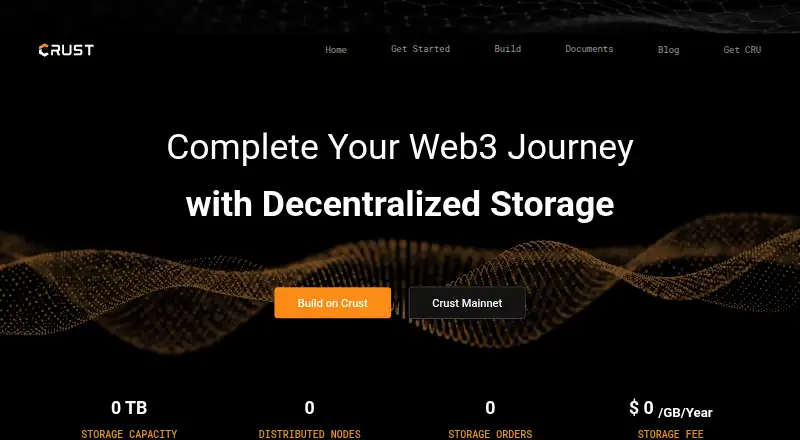
What Crust Network is
Crust Network is a blockchain-based decentralized storage network supporting IPFS and application storage interfaces. Users place on-chain orders for files identified by IPFS CIDs, and Crust nodes fetch, store, and distribute them. Orders show as waiting while nodes retrieve files and successful after storage. Successful files can be reached through standard IPFS interfaces and gateways. Uploads can use a gateway, with authorization signed by a Crust account at no transaction fee, or a local IPFS client. Storage pricing changes with network storage, on-chain state, and throughput resources; users may add a tip to expedite an order. The Storage User application and download links provide retrieval, while IPFS Scan displays distribution, retrieval locations, storing nodes, and storage status. Developers can use crust.js, JavaScript libraries, and website-publishing tools including the CLI, Node.js package, and GitHub Action. Trusted Execution Environment technology supports storage proofs. Crust Wallet is non-custodial, and lost mnemonic phrases or backups cannot recover accounts or assets.
Good
- IPFS-compatible decentralized storage
- On-chain orders identified by IPFS CIDs
- Gateway and local IPFS uploads
- Storage status visible through IPFS Scan
- CLI, Node.js, and GitHub Action publishing
Watch out
- Storage fees change dynamically
- Orders can remain waiting while nodes fetch files
- Files smaller than 32G are recommended for troubleshooting
- Lost wallet recovery phrases cannot recover assets
Who it suits
Crust Network suits developers and applications needing decentralized IPFS-compatible storage. It also fits teams publishing websites through command-line, Node.js, or GitHub Action workflows.
Verdict
Crust Network combines on-chain storage orders, IPFS access, developer tooling, and verifiable storage proofs. Its variable fees and non-custodial wallet responsibilities require careful operational planning.
The facts
Each one read from Crust Network's own pages, with the date it was checked.
What it does
- Account security
- Crust Wallet is non-custodial; the maker says lost mnemonic phrases or backup files cannot be used to recover the account or its assets.checked 4 Oct 2026
- Consensus
- Crust's GPoS consensus uses storage-proof reports to calculate storage-related parameters and encourages token holders to stake with nodes.checked 9 Oct 2026
- Developer API
- Crust provides a PolkadotJS-based SDK, crust.js, for accessing Crust Network functionality.checked 4 Oct 2026
- Developer tools
- Crust documents JavaScript libraries for interacting with the network, with code released under an Apache-2.0 license.checked 9 Oct 2026
- File uploads
- Users can upload through a gateway or use a local IPFS client; gateway uploads require signing with a Crust account, and that authorization has no transaction fee.checked 4 Oct 2026
- Hosting integrations
- The documented GitHub Actions workflow can use Crust's public IPFS gateway or other pin services, including Pinata and IPFS Cluster.checked 9 Oct 2026
- Integrations
- The maker documents website publishing through Crust CLI, a Node.js package, or a GitHub Action.checked 4 Oct 2026
- Notable limit
- The maker recommends keeping files smaller than 32G when troubleshooting storage orders that remain pending.checked 4 Oct 2026
- Pricing
- Storage fees are dynamically calculated; an order fee includes a basic file fee, a dynamic adjustment fee and an optional user-selected tip.checked 9 Oct 2026
- Proof mechanism
- Crust says its MPoW storage-proof mechanism uses Trusted Execution Environment technology to check storage and generate reports verifiable by network nodes.checked 9 Oct 2026
- Retrieval
- Users can retrieve stored files through the Storage User application or use its download link.checked 4 Oct 2026
- Security
- Crust describes its storage proof layer as using Trusted Execution Environment technology to periodically check node storage and produce workload reports verifiable by other nodes.checked 4 Oct 2026
- Smart contract integrations
- Crust documents storage smart contracts deployed on Ethereum, Arbitrum One, Polygon, Astar, Aptos and Elrond.checked 9 Oct 2026
- Storage access
- After an order succeeds, files can be accessed through standard IPFS interfaces and gateways.checked 9 Oct 2026
- Storage market
- Users can place on-chain storage orders for files, which Crust nodes store and distribute.checked 4 Oct 2026
- Storage orders
- Users can place on-chain storage orders for files identified by IPFS CIDs, and Crust nodes store those files.checked 9 Oct 2026
- Storage order status
- Crust Apps shows orders as waiting while nodes fetch the file and success after Crust nodes have fetched and stored it.checked 9 Oct 2026
- Storage status
- IPFS Scan displays file distribution, retrieval locations, storing nodes, and storage status across incentive layers.checked 4 Oct 2026
- Support
- The developer documentation directs users to log issues or submit pull requests for documentation gaps and questions.checked 9 Oct 2026
- Wallet limitation
- Crust Wallet supports interaction with Crust Mainnet but not Crust Parachain or ERC20-based CRU tokens.checked 9 Oct 2026
- Website hosting
- Crust documents three ways to publish websites: its command-line tool, a Node.js package and a GitHub Action.checked 9 Oct 2026
- What it does
- Crust provides a decentralized storage network that supports protocols such as IPFS and exposes storage interfaces to applications.checked 9 Oct 2026
Alternatives to Crust Network
- 1

Sia
Free planOpen sourceAndroidiOSWebAPI8.4From $7.99 a month - 2

Aleph Cloud (formerly Aleph.im)
Free planOpen sourceWebAPILinuxmacOS8.1$0.01 usage-based - 3
Datum Storage
Free planAndroidiOSWebAPI7.9From $3.99 a month - 4
Carbide Network
Free planAndroidiOSAPImacOS7.6$0.01 usage-based - 5

Peergos
Free planAndroidWebLinuxmacOS6.9Free plan - 6

Storj
WebAPILinuxmacOS6.8From $29 a month