
ClickSend SMS API
ClickSend SMS API provides business text messaging through a browser service or API.
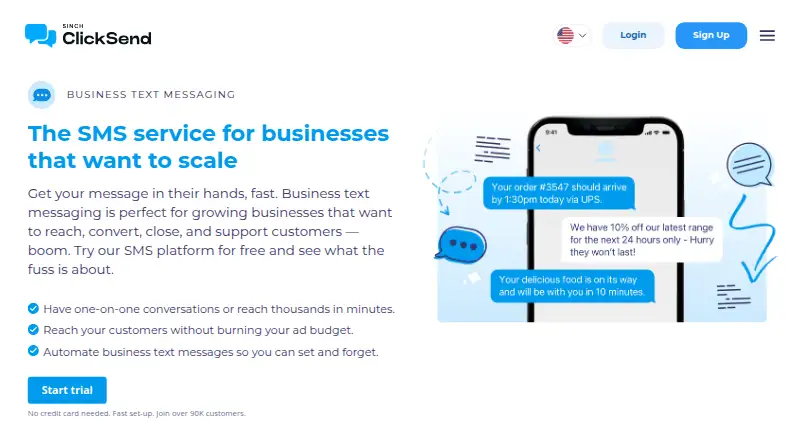
What ClickSend SMS API is
ClickSend SMS API provides business text messaging through a browser service or API. Businesses can send promotional campaigns, transactional messages such as reminders and delivery updates, and one-time passwords. The API supports sending and managing SMS, checking send costs, and reviewing message history. Two-way messaging allows customers to reply, and ClickSend says inbound replies are free. Recurring workflows can be built with no-code integrations or code, with connections including Zapier, Microsoft Power Automate, Make, Salesforce, and IFTTT. SDKs are available for PHP, Node.js, Ruby, Swift, Objective-C, Python, C#, Java, Go, and Perl. ClickSend describes TLS 1.2 protection for customer connections and encryption for sensitive data at rest and in transit. It advertises human-staffed chat support 24 hours a day, 365 days a year, and a 99.95% uptime SLA guarantee. A 14-day trial is available, but there is no free plan. New customers need support approval for SMS containing URLs.
Good
- Supports two-way messaging with free inbound replies.
- Offers SDKs in ten listed programming languages.
- Lists integrations including Salesforce and IFTTT.
- Advertises year-round human-staffed chat support.
- Provides a 14-day trial.
Watch out
- No free plan is available.
- Carrier fees apply in addition to messaging.
- Messages over 160 characters use multiple parts.
- New customers need approval for SMS containing URLs.
Who it suits
It suits businesses that need API-based or browser-based SMS for campaigns, operational updates, or one-time-password verification. Teams can connect recurring workflows through listed integrations or developer SDKs.
Verdict
ClickSend combines business SMS, workflow automation, and developer tools for both outbound and conversational messaging. Before choosing it, account for carrier fees, multi-part messages, and the URL approval limitation for new customers.
Plans and prices
From ClickSend SMS API's own pricing page, checked 15 Oct 2026.
| Plan | Price | What it gives you |
|---|---|---|
| Enterprise | $0.01, paid once | 67% saving · additional carrier fees apply · per SMS when topping up from $2,000 |
| Scale | $0.01, paid once | 54% saving · additional carrier fees apply · per SMS when topping up from $1,000 |
| Growth | $0.02, paid once | 28% saving · additional carrier fees apply · per SMS when topping up from $100 |
| Boost | $0.03, paid once | small-business tier · additional carrier fees apply · per SMS when topping up from $20 |
| Dedicated Number | $3.46 a month | US number · inbound SMS free · monthly |
The facts
Each one read from ClickSend SMS API's own pages, with the date it was checked.
What it does
- Access controls
- Customers can manage API keys in the web portal, while ClickSend says staff access uses role-based controls and multi-factor authentication.checked 2 Oct 2026
- Analytics
- SMS marketing pages state that campaign reporting and analytics are available after sending.checked 15 Oct 2026
- API authentication
- The v2 HTTP API authenticates with an API username and key, or subaccount credentials, and recommends SSL.checked 15 Oct 2026
- API functions
- The SMS API supports sending and managing SMS, checking send costs, and viewing message history.checked 2 Oct 2026
- API limits
- The legacy HTTP API documentation recommends POST for up to 1,000 simultaneous recipients and GET for fewer than 100.checked 15 Oct 2026
- API protocols
- The company offers REST, HTTP, FTP and SMPP interfaces for SMS integration.checked 15 Oct 2026
- Automation
- ClickSend describes recurring message workflows ranging from no-code integrations to full-code builds.checked 2 Oct 2026
- Compliance infrastructure
- ClickSend hosts data on AWS and points to AWS accreditation for ISO 27001, HIPAA and SOC 2 requirements.checked 15 Oct 2026
- Contact management
- The service supports contact-list segmentation and campaign management features.checked 15 Oct 2026
- Credit policy
- Trial credits expire after 14 days, while prepaid credits remain available until an account has been inactive for 12 months.checked 15 Oct 2026
- Developer tools
- ClickSend offers SDKs for PHP, Node.js, Ruby, Swift, Objective-C, Python, C#, Java, Go, and Perl.checked 2 Oct 2026
- Documentation depth
- Developer documentation includes API reference pages, quickstarts, Postman collections, OpenAPI downloads, authentication, errors, testing numbers and delivery callbacks.checked 15 Oct 2026
- Global coverage
- The developer site says the API sends SMS and MMS to more than 190 countries through direct routes.checked 15 Oct 2026
- Integrations
- ClickSend advertises more than 200 integrations and names Zapier, Make, Power Automate, Salesforce, IFTTT, Magento and Bubble among them.checked 15 Oct 2026
- Limit: advanced features
- G2 reviewers say the product lacks some sophisticated features and offers limited customization compared with more advanced platforms.checked 15 Oct 2026
- Limit: delivery and compliance
- Trustpilot reviews include complaints about country-specific delivery failures and carrier registration or compliance requirements.checked 15 Oct 2026
- Messaging
- The service supports two-way conversational messaging, and the pricing page says inbound SMS replies are free.checked 2 Oct 2026
- MMS feature
- The platform API supports sending images and videos over text as MMS.checked 15 Oct 2026
The company
- Company legal name
- The Android listing identifies the developer as ClickSend Pty Ltd.checked 15 Oct 2026
- Company size
- ClickSend says it employs more than 100 people across four continents.checked 15 Oct 2026
- Founded
- ClickSend says founder Matt Larner started the company in 2013.checked 15 Oct 2026
- Headquarters
- LinkedIn lists Melbourne, Victoria as headquarters, while ClickSend describes its origin as Perth, Western Australia.checked 15 Oct 2026
Money
- Limit: high-volume cost
- G2 review summaries report that costs can become high for large message volumes.checked 15 Oct 2026
- Limit: trial credits
- Software Advice reviewers complain that the free trial credits are insufficient for fully evaluating the product.checked 15 Oct 2026
The full review of ClickSend SMS API
ClickSend SMS API combines browser-based business texting with an API for sending and receiving SMS. It is best suited to teams automating campaigns, alerts, or verification messages across existing tools. Its broad developer and workflow support is balanced by substantial minimum top-ups and a URL restriction for new customers.
Overview
ClickSend handles promotional texts, transactional messages such as reminders and delivery updates, and one-time-password verification. The API can send and manage messages, check send costs, and show message history; delivery status, webhooks, and two-way messaging support follow-up and operational tracking. Inbound SMS replies are free, which helps keep conversational exchanges from adding a separate reply charge.
Recurring workflows can be built through no-code integrations or full-code implementations. That range makes the service relevant to both operations teams and developers, though businesses whose messages depend on URLs should resolve ClickSend’s approval restriction before committing: URL-containing SMS is paused for new customers unless support approves it.
Key features
- API and developer support: SDKs cover PHP, Node.js, Ruby, Swift, Objective-C, Python, C#, Java, Go, and Perl. That breadth reduces the need to build directly against an API in an unfamiliar language, while message history and cost checks help with routine administration.
- Workflow integrations: Listed connections include Zapier, Microsoft Power Automate, Make, GoHighLevel, ActiveCampaign, Salesforce, Bubble.io, and IFTTT. Teams can connect recurring messaging to those tools; organizations outside these ecosystems may need to build a custom integration.
- Security controls: ClickSend says connections use TLS 1.2 with AES ciphers and that sensitive data is encrypted at rest and in transit. Customers manage API keys through the web portal; staff access uses role-based controls and multi-factor authentication.
- Support and uptime: The SMS page advertises chat staffed by people 24 hours a day, 365 days a year, and a 99.95% uptime SLA guarantee. Those commitments are useful for business-critical messaging, though they do not remove the need to account for carrier fees and message-part billing.
Pricing
ClickSend is paid, offers a 14-day trial, and has no free plan. Its pay-as-you-go tiers are presented at no cost, with the top-up amount and discount distinguishing them: Boost requires a top-up from $20 and has no subscription; Growth starts at $500 and saves 7%; Scale starts at $3,000 and saves 14%; Enterprise starts at $10,000 and saves 21%.
Boost is the least-committal fit for lower-volume senders, but its $20 minimum still means funding an account rather than paying only for a single message. Growth, Scale, and Enterprise offer progressively larger savings in return for much larger top-ups, so they suit teams confident in their volume better than occasional senders. Inbound replies are free, but additional carrier fees apply, and SMS longer than 160 characters is billed as multiple message parts. Those charges can make campaign length and destination mix important cost controls.
Platforms
ClickSend supports API, iOS, macOS, and web. The web portal provides a browser route for business SMS and API-key management, while the API and SDKs suit teams embedding messaging in software or workflows.
Who it's for
ClickSend is a strong fit for businesses that need a mix of transactional and promotional SMS, want replies or delivery status in their processes, and can use its integrations or SDKs. It is less suitable for a low-volume buyer unwilling to meet a top-up minimum, or for a new customer whose messages must contain URLs before approval is secured.
Pros and cons
- Pro — flexible implementation: A broad SDK lineup, workflow integrations, browser access, webhooks, and delivery status give teams several ways to fit messaging into existing operations.
- Pro — supports conversations: Two-way messaging and free inbound replies make response-based workflows practical without a separate inbound SMS charge.
- Pro — explicit reliability and support commitments: The advertised 99.95% uptime SLA and year-round human-staffed chat are relevant for operational messaging.
- Con — top-ups rise sharply across discounted tiers: Savings require funding from $500 to $10,000 beyond the $20 Boost entry point, which can be a poor fit for uncertain or modest usage.
- Con — usage costs can exceed the headline tier: Carrier fees are additional and messages over 160 characters count as multiple parts.
- Con — URL approval can block a common message pattern: New customers cannot send SMS containing URLs unless support approves them.
Alternatives
For a broader category comparison, browse Transactional SMS Software.
- Mailchimp is worth considering when email campaigns matter more than API-based SMS: its free plan includes 250 contacts, 500 emails per month, 250 per day, one audience, and one seat.
- Bandwidth Messaging API is another paid API option with a free trial and per-message U.S. outbound SMS plans; choose it when those U.S. routes better match your needs.
- Telnyx SMS API is a paid API alternative with published pay-as-you-go rates before volume tiers; compare it if rate-based pricing is a priority.
- Clickatell SMS API offers a free plan and trial alongside prepaid messaging with destination- and message-type-dependent prices; it may suit a buyer seeking that alternative pricing setup.
- Gupshup is a paid API and web option with a free plan and a stated 0.001 USD per-message fee; consider it if that fee structure is more suitable.
- Telnyx Text-to-Speech API is a separate API product to consider when text-to-speech, rather than SMS, is the requirement.
- Bird Verify is an API option with a free plan where verification is included and channel-message charges apply; consider it for verification-focused needs.
- 2Factor.in OTP API offers a free Starter plan with test credits, sandbox channels, REST API and SDKs, email support, and basic analytics; consider it when OTP testing is the priority.
Verdict
Choose ClickSend when you need business SMS that can span campaigns, transactional alerts, and two-way workflows, backed by broad SDK coverage and round-the-clock chat. Look elsewhere if your volume cannot justify even the $20 top-up, if message economics depend on avoiding carrier and multi-part charges, or if new-customer SMS must include URLs without approval.
Getting started
- Visit the ClickSend SMS website.
- Choose the API or browser service for sending and managing messages.
- Use the 14-day trial to get started.
- Select a pay-as-you-go top-up level: $20, $500, $3,000, or $10,000.
- Manage API keys through the web portal if using the API.
Limits worth knowing
The trial lasts 14 days, and the listed pay-as-you-go top-ups start at $20. Additional carrier fees apply, messages exceeding 160 characters are charged as multiple parts, and new customers need support approval to send SMS containing URLs.
Questions
Is ClickSend SMS API free?
There is no free plan. A 14-day trial is available, followed by pay-as-you-go top-ups.
What does it cost?
The listed top-up levels are $20, $500, $3,000, and $10,000. Additional carrier fees apply.
What platforms does ClickSend support?
The listed platforms are API, iOS, macOS, and web.
Can recipients reply to ClickSend messages?
Yes. The service supports two-way messaging, and ClickSend says inbound SMS replies are free.
Which integrations are available?
Listed integrations include Zapier, Microsoft Power Automate, Make, GoHighLevel, ActiveCampaign, Salesforce, Bubble.io, and IFTTT.
Can new customers send messages with URLs?
ClickSend says it is pausing SMS messages containing URLs for new customers. They can contact support to request approval.
Alternatives to ClickSend SMS API
- 1

Mailchimp
Free planAndroidiOSWebAPI8.3From $13 a month - 2

Textmagic
Free planAndroidiOSWebAPI8.2Free plan - 3
Commio SMS API
Free planAndroidiOSWebAPI7.9From $0.25 a month - 4
LINK Mobility SMS API
Free planAndroidiOSWebAPI7.9From zł49 a month - 5

Callr
AndroidiOSWebAPI7.6From €599 a month - 6
D7 Networks
Free planWebAPI7.5$0.01 one-time