
Clawd Cursor
Clawd Cursor gives AI agents local control of desktop applications for GUI tasks where a native API or command-line tool is unavailable.
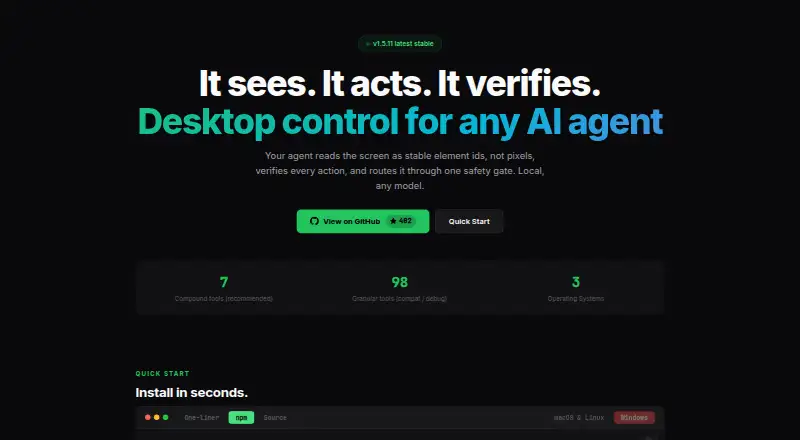
What Clawd Cursor is
Clawd Cursor gives AI agents local control of desktop applications for GUI tasks where a native API or command-line tool is unavailable. It builds a screen map from accessibility information and OCR, assigning stable element IDs and confidence scores; screenshots are used when needed. Agents can click and type, and actions can be checked against an expected result. The maker says every tool call passes through one safety layer, and describes the software as local, localhost-only by default, and without telemetry. Connections are available through stdio MCP or an HTTP MCP daemon, with Claude Code, Cursor, Windsurf, OpenClaw, and Zed listed as MCP hosts. The tool includes seven recommended compound tools and 98 granular tools for compatibility and debugging, and its maker says it works with any model. It supports Windows, macOS 12 or later, and Linux X11/Wayland. Clawd Cursor is free and MIT licensed. Installation requires Node.js 20 or later; desktop control requires one-time consent, and macOS requires Accessibility permission.
Good
- Maps screen elements with accessibility data and OCR.
- Actions can be checked against expected outcomes.
- Localhost-only by default, according to its maker.
- Supports Windows, macOS, and Linux.
- Free and MIT licensed.
Watch out
- Installation requires Node.js 20 or later.
- Desktop control requires one-time consent.
- macOS requires Accessibility permission.
- Screen Recording is optional for vision fallback.
Who it suits
It suits people configuring AI agents to perform desktop GUI tasks locally when a native API or CLI is not available. It may be relevant if your system and MCP host are among those listed.
Verdict
Clawd Cursor is a local desktop-control option for agent-driven GUI work, with explicit consent and action checks. Before setting it up, account for the Node.js requirement and platform permissions.
Plans and prices
From Clawd Cursor's own pricing page, checked 29 Sep 2001.
| Plan | Price | What it gives you |
|---|---|---|
| Clawd Cursor | Free | Open source · MIT |
The facts
Each one read from Clawd Cursor's own pages, with the date it was checked.
What it does
- Connection modes
- Agents can connect through stdio MCP or an HTTP MCP daemon on 127.0.0.1:3847/mcp.checked 29 Sep 2001
- Installation requirement
- The GitHub README says Node.js 20 or later is required.checked 29 Sep 2001
- Integrations
- The site lists Claude Code, Cursor, Windsurf, OpenClaw, and Zed as MCP hosts.checked 29 Sep 2001
- Intended use
- The README describes it as a last-mile option for GUI tasks where a native API or CLI is unavailable.checked 29 Sep 2001
- License
- The site identifies Clawd Cursor as MIT licensed.checked 29 Sep 2001
- Local operation
- The maker describes it as local, localhost-only by default, and without telemetry.checked 29 Sep 2001
- Model support
- The maker says it works with any model; the daemon can also use a configured built-in LLM.checked 29 Sep 2001
- Operating systems
- It supports Windows x64/ARM64, macOS 12 or later, and Linux X11/Wayland.checked 29 Sep 2001
- Permissions
- Desktop control requires one-time consent; macOS also requires Accessibility permission, while Screen Recording is optional for vision fallback.checked 29 Sep 2001
- Safety
- Every tool call passes through one safety layer, and actions can be checked against an expected outcome.checked 29 Sep 2001
- Screen reading
- It combines accessibility data and OCR into a confidence-scored map with stable element IDs, using screenshots only when needed.checked 29 Sep 2001
- Tools
- It offers 7 recommended compound tools and 98 granular tools for compatibility and debugging.checked 29 Sep 2001
- What it does
- Clawd Cursor gives AI agents local control of desktop apps through a screen map, actions such as clicks and typing, and action verification.checked 29 Sep 2001
The full review of Clawd Cursor
Overview
Clawd Cursor gives AI agents a way to work in desktop apps when a native API or CLI is unavailable. It is best suited to developers building agent workflows who want local GUI control with explicit consent and action checks. Its focus is deliberately narrow: a last-mile bridge to graphical interfaces, not a substitute for direct integrations.
The maker describes it as localhost-only by default and without telemetry. Agents connect through stdio MCP or an HTTP MCP daemon at 127.0.0.1:3847/mcp, and the software is MIT licensed. That local-first design will appeal to people who want desktop actions to stay on their machine, though the setup still requires operating-system permissions.
Key features
Screen understanding and action checks
Clawd Cursor combines accessibility data and OCR into a confidence-scored screen map, assigning stable IDs to interface elements. Agents can target those elements for actions such as clicking and typing; screenshots are used only when needed as a vision fallback. This offers a more structured target than screen coordinates alone, while confidence scoring signals that screen interpretation is not infallible. Actions can be checked against an expected outcome, a useful safeguard when an agent is changing desktop state.
Agent connections and tools
Claude Code, Cursor, Windsurf, OpenClaw, and Zed are named as MCP hosts. Seven recommended compound tools provide a shorter path to common operations, while 98 granular tools support compatibility and debugging. The maker says the system works with any model, and the daemon can also use a configured built-in LLM. That breadth suits developers adapting different agents; the distinction between compound and granular tools also means the larger tool set is not the only starting point.
Every tool call passes through one safety layer, and desktop control requires one-time consent. macOS additionally requires Accessibility permission; Screen Recording is optional for vision fallback. The checks and consent reduce the risk of silent control, but this remains software that can act on desktop apps, so it is not the right fit for unattended workflows that cannot tolerate mistaken actions.
Pricing
Clawd Cursor is free: its sole plan, Clawd Cursor, costs nothing and is open source under MIT. There is no free trial because there is no paid tier to trial. The plan includes desktop app control, browser control, screen understanding, local deployment, human approval controls, and API access. The open-source license and free plan make it a practical option for individuals and teams able to handle their own setup; there are no paid-plan quotas, seat limits, or renewal terms to weigh.
The trade-off is operational rather than financial. Installation requires Node.js 20 or later, desktop control needs one-time consent, and macOS users must grant Accessibility permission. Windows supports x64 and ARM64, macOS requires version 12 or later, and Linux supports X11 and Wayland.
Platforms
Clawd Cursor runs on Windows, macOS, and Linux, and its deployment is local. It supports Windows x64 and ARM64, macOS 12 or later, and Linux X11 or Wayland. The connection options are stdio MCP and an HTTP MCP daemon on 127.0.0.1:3847/mcp. This makes it relevant to desktop-agent developers across the three major desktop platforms, but not to readers seeking a hosted GUI-control service.
Who it's for
Choose Clawd Cursor if you are connecting an AI agent to desktop software with no suitable API or CLI, and want local operation, consent, and outcome checks. It is especially suited to technical users comfortable with Node.js, MCP connections, and platform permissions. If your workflow already has a dependable native integration, Clawd Cursor's stated last-mile role gives little reason to add GUI control.
Pros and cons
- Pros: Localhost-only operation by default and no telemetry, as described by the maker, suit privacy-conscious local workflows.
- Pros: A confidence-scored map with stable element IDs and action checks gives agents structure and a way to verify outcomes.
- Pros: The free MIT-licensed plan includes local desktop and browser control, screen understanding, approval controls, and API access.
- Cons: Node.js 20 or later is required, and macOS users must grant Accessibility permission, adding setup work.
- Cons: The product is intended for last-mile GUI tasks; it is not a compelling layer when a native API or CLI already handles the job.
Alternatives
Browse AI Computer Use Agents to compare this category. Consider Contop if you want an alternative spanning Android and iOS as well as desktop platforms. QuickDesk is another free, MIT-licensed option, with no feature restrictions or connection limits in its open-source plan. Pan-Agent is a free alternative across API, self-hosted, and desktop platforms.
UFO is another free option, with Android, Linux, and Windows support. Choose Simular Sai instead if its cloud-based Windows computer and credit-based access suit your workflow; its Starter plan is $50 a month, billed at an early-access discount. Screenbox is another free choice across web, Windows, macOS, and Linux. DesktopCtl is worth considering for a macOS-only option that requires no integrations and works with any desktop app. Lapu AI offers a free core plan and a paid Premium tier at €16 a month, billed yearly at €192 with a 20% saving.
Verdict
Clawd Cursor is a strong fit for developers who need local, agent-driven control of desktop apps that lack a native integration. Its free MIT license, structured screen map, and action checks are the reasons to choose it. Look elsewhere if you need a hosted service, want to avoid Node.js and permission setup, or can handle the task through a native API or CLI instead.
Alternatives to Clawd Cursor
- 1

Claude Code
Free planAndroidiOSWebWindows7.4From $17 a month - 2

Gemini
Free planAndroidiOSWebWindows6.9Free plan - 3
Computer Use OOTB
Free planWebmacOSSelf-hostedWindows6.8Free plan - 4
Lapu AI
Free planmacOSWindows6.7From €16 a month - 5
QuickDesk
Free planAndroidWebAPImacOS6.5Free plan - 6
Contop
AndroidiOSLinuxmacOS6.4