
Certinal
Certinal describes itself as a healthcare consent and compliance platform for capturing, digitally signing, version-controlling, and filing patient consent t…
What Certinal is
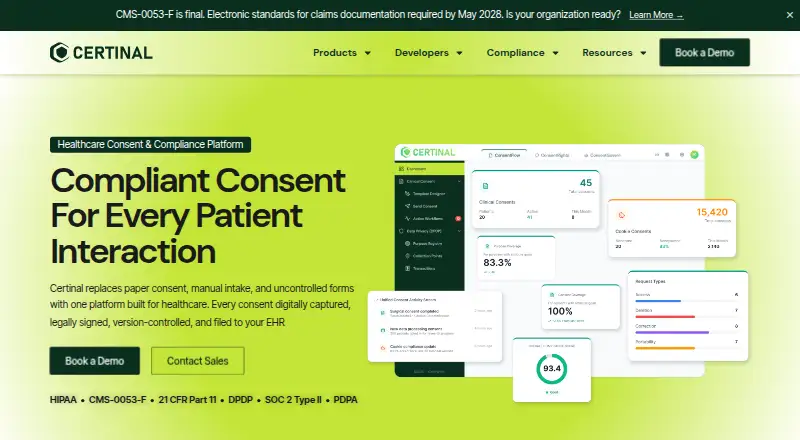
Certinal describes itself as a healthcare consent and compliance platform for capturing, digitally signing, version-controlling, and filing patient consent to an EHR. Its healthcare workflows cover surgical, procedure-specific, clinical trial, general treatment, and data-processing consent. Patients can complete registration and consent before appointments through secure SMS or email links. The eSignature product supports sequential, parallel, and hybrid signing, along with templates, bulk sending, audit trails, SMS authentication, and configurable signing order. Certinal says it connects directly with Epic, Oracle Cerner, MEDITECH, and OpenEMR; other systems can connect through HL7 and FHIR APIs. Listed business connectors include Salesforce, SharePoint, Workday, SAP, Oracle, and Google. The API Enterprise plan includes REST API access, embedded signing, white-labeling, real-time reporting, and customized workflows. The healthcare product page says data is encrypted at rest with AES-256 and in transit with TLS 1.2 or higher, with a signed BAA for healthcare customers. Certinal is available on Android, iOS, web, and via API. Pricing is on request, and the eSign FAQ offers a two-week trial at no additional cost.
Good
- Supports several patient consent workflows.
- Patients can complete consent before appointments.
- Direct connections include Epic and MEDITECH.
- Offers a two-week trial at no additional cost.
- Healthcare data encryption and a signed BAA are described.
Watch out
- Pricing is on request.
- eSign Enterprise lists a 100MB file size limit.
- Implementation timing depends on requirements.
Who it suits
Certinal's healthcare consent plan is intended for enterprise health systems managing consent across multiple hospitals, departments, and regulatory geographies. Its eSignature and API options may suit organizations needing signing workflows or system integrations.
Verdict
Certinal combines healthcare consent workflows with eSignature and API options. Health systems should confirm pricing, integration needs, and implementation requirements with the provider.
Plans and prices
From Certinal's own pricing page, checked 20 Sep 2026.
| Plan | Price | What it gives you |
|---|---|---|
| Consent and Compliance Enterprise | — | Clinical and data-processing consent · Multi-channel capture · EMR-native integration · Tamper-proof audit trail · Identity verification |
| eSign Enterprise | — | 100 MB file size limit |
| eSignature API Enterprise | — | REST API · Embedded signing · Full white-labeling · Real-time reporting · Customized workflows |
| eSignature API Sandbox | Free | Limitless sandbox · enterprise-level functionality · REST API testing |
| eSignature API Enterprise Plan | Priced on request | REST API · embedded signing · full white-labeling · real-time reporting · customized workflows |
| Consent and Compliance Enterprise Plan | Priced on request | Clinical and data processing consent · multi-channel capture · EMR-native integration · 80+ languages · identity verification |
| eSign Enterprise Plan | Priced on request | 100MB file size limit · real-time status · templates · bulk send · two-factor authentication · mobile/tablet signing |
The facts
Each one read from Certinal's own pages, with the date it was checked.
What it does
- API
- The API Enterprise plan includes REST API, embedded signing, white-labeling, real-time reporting, and customized workflows.checked 11 Oct 2026
- API access
- Yeschecked 20 Sep 2026
- Audit trail
- Yeschecked 20 Sep 2026
- Bulk sending
- Yeschecked 20 Sep 2026
- Compliance
- Certinal lists ISO 27001:2013, SSAE SOC I and SOC II Type 2, IRAP, and other security and privacy standards on its compliance page.checked 11 Oct 2026
- Consent workflows
- Healthcare consent workflows cover surgical, procedure-specific, clinical trial, general treatment, and data processing consent.checked 11 Oct 2026
- Document templates
- Yeschecked 20 Sep 2026
- eSignature
- Its eSignature product supports sequential, parallel, and hybrid signing workflows.checked 11 Oct 2026
- File limit
- The eSign Enterprise plan lists a 100MB file size limit.checked 11 Oct 2026
- Healthcare EHRs
- Certinal says it integrates directly with Epic, Oracle Cerner, MEDITECH, and OpenEMR, with other systems supported through HL7 and FHIR APIs.checked 11 Oct 2026
- Implementation
- Certinal says eSignature implementation can be completed within a week, subject to implementation requirements.checked 11 Oct 2026
- Integrations
- The integrations page lists Salesforce, SharePoint, Workday, SAP, Oracle, and Google connectors.checked 11 Oct 2026
- Intended customers
- The pricing page describes its healthcare consent plan as purpose-built for enterprise health systems managing consent across multiple hospitals, departments, and regulatory geographies.checked 11 Oct 2026
- Patient intake
- Patients can complete digital registration and consent before an appointment through a secure SMS or email link.checked 11 Oct 2026
- Product
- Certinal describes itself as a healthcare consent and compliance platform that captures, digitally signs, version-controls, and files patient consent to the EHR.checked 11 Oct 2026
- Security
- The healthcare product page says data is encrypted at rest with AES-256 and in transit with TLS 1.2 or higher, with a signed BAA for healthcare customers.checked 11 Oct 2026
- Signature order
- bothchecked 20 Sep 2026
- SMS authentication
- Yeschecked 20 Sep 2026
The company
- Headquarters
- Wilmington, Delaware, United Stateschecked 28 Sep 2026
Money
- Trial
- The eSign FAQ says Certinal offers a two-week trial at no additional cost.checked 11 Oct 2026
The full review of Certinal
Certinal is a healthcare consent platform with electronic signing and API options. It is best suited to enterprise health systems coordinating consent across facilities and departments. Its appeal is the connection between patient intake, consent workflows, and EHRs; buyers should be prepared for custom pricing and implementation planning.
Overview
Certinal covers consent capture, digital signing, version control, and filing to an EHR. Patients can complete registration and consent before an appointment through a secure link sent by SMS or email, which makes it a strong fit for organizations bringing paperwork into digital intake. Its healthcare focus and enterprise orientation are less compelling for a small team that only needs basic document signing.
Direct integrations include Epic, Oracle Cerner, MEDITECH, and OpenEMR; other systems can connect through HL7 and FHIR APIs. Certinal also lists connectors for Salesforce, SharePoint, Workday, SAP, Oracle, and Google. That breadth can help fit consent into established systems, though the value depends on each organization's integration and implementation requirements.
Key features
Consent and signing workflows
Healthcare consent workflows span surgical, procedure-specific, clinical trial, general treatment, and data-processing consent. The Consent and Compliance Enterprise plan combines clinical and data-processing consent with multi-channel capture, EMR-native integration, and identity verification; another plan description also includes support for 80+ languages. This is a focused package for health systems managing consent across multiple hospitals, departments, and regulatory geographies, rather than a general-purpose signing plan.
Certinal eSignature supports sequential, parallel, and hybrid signing, so organizations can accommodate different approval paths. Audit trails and document templates support recordkeeping and repeatable workflows, while bulk sending can help when many documents need to be issued. SMS authentication adds another identity-check option. These capabilities suit structured, high-volume processes better than occasional one-off signing.
API, security, and implementation
The API Enterprise plan includes REST API access, embedded signing, white-labeling, real-time reporting, and customized workflows. That makes it the more relevant option for teams embedding signing into their own applications or processes. The API Sandbox provides an open REST API 3.0 sandbox with enterprise-level functionality, but it is a sandbox plan rather than a substitute for the Enterprise plan's production-oriented features.
Certinal says healthcare data is encrypted at rest with AES-256 and in transit with TLS 1.2 or higher, and that it provides a signed BAA for healthcare customers. Its compliance materials list ISO 27001:2013, SSAE SOC I and SOC II Type 2, IRAP, and other standards. These are pertinent assurances for healthcare buyers, but organizations should assess them against their own compliance requirements. eSignature implementation can be completed within a week, subject to implementation requirements, so the actual timeline depends on the environment.
Pricing
Certinal is paid software with custom pricing, and it offers a two-week trial at no additional cost. The trial gives buyers a defined window to assess fit, but no published price or seat quota makes it difficult to compare total cost without a provider quote.
- Consent and Compliance Enterprise: Custom pricing. Clinical and data-processing consent, multi-channel capture, EMR-native integration, and identity verification; one plan description also includes 80+ languages. It is aimed at enterprise health systems coordinating consent across multiple hospitals, departments, and regulatory geographies.
- eSign Enterprise: Custom pricing. The plan includes a 100 MB file-size limit. A separate plan description also names real-time status, templates, bulk sending, two-factor authentication, and mobile/tablet signing. Confirm which package terms apply when requesting a quote.
- eSignature API Sandbox: Custom pricing. An open REST API 3.0 sandbox with enterprise-level functionality, suited to evaluating an API-based workflow.
- eSignature API Enterprise: Custom pricing. REST API, embedded signing, full white-labeling, real-time reporting, and customized workflows. Choose it when integration and branded embedded signing are central requirements.
Pricing information does not establish seat counts or usage quotas, so buyers should confirm those alongside implementation requirements and the scope of any integrations before committing.
Platforms
Certinal supports web, iOS, Android, and API access. That combination serves organizations working across browser-based administration, mobile devices, and embedded integrations; the platform list alone does not establish that every workflow is available in every client.
Who it's for
Certinal is most appropriate for enterprise health systems that need to manage consent across multiple hospitals, departments, or regulatory geographies and connect it to EHR workflows. It is also a contender for organizations that need configurable signing sequences or want to embed signing through an API. Smaller practices and buyers focused chiefly on low-cost, general-purpose signatures are more likely to find its enterprise emphasis and custom pricing a mismatch.
Pros and cons
- Pro: Healthcare-specific consent types and patient pre-appointment intake address workflows that generic eSignature tools may not center on.
- Pro: Direct connections to four named EHRs, with HL7 and FHIR APIs for other systems, give health organizations multiple integration paths.
- Pro: Sequential, parallel, and hybrid signing, alongside templates, bulk sending, and audit trails, supports varied and repeatable approval processes.
- Con: Custom pricing and no stated seat or usage allowances make budget comparison dependent on a provider quote.
- Con: Implementation is subject to requirements, so the stated ability to complete it within a week is not a guaranteed timeline for every organization.
- Con: The enterprise healthcare orientation is likely more than a small practice or individual seeking occasional signatures needs.
Alternatives
For buyers who want another eSignature option, the E-Signature Software and Electronic Signature Software directories provide broader category comparisons.
- Esup-Signature is a free, Apache 2.0 open-source option for institutions willing to install it on their own server.
- OpenSign offers a free plan with unlimited digital signatures and templates, completion certificates, sequential signing, OpenSign Drive, and email notifications for buyers who want a free alternative.
- Sign.Plus has a free plan with three signature requests total and one template; consider it if that small allowance fits your needs.
- Dropbox Sign offers three signature requests per month on its free plan, making it a lower-commitment choice for light signing volume.
- Jotform has a free Starter plan with five forms and 100 monthly submissions, so it may suit teams centered on forms and submissions.
- Signaturely offers one document or signature request per month for free, with an audit trail and history, for very occasional use.
- BoldSign offers a free Essential plan with 25 envelopes per month, two templates, and one user, a defined allowance for small signing needs.
- eSignly has a lifetime free plan with five signing requests per month and a 5 MB PDF limit, for individuals with modest volume and small files.
Verdict
Choose Certinal if you are an enterprise health system that needs healthcare consent workflows tied to patient intake and EHRs, or an organization building signing into a product through APIs. Its strongest reason to buy is this combination of consent-specific workflows and integration options. Look elsewhere if a transparent, low-cost general-purpose signing tool is the priority: Certinal's custom pricing and implementation-dependent fit make that a less direct match.
Getting started
- Open the Certinal website
- Start the two-week trial at no additional cost
- Choose Android, iOS, web, or API access
- Configure consent or eSignature workflows and templates
- Connect an EHR, business system, or HL7/FHIR API
- Complete implementation according to your requirements
Limits worth knowing
The eSign Enterprise plan lists a 100MB file-size limit. Pricing is on request, and implementation is subject to implementation requirements.
Questions
How much does Certinal cost?
Certinal uses pricing on request. The eSign FAQ offers a two-week trial at no additional cost.
Which platforms are supported?
Certinal is available on Android, iOS, web, and through an API.
Which EHR systems can it connect to directly?
Certinal lists Epic, Oracle Cerner, MEDITECH, and OpenEMR, with other systems supported through HL7 and FHIR APIs.
What does API Enterprise include?
It includes REST API access, embedded signing, full white-labeling, real-time reporting, and customized workflows.
What security measures are described for healthcare customers?
The healthcare product describes AES-256 encryption at rest, TLS 1.2 or higher in transit, and a signed BAA.
Alternatives to Certinal
- 1

Zoho Sign
Free planAndroidiOSWebAPI9.1From $10 a month - 2
Dropbox Sign
Free planAndroidiOSWebAPI9.0Free plan - 3
Sertifi by Flywire
Free planAndroidiOSWebAPI8.7Free plan - 4

Jotform
Free planAndroidiOSWeb8.7From $39 a month - 5

OpenSign
Free planOpen sourceWebAPILinuxmacOS8.7From $9.99 a month - 6

BoldSign
Free planAndroidiOSAPIExtension8.6From $5 a month