Callboard
Callboard is an open-source system for managing event proposals, reviews, speaker onboarding, agenda planning and schedule publication.
What Callboard is
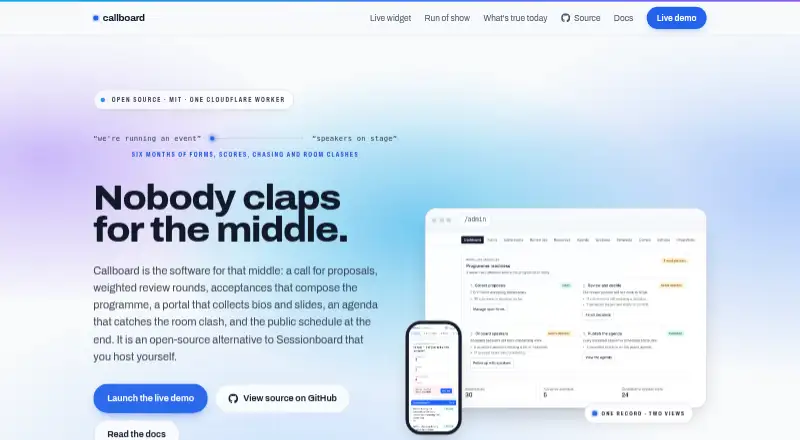
Callboard is an open-source system for managing event proposals, reviews, speaker onboarding, agenda planning and schedule publication. Organizers can build CFP forms with conditional questions, participant rules, character limits and closing dates, then route proposals to tracks. Reviewers see their assigned proposals, while organizers can apply weighted scores across two rounds. Accepted speakers use a portal to update session details, upload materials, complete tasks and read event resources. Agenda planning places sessions into rooms and time slots, with a conflict view to flag overlaps. Published schedules can be embedded and exported as calendar invites or CSV, or accessed through an API. Documented integrations include Accelevents CSV export, optional API push, an Airtable mirror and signed webhooks. Callboard is self-hosted under the MIT license, with its main application described as one Cloudflare Worker using D1 and R2. Public self-serve signup and per-organization tenancy are not built yet; organizations are provisioned by the deployment operator. The demo routes email to its console rather than sending messages to speakers.
Good
- Open source under the MIT license.
- Supports weighted reviews across two rounds.
- Agenda conflict view flags overlapping sessions.
- Schedules export to calendar invites and CSV.
Watch out
- Public self-serve signup is not built yet.
- Organizations require provisioning by the deployment operator.
- Demo email does not reach speakers.
Who it suits
Callboard suits event organizers who want to manage submissions, review, speaker tasks and schedules in a self-hosted tool. It is relevant to events with session tracks and room scheduling.
Verdict
Callboard covers a broad event-program workflow and can be self-hosted. Organizations should account for operator-managed provisioning and the demo’s console-only email behavior.
Plans and prices
From Callboard's own pricing page, checked 9 Oct 2026.
| Plan | Price | What it gives you |
|---|---|---|
| Self-hosted | Free | Open source · MIT · Self-hosted |
The facts
Each one read from Callboard's own pages, with the date it was checked.
What it does
- Agenda
- The agenda supports scheduling by room and time and identifies room or session conflicts.checked 9 Oct 2026
- AI triage
- AI abstract triage provides an advisory score and recommendation but cannot write committee reviews or change submission status.checked 9 Oct 2026
- API access
- API keys have six independently grantable scopes, four read and two write, and scopes do not cascade.checked 4 Oct 2026
- CFP forms
- Its proposal forms support conditional questions, character limits, participant rules, close dates, and routing proposals to tracks.checked 9 Oct 2026
- Demo email limitation
- The demo routes email to its console mail driver, so it does not send messages to speakers.checked 9 Oct 2026
- Demo limitation
- The demo prints emails to its console instead of sending them to recipients.checked 4 Oct 2026
- Deployment
- The main application is described as one Cloudflare Worker using D1 and R2.checked 4 Oct 2026
- Hosting
- The documented self-hosted setup uses one Cloudflare Worker, a D1 database, and an R2 bucket; the site says no other service is required to run the workflow.checked 9 Oct 2026
- Integrations
- The documentation lists an Accelevents CSV export, optional API push, an Airtable mirror, and signed webhooks with optional Svix delivery.checked 9 Oct 2026
- Intended users
- Callboard describes itself as speaker and CFP management for events, covering the workflow from public submissions through organizers, reviewers and speakers.checked 4 Oct 2026
- License
- The project is open source under the MIT license.checked 4 Oct 2026
- Not available
- The site says self-serve organizations and per-organization tenancy are not built yet; organizations are provisioned by the deployment operator and organizer rights are deployment-wide.checked 9 Oct 2026
- Open source
- Callboard is open source under the MIT license and can be self-hosted.checked 9 Oct 2026
- Publishing
- Published schedules include ordered speaker and co-speaker names and can feed calendar invites, CSV exports and an API.checked 4 Oct 2026
- Publishing and exports
- Published schedules can be embedded, and programme data can be exported as calendar invites or CSV and accessed through an API with per-event scoped keys.checked 9 Oct 2026
- Purpose
- Callboard manages event proposals, reviews, speaker onboarding, agenda planning, and publishing the public schedule.checked 9 Oct 2026
- Review
- Reviewers get assigned-only workspaces, weighted scoring across two rounds, and organizers can see aggregate scores and outstanding reviews.checked 9 Oct 2026
- Security
- The documentation says uploads are proxied through the Worker so ownership checks apply on read and write paths, and secrets are supplied through Wrangler rather than stored in the repository.checked 4 Oct 2026
- Speaker portal
- Accepted speakers can edit session details, upload headshots and materials, complete tasks, and access event resources through a portal.checked 9 Oct 2026
Alternatives to Callboard
- 1
Fourwaves
Free planAndroidiOSWebAPI8.2From $999 a year - 2

Zoho Backstage
Free planAndroidiOSWebAPI8.2From ₹7,900 a month - 3

pretalx
Free planOpen sourceWebAPILinuxSelf-hosted8.0From €499 a year - 4
Indico
Free planAndroidiOSWebAPI7.4Free plan - 5
Sessionize
Free planAndroidiOSWeb7.3$499 one-time - 6

BagEvent
AndroidiOSWebmacOS7.1From $99 a month