
Bugzilla
Bugzilla is free, web-based software for tracking bugs, issues, enhancements, and other change requests in products.
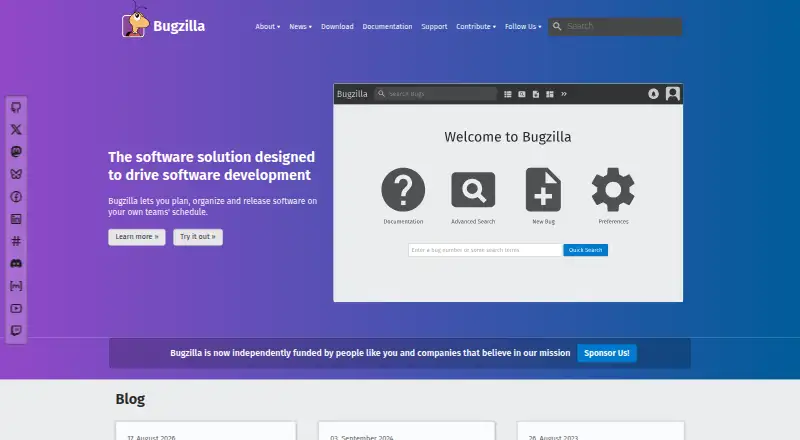
What Bugzilla is
Bugzilla is free, web-based software for tracking bugs, issues, enhancements, and other change requests in products. It must be installed on your own server. Search includes full-text queries and advanced criteria such as time-based searches. Users can choose which bug-change emails they receive, and scheduled search reports can be emailed as often as every fifteen minutes. Reporting tools generate tables, graphs, and reports from bug data, with CSV export. Administrators can customize workflows, statuses, resolutions, and fields, and extend installations with templates and extensions. Groups control who can view or edit bugs; members of an insider group can mark comments and attachments private. Bugzilla provides XML-RPC and JSON-RPC web services and supports built-in, LDAP, and web-server authentication, along with MySQL, PostgreSQL, or Oracle databases. Its Patch Viewer integrates with LXR, CVS, and Bonsai. The project describes security measures including Perl taint mode, cross-site scripting protections, restricted-information hiding, and account locks after a few failed password guesses. Community help is available through a mailing list and chat rooms; the project does not directly offer commercial support.
Good
- Supports customizable workflows, statuses, and fields.
- Scheduled search reports can arrive every fifteen minutes.
- Reports can be exported as CSV.
- Groups can limit bug viewing and editing.
Watch out
- Must be installed on your own server.
- Commercial support is not directly offered.
- Database choices are MySQL, PostgreSQL, or Oracle.
Who it suits
Bugzilla suits software teams and organizations that need defect tracking, custom workflows, or controls over bug visibility. It is best considered by users able to install and maintain server software.
Verdict
Bugzilla provides configurable defect tracking with search, reporting, and access controls. Its self-hosted setup and community-based support are important considerations.
Plans and prices
From Bugzilla's own pricing page, checked 3 Oct 2026.
| Plan | Price | What it gives you |
|---|---|---|
| Bugzilla | Free | Free and open source · self-hosted server software |
The facts
Each one read from Bugzilla's own pages, with the date it was checked.
What it does
- Access controls
- Groups can control who can view or edit bugs, and members of an insider group can mark attachments and comments private.checked 3 Oct 2026
- Authentication and databases
- It supports its built-in user database, LDAP, web-server authentication methods, and MySQL, PostgreSQL, or Oracle databases.checked 3 Oct 2026
- Deployment
- Bugzilla is web-based software that must be installed on your own server.checked 3 Oct 2026
- Integrations and API
- Bugzilla provides XML-RPC and JSON-RPC web services, and its Patch Viewer integrates with LXR, CVS, and Bonsai.checked 3 Oct 2026
- Intended users
- The project describes Bugzilla as a system for software defect tracking and says organizations may turn to it when they need workflow management, bug visibility controls, or custom fields.checked 3 Oct 2026
- Notifications
- Users can choose which bug-change email notifications they receive, and scheduled search reports can be emailed as often as every fifteen minutes.checked 3 Oct 2026
- Purpose
- Bugzilla is a defect-tracking system for tracking bugs, issues, enhancements, and other change requests in products.checked 3 Oct 2026
- Reporting
- Bugzilla can generate tables, graphs, and reports from bug data and export reports as CSV.checked 3 Oct 2026
- Search
- It offers basic full-text search and advanced queries, including time-based searches.checked 3 Oct 2026
- Security
- The project says Bugzilla uses Perl taint mode to help prevent SQL injection, has protections against cross-site scripting, hides group-restricted information, and locks accounts after a few failed password guesses.checked 3 Oct 2026
- Support
- Bugzilla is community supported; help is available through a mailing list and chat rooms, while the project says it does not directly offer commercial support.checked 3 Oct 2026
- Workflow
- Administrators can customize workflows, statuses, resolutions, and fields, and extend installations with templates and extensions.checked 3 Oct 2026
The company
- Founded
- 1998checked 28 Sep 2026
- Headquarters
- United Stateschecked 28 Sep 2026
- Maker
- The Bugzilla Project is managed by Zarro Boogs Corporation, a US non-profit incorporated in Michigan in 2023.checked 3 Oct 2026
Where it runs
- Platforms
- The project says Bugzilla can be installed on operating systems including Windows, Mac, and Linux, and can run with Apache or other web servers such as IIS.checked 3 Oct 2026
The full review of Bugzilla
Overview
Bugzilla is a free, open-source defect tracker for bugs, issues, enhancements, and other change requests. It is best suited to software organizations that can operate a server and want precise control over workflow and visibility. The trade-off is clear: there is no license fee, but deployment, administration, and support remain with your organization and its community.
Key features
Search combines basic full-text lookup with advanced and time-based queries, making it practical to find a specific defect or build a filtered queue for ongoing work. Users can select which bug-change emails they receive, and scheduled search reports can be delivered as frequently as every fifteen minutes. Teams can therefore tailor notification volume instead of forcing every participant into the same stream.
Administrators can define workflows, statuses, resolutions, and fields, then extend an installation with templates and extensions. This is a substantial advantage for organizations whose review or release process does not fit a fixed template. It also means someone must design, maintain, and govern those customizations; teams wanting a managed, ready-configured service should look elsewhere.
Bug data can produce tables, graphs, and reports, with CSV export for downstream analysis. XML-RPC and JSON-RPC web services support integrations, while Patch Viewer connects with LXR, CVS, and Bonsai. Those interfaces are especially relevant to development groups that need tracker data in existing tools rather than in an isolated application.
Groups can restrict who views or edits bugs, and an insider group can mark attachments and comments private. The project describes Perl taint mode, SQL-injection defenses, cross-site-scripting protections, concealment of group-restricted information, and account locking after several failed password guesses. These controls support sensitive engineering work, although the security and privacy outcome still depends on competent operation of your own server.
Authentication can use Bugzilla's built-in database, LDAP, or web-server methods. Supported databases include MySQL, PostgreSQL, and Oracle, giving organizations options that fit existing infrastructure. Custom workflows, roadmaps, and time tracking are also supported.
Pricing
Bugzilla — free (free and open source; self-hosted server software). This is the complete software at no license cost, with no paid tier described. The apparent saving must be weighed against server hosting, upgrades, configuration, backups, and internal administration. Community support comes through a mailing list and chat rooms; the project does not directly provide commercial support. It is a strong financial fit for organizations with operational expertise, but less suitable when a team needs a vendor accountable for uptime or support response.
Platforms
Bugzilla is web-based and runs on self-hosted deployments across Linux, macOS, and Windows environments. API access is provided through XML-RPC and JSON-RPC services. Because it must be installed on your own server, the platform list describes deployment options rather than a hosted subscription with vendor-managed infrastructure.
Who it's for
Choose Bugzilla when a software organization needs configurable defect workflows, custom fields, controlled visibility, reporting, and integration with established development systems. It also fits teams that already operate compatible databases or authentication services and can take responsibility for maintenance. It is a poor match for buyers seeking a turnkey cloud tracker, direct commercial support, or minimal administration.
Pros and cons
Pros
- No software charge: the free, open-source plan removes per-seat licensing costs.
- Deep process control: administrators can tailor statuses, resolutions, fields, workflows, templates, and extensions.
- Useful reporting and automation: graphs, tables, CSV export, scheduled reports, and frequent email delivery support operational review.
- Granular visibility: groups and insider privacy controls can separate sensitive bugs, comments, and attachments.
- Integration flexibility: APIs and Patch Viewer links support programmatic and development-tool workflows.
Cons
- Self-hosting required: your organization must run and maintain the server rather than relying on a managed service.
- Community-only support: assistance comes through mailing lists and chat, with no direct commercial support from the project.
- Administrative overhead: extensive customization is valuable but requires people to configure and govern it.
Alternatives
Game Bug Tracking Software is the relevant category list for comparing tools focused on game-development defect work.
Issue Tracking Software is the broader category to consult when your needs extend beyond software bugs.
Linear is the better choice for a hosted, multi-platform workflow with a free plan for unlimited members, two teams, and 250 issues, plus paid expansion.
YouTrack suits teams wanting a hosted option, including a free cloud tier for up to 10 users with 30 GB of storage.
Backlog is preferable when a hosted freemium product, Git and Subversion support, and a free tier for 10 users, one project, and 100 MB are priorities.
MantisBT is another free, open-source, self-hosted bug tracker.
Trac is a free, open-source project tool deployed on your own server.
Launchpad is a free option for open-source projects, with commercial plans also offered.
Redmine provides free, GPL v2 open-source self-hosted project management.
Roundup is free software with an MIT license except for noted bundled components.
Verdict
Bugzilla is a strong recommendation for technically capable software organizations that want highly configurable defect tracking, granular access control, and integration without license fees. Look elsewhere if you need hosted convenience, vendor-backed support, or an implementation that requires little ongoing administration.
Alternatives to Bugzilla
- 1

Jira
Free planAndroidiOSWebAPI8.4Free plan - 2

Linear
Free planAndroidiOSWebAPI8.4From $10 a month - 3
Redmine
Free planOpen sourceWebAPILinuxmacOS7.8Free plan - 4

Backlog
Free planAndroidiOSWebAPI7.7From $35 a month - 5
Trac
Free planOpen sourceWebAPILinuxmacOS7.6Free plan - 6

YouTrack
Free planAndroidiOSWebWindows7.4From $5.40 a month