Boundary
Boundary gives people authenticated, identity-based access to infrastructure without requiring direct access to its underlying network.
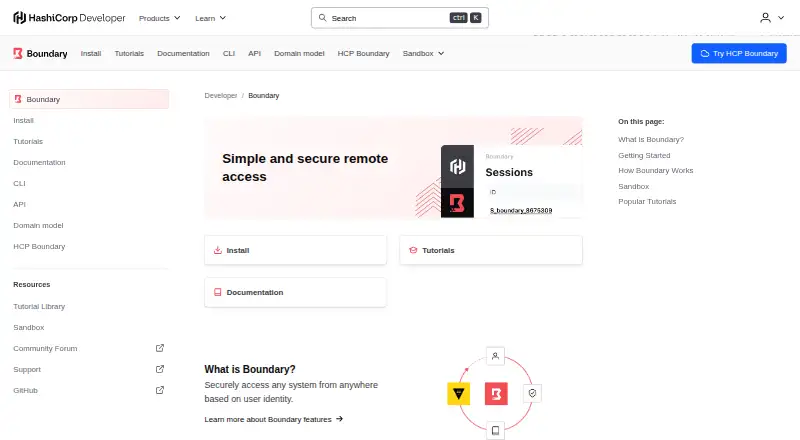
What Boundary is
Boundary gives people authenticated, identity-based access to infrastructure without requiring direct access to its underlying network. It supports just-in-time and least-privilege access, role-based authorization, and single sign-on with OIDC or LDAP. Users can reach TCP, SSH, RDP, HTTPS, RDS, Kubernetes, and database targets through familiar clients such as SSH tools, PuTTY, Remote Desktop, database clients, and web browsers. Boundary can broker credentials and integrate with HashiCorp Vault for short-lived dynamic credentials and credential injection. Target discovery can be automated, with dynamic AWS, Azure, and GCP host catalogs available in HCP Boundary.
Organizations can choose managed HCP Boundary, optionally with customer-run workers, or self-managed Boundary Enterprise. Community Edition is free; HCP Boundary Standard and Plus have usage-based billing with no price listed. Standard includes Vault credential injection and audit log streaming, while Plus adds session recording and playback. Boundary also supports Terraform, a REST API, CLI, and SDK, and uses TLS or mutual TLS, granular scopes, and envelope encryption for stored sensitive data.
Good
- Supports just-in-time and least-privilege access.
- Connects to infrastructure targets including SSH, RDP, and Kubernetes.
- Vault integration can provide short-lived dynamic credentials.
- Audit logs and streaming are available.
- Community Edition is free.
Watch out
- HCP Boundary pricing is usage-based and not listed.
- Session recording and playback are listed for Plus.
- Enterprise is self-managed.
Who it suits
Boundary suits organizations that need controlled access to infrastructure across a hybrid deployment. It is also relevant to teams using Vault, Terraform, or identity providers such as Okta, Microsoft Entra ID, Auth0, and LDAP.
Verdict
Boundary combines identity-based access controls with credential brokering, target discovery, and audit capabilities. The choice between managed HCP Boundary and self-managed Enterprise may guide deployment decisions.
Plans and prices
From Boundary's own pricing page, checked 15 Oct 2026.
| Plan | Price | What it gives you |
|---|---|---|
| Boundary Community Edition | Free | Source-available CE; repository archived October 8, 2026 · no further releases, fixes, or security patches planned |
| HCP Boundary Plus | Free | Standard features · session recording · standard HashiCorp Cloud SLA · first 1–5 users monthly; then $47.91667/user/month with Silver Support or $50.00000/user/month with Gold Support (6–20 users) |
| HCP Boundary Standard | Free | Boundary Community features · Vault dynamic credential injection · audit-log streaming · standard HashiCorp Cloud SLA · first 1–5 users monthly; then $23.95833/user/month with Silver Support or $25.00000/user/month with Gold Support (6–20 users) |
| Boundary Enterprise | Priced on request | Self-managed deployment · full feature parity with HCP Boundary · commercial support |
The facts
Each one read from Boundary's own pages, with the date it was checked.
What it does
- Access controls
- Boundary supports just-in-time and least-privilege network access, role-based authorization, and single sign-on through OIDC and LDAP.checked 7 Oct 2026
- Access model
- It centralizes access control, applies role-based permissions, and creates auditable sessions while protecting credentials and network details.checked 15 Oct 2026
- API
- Boundary exposes a REST API with correlation IDs, rate limiting, filtering, pagination, and standard resource methods.checked 15 Oct 2026
- Authentication
- Supported authentication methods are password, OpenID Connect, and LDAP, with OIDC examples including Okta, Auth0, and Microsoft Entra ID.checked 15 Oct 2026
- Automation
- Boundary supports Terraform for automated deployment and configuration and provides a REST API, CLI, and SDK.checked 7 Oct 2026
- Cloud integrations
- Documented dynamic host catalogs cover AWS, Azure, and Google Cloud, and AWS catalogs can authenticate with IAM AssumeRole.checked 15 Oct 2026
- Community-edition status
- HashiCorp announced October 2026 that Community Edition is deprecated, archived, read-only, and will receive no new releases, fixes, or security patches.checked 15 Oct 2026
- Compatible clients
- Users can connect through existing tools such as SSH clients, PuTTY, Remote Desktop, database clients, and web browsers.checked 7 Oct 2026
- Credential brokering
- Boundary can retrieve centrally stored credentials and return them to users during target connections.checked 15 Oct 2026
- Credential injection
- Boundary can inject credentials into sessions so users receive a passwordless connection and never see the secret.checked 15 Oct 2026
- Credential management
- Boundary can broker credentials and integrate with HashiCorp Vault for short-lived dynamic credentials and credential injection.checked 7 Oct 2026
- Deployment options
- HCP Boundary is managed by HashiCorp with optional customer-run workers, while Boundary Enterprise is self-managed.checked 7 Oct 2026
- Discovery
- Boundary automates target discovery and supports dynamic host catalogs for AWS, Azure, and GCP in HCP Boundary.checked 7 Oct 2026
- Documentation depth
- The documentation set covers CLI, API, domain model, HCP deployment, target connections, HCL configuration, permissions, data security, TLS connections, and filtering.checked 15 Oct 2026
- Dynamic discovery
- Terraform discovery and dynamic host catalogs can automatically onboard targets and track changing IP addresses without an agent.checked 15 Oct 2026
- Identity integrations
- Boundary supports identity providers including Okta, Microsoft Entra ID, Auth0, and other OIDC-compatible providers, as well as LDAP authentication.checked 7 Oct 2026
- Install support
- Official installers and packages cover Linux distributions, macOS, Windows, FreeBSD, NetBSD, OpenBSD, Solaris, and Boundary Desktop packages for macOS, Windows, and Debian Linux.checked 15 Oct 2026
- Latest release
- Boundary 1.0.2 was released September 10, 2026 for HCP and Enterprise editions.checked 15 Oct 2026
- Licence
- The repository uses Business Source License 1.1 with IBM as licensor; each version changes to MPL 2.0 four years after publication.checked 15 Oct 2026
The company
- Company funding and ownership record
- Crunchbase lists HashiCorp as acquired by IBM and records 16 investors, including Geodesic Capital and an employee stock-option fund.checked 15 Oct 2026
- Company profile
- LinkedIn lists HashiCorp as a public software-development company founded in 2012, headquartered in San Francisco, with 1,001–5,000 employees.checked 15 Oct 2026
- Founded
- 2020checked 28 Sep 2026
- Headquarters
- San Francisco, California, United Stateschecked 28 Sep 2026
Money
- Free access
- HashiCorp's Boundary product page says users can get started for free, and the developer site offers HCP Boundary for free.checked 7 Oct 2026
The full review of Boundary
Boundary is built for organizations that need to grant infrastructure access by verified identity instead of placing people on the underlying network. It fits security and platform teams running mixed cloud and self-managed estates, especially where temporary privileges and credential brokering matter. The product is powerful, but choosing between managed HCP editions and self-managed Enterprise has direct operational and budgeting consequences.
Overview
Boundary authenticates a person, authorizes a narrowly scoped connection, and brokers the session to a target without exposing the surrounding network. Just-in-time and least-privilege policies, role-based authorization, and OIDC or LDAP single sign-on provide a practical way to reduce broad standing access. TLS or mutual TLS protects communications, while envelope encryption protects sensitive data stored by the service.
Connections cover TCP, SSH, RDP, HTTPS, RDS, Kubernetes, and database targets. Existing SSH clients, PuTTY, Remote Desktop, database applications, and browsers can be used, so teams do not have to replace established operator workflows with a proprietary client.
Key features
Identity and authorization
Integrations include Okta, Microsoft Entra ID, Auth0, other OIDC-compatible identity providers, and LDAP. Granular scopes and role-based controls let administrators separate environments and responsibilities. This is a strong fit for privileged-access programs; smaller teams seeking only a simple remote-access tunnel may find the policy model more than they need.
Credentials and target discovery
Boundary brokers credentials and can work with HashiCorp Vault to inject short-lived dynamic credentials. That reduces the exposure created by reusable secrets, although teams must be prepared to operate the Vault integration when they want that benefit. HCP Boundary can discover targets automatically and maintain dynamic host catalogs for AWS, Azure, and Google Cloud, which is valuable when infrastructure changes frequently.
Auditing and automation
Audit logs can be streamed for SIEM workflows, and the Plus edition adds session recording and playback. Those controls improve investigations and compliance evidence, but recording is an edition-dependent capability rather than a universal feature. Terraform support, a REST API, CLI, and SDK make Boundary suitable for repeatable platform provisioning instead of manual access administration.
Deployment and clients
HashiCorp operates HCP Boundary, with optional customer-run workers; Boundary Enterprise is self-managed. The installer provides macOS, Windows, and Linux downloads plus desktop clients, while the service also supports API and web use. This hybrid range accommodates regulated deployments and cloud-managed operations, but self-management brings infrastructure and upgrade responsibility.
Pricing
| Plan | Price | What you get |
|---|---|---|
| Boundary Community Edition | free | Community Edition features |
| HCP Boundary Standard | Custom pricing, usage-based | Per-user monthly rate depends on edition; Vault dynamic credential injection and audit-log streaming |
| HCP Boundary Plus | Custom pricing, usage-based | Standard features plus session recording |
| Boundary Enterprise | Custom pricing | Self-managed deployment with full HCP Boundary feature parity |
The free Community Edition and free HCP access make evaluation possible without a license charge, and a free trial is offered. Standard is the sensible managed tier when streaming and dynamic credentials are priorities; Plus is aimed at organizations that need replayable sessions. Enterprise suits teams that must run the control plane themselves. Because HCP billing is usage-based and no rates are published, forecast user volume before committing. The free options do not provide the Plus edition's recording capability.
Platforms
Boundary supports API, web, Linux, macOS, and Windows, with self-hosted deployment available. TCP, SSH, and RDP are core access methods, alongside HTTPS, RDS, Kubernetes, and database targets. Its hybrid deployment model supports both HashiCorp-managed service operation and customer-managed infrastructure.
Who it's for
Choose Boundary for infrastructure, security, and platform teams that need identity-centered privileged access across AWS, Azure, Google Cloud, and private systems, with SIEM export, Vault integration, or session evidence. It is less compelling for a small group that only needs a basic VPN replacement and has no appetite for policy, identity, or credential administration.
Pros and cons
Pros
- Identity-based, least-privilege access avoids exposing entire networks.
- Broad protocol and client support preserves SSH, RDP, database, and browser workflows.
- Vault integration enables short-lived credentials and credential injection.
- HCP discovery catalogs dynamic AWS, Azure, and Google Cloud hosts.
- Terraform, API, CLI, and SDK support repeatable automation, while audit streaming supports SIEM pipelines.
Cons
- HCP prices are usage-based and unpublished, making cost estimation difficult.
- Session recording is restricted to Plus.
- Enterprise customers must operate the self-managed deployment.
- Advanced credential brokering depends on HashiCorp Vault integration.
Alternatives
Cloudflare Access is a better fit for teams wanting a freemium service with a free tier capped at 50 users and broad mobile support. Pick Twingate when its free Starter plan's five-user and 50-resource limits match a smaller deployment. NetBird suits teams preferring self-hosting with a free allowance of five users and 100 machines. Bowtie Private Access is worth considering for a free, small-team setup capped at three users and two devices per user. Pomerium offers a personal free tier for 10 users, 10 routes, and five policies. AWS Verified Access is the alternative when an AWS-centered paid service is preferable. Cloudflare Gateway provides a free 50-user tier with up to 24 hours of standard log retention. OpenVPN CloudConnexa is a straightforward option when five included seats and a familiar VPN vendor matter.
Browse the Zero Trust Network Access Software category for more choices.
Verdict
Boundary is a strong recommendation for organizations that need granular, identity-based infrastructure access, Vault-backed credentials, and auditable sessions across hybrid environments. Its main reason to choose is the combination of protocol flexibility and privileged-access controls. Look elsewhere if predictable published pricing, a simpler setup, or a small-team free quota matters more than deep policy and deployment options.
Alternatives to Boundary
- 1

Tailscale
Free planOpen sourceAndroidiOSWebAPI8.7From $1 a month - 2

Cloudflare Access
Free planAndroidiOSWebAPI7.8$7 usage-based - 3
VShell Server
WebAPILinuxmacOS7.5$599 one-time - 4

Bastillion
Free planWebLinuxmacOSSelf-hosted7.1From $149 a year - 5

Bitvise SSH Server
Free planSelf-hostedWindows6.9Free plan - 6
wolfSSH
Free planAPILinuxmacOSSelf-hosted6.8From $2,600 a year