
Bezel
Bezel is a web platform for creating, managing, previewing, and publishing design decisions for digital products.
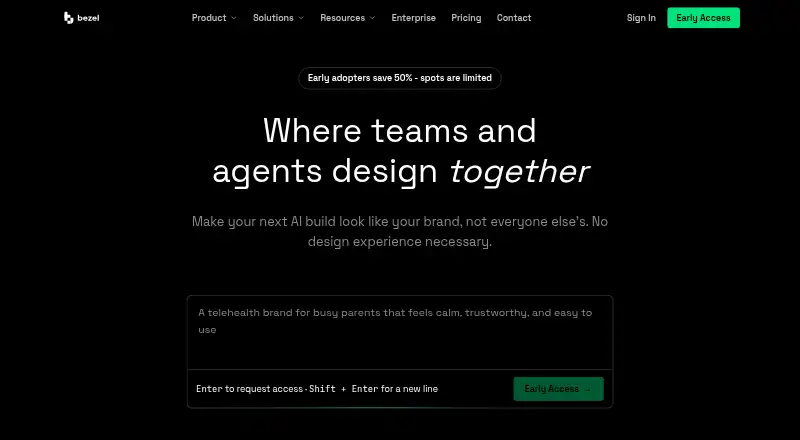
What Bezel is
Bezel is a web platform for creating, managing, previewing, and publishing design decisions for digital products. Its guides and AI assistant help teams shape colors, typography, spacing, and other choices. Projects can preview token changes against Storybook, a staging site, or a local development server without rebuilding or exporting. Bezel uses the W3C Design Tokens format and says it adopts the 2025.10 specification. It lists workflows for Claude, ChatGPT, Cursor, Windsurf, Bolt.new, Figma Make, and MCP, and checks palette color relationships against WCAG AA and AAA criteria. Teams can publish versioned token releases with tracked changes, optional notes, and downloadable snapshots. A free Crystal receiver accepts live token updates. Access is restricted: Free, Teams, and Enterprise are not yet open, while Pro early access requires a request, review, demo, and acceptance. The listed Pro price is $84 a year, billed annually.
Good
- Previews token changes without rebuilding or exporting
- Checks palette contrast against WCAG AA and AAA
- Publishes versioned releases with tracked changes
- Supports several named AI and design workflows
Watch out
- Free, Teams, and Enterprise are not open for signup
- Pro access requires request, review, demo, and acceptance
- Component documentation and design tool sync are not supported
Who it suits
Bezel is aimed at product designers, design engineers, developers, founders, and teams using AI coding agents. It suits people who want to manage design tokens and preview changes in development environments.
Verdict
Bezel combines token management, live previews, contrast checks, and versioned releases in a web platform. Availability is a significant constraint, so prospective users should account for the limited Pro access and unopened plans.
Plans and prices
From Bezel's own pricing page, checked 15 Oct 2026.
| Plan | Price | What it gives you |
|---|---|---|
| Free | Free | 75 AI credits · 1 project · 1 theme · 1,000 design tokens · waitlist |
| Pro | $7 a month | MCP Server · Accessibility Guides · 1,750 AI credits · 12 projects · 5 themes · 35,000 design tokens · early-access acceptance · annually for one year; $14 shown as regular price |
| Teams | $29 a month | 20 seats · shared workspace · project sharing · multiple organizations · 25 projects · dedicated Slack support · waitlist · per seat, billed annually; planned |
| Enterprise | Priced on request | role-based permissions · 9,000 AI credits · unlimited projects, themes and tokens · add-on AI credits · planned |
The facts
Each one read from Bezel's own pages, with the date it was checked.
What it does
- Accessibility
- Color relationships are checked live against WCAG AA and AAA contrast criteria.checked 15 Oct 2026
- AI agent access
- The hosted MCP server exposes project context, tokens and guidelines to compatible coding agents.checked 15 Oct 2026
- AI integrations
- The site lists workflows for Claude, ChatGPT, Cursor, Windsurf, Bolt.new, Figma Make, and MCP.checked 3 Oct 2026
- Automatic propagation limit
- Bezel currently does not automatically propagate completed migrations to every repository; users use token editing, previews, releases, Bezel Kit and MCP instead.checked 15 Oct 2026
- Availability
- Free, Teams, and Enterprise are not yet open, and Pro early access is limited and subject to a request, review, demo, and acceptance.checked 3 Oct 2026
- CLI integration
- The bezel-kit CLI reads design-tokens.json and generates scoped CSS variables through bezel init and bezel build.checked 15 Oct 2026
- Crystal receiver
- The Crystal package is dependency-free, free to use and receives live token updates through a browser message bridge.checked 15 Oct 2026
- Data handling
- The policy says Bezel stores tokens, projects, and related content to provide the service and does not sell personal information.checked 3 Oct 2026
- Design guides
- Its guided workflows cover color, typography, spacing and borders, with an AI assistant that helps shape a custom system.checked 15 Oct 2026
- Design tools
- It includes design guides and an AI assistant for shaping colors, typography, spacing, and other design decisions.checked 3 Oct 2026
- Export formats
- The rename announcement lists Tailwind configuration, shadcn/ui variables, Mantine overrides, CSS custom properties and DTCG JSON as unchanged outputs.checked 15 Oct 2026
- Founder background
- The founder story says the founder spent about eight years at a prior company, led roughly 20 engineers across three teams, and then worked full-time on Bezel.checked 15 Oct 2026
- Intended users
- Bezel says it is built for product designers, design engineers, software developers, founders, and teams using AI coding agents.checked 3 Oct 2026
- Library licences
- bezel-kit, crystal and loupe use PolyForm Shield 1.0.0, while radium uses MIT; the Shield licence excludes competing products.checked 15 Oct 2026
- Library packages
- The documented packages are bezel-kit for CSS generation, crystal for live preview, loupe for themes and fonts, and radium as a component library.checked 15 Oct 2026
- Limit: directory data quality
- GetApp places its Bezel listing in Data Privacy and shows zero counts for compliance management, data discovery and data-subject-request features, indicating the listing is likely for a different product.checked 15 Oct 2026
- Limit: independent praise evidence
- GetApp reports no user reviews and a 0.00/10 recommendation score, so it provides no repeated independent praise for the bezel.new product.checked 15 Oct 2026
- Live preview
- Projects can point to Storybook, a staging site or a local server so token edits restyle real components without a rebuild.checked 15 Oct 2026
- Live previews
- Projects can preview token changes against Storybook, a staging site, or a local development server without a rebuild or export step.checked 3 Oct 2026
- Manual developer setup
- All plans, including Free, can download design-tokens.json and use Bezel Kit without MCP.checked 15 Oct 2026
- MCP authentication
- MCP uses Streamable HTTP with OAuth at https://mcp.bezel.new/mcp and does not require an API key.checked 15 Oct 2026
The company
- Company
- The site copyright identifies Token Designer Inc.checked 3 Oct 2026
- Maker legal name
- The site footer identifies the company as Token Designer Inc.checked 15 Oct 2026
Money
- MCP plan requirement
- MCP access requires the Pro plan or higher.checked 15 Oct 2026
The full review of Bezel
Bezel is a cloud platform for creating and operating token-based design systems. It suits product designers, design engineers, developers, founders, and teams building with AI coding agents. Its value is highest when live, in-context token previews and release tracking matter more than broad documentation or governance.
Overview
Bezel brings colors, typography, spacing, and related design decisions into a managed system, supported by design guides and an AI assistant. The notable workflow is immediate feedback: token edits can be previewed against Storybook, a staging site, or a local development server without rebuilding or exporting. That makes it practical for evaluating a change in the interface where it will be used, rather than in an isolated token file.
The platform uses the W3C Design Tokens format and says it adopts the 2025.10 specification. Versioned releases record tracked changes, optional release notes, and downloadable snapshots, giving teams a usable history of design decisions. Bezel is not a component-documentation, design-tool-sync, or governance-workflow product, so organizations needing those capabilities will need complementary software.
Key features
- Token design and AI assistance: Guides and the AI assistant help develop palettes, type scales, spacing, and other token decisions. Listed workflows cover Claude, ChatGPT, Cursor, Windsurf, Bolt.new, Figma Make, and MCP. AI credits are capped, so heavy assisted work must stay within the allowance of the chosen plan.
- Live previews: Changes can be viewed in Storybook, staging, or a local development server without a rebuild or export step. This shortens the review loop for developers and designers, while the absence of design-tool sync limits teams expecting a direct Figma-style connection.
- Standards-based tokens: W3C Design Tokens support gives technically minded teams a current interchange format, with Bezel’s stated adoption of the 2025.10 specification.
- Accessibility checks: Palette construction checks color relationships against WCAG AA and AAA criteria. That is useful for catching contrast problems early, although it is focused on color relationships rather than a complete accessibility program.
- Crystal receiver: The free, dependency-free Crystal receiver accepts live token updates from Bezel, and its source code is on GitHub. It offers a low-overhead way to consume updates in a project.
- Release management: Versioned publishing, change tracking, release notes, and downloadable snapshots suit teams that need reproducible token releases and an audit trail.
- Security and data handling: Bezel says it encrypts data, stores it securely, and performs regular security assessments. It stores tokens, projects, and related content to provide the service and says it does not sell personal information, while acknowledging that absolute security cannot be guaranteed.
Pricing
Bezel uses a freemium model, but access is the decisive qualification. Free, Teams, and Enterprise are not yet open; Pro early access is limited and requires a request, review, demo, and acceptance.
- Free — free: 75 AI credits, one project, one theme, and 1,000 design tokens. It is suitable for a small evaluation or a single token set, but the signup is not yet open.
- Pro — $84 a year (billed $84.00 per year, equal to $7.00/month, billed annually): 1,750 AI credits, 12 projects, five themes, 35,000 design tokens, an MCP Server, and Accessibility Guides. This is the most capable currently targeted option for an accepted individual or small team, but early access is limited and acceptance requires a demo. Pro early adopters receive guided onboarding and personalized support during their first year.
- Teams — $29 a year (billed $29 per seat monthly, billed annually): 20 team seats, a shared workspace, project sharing, multiple-organization support, 25 projects, and dedicated Slack support. It is planned rather than open, and the stated billing wording means teams should confirm the final commercial terms before committing.
- Enterprise — custom pricing: Role-based permissions, 9,000 AI credits, unlimited projects, themes, and design tokens, plus add-on AI credits. It is planned and aimed at organizations that need scale and permission controls.
Platforms
Bezel runs on the web and uses cloud hosting. The Crystal receiver provides a separate way to receive live token updates, but the product itself is not presented as a native desktop or mobile application.
Who it's for
Choose Bezel when a token-driven product needs rapid previews in real environments, standards-based token files, and versioned releases. It is especially relevant to teams incorporating AI coding agents through the listed integrations. It is a weaker fit for a designer seeking direct design-tool synchronization, or for an organization that requires built-in component documentation and governance workflows.
Pros and cons
Pros
- Live Storybook, staging, and local previews avoid rebuild and export steps.
- W3C-format tokens and versioned snapshots support repeatable releases.
- WCAG AA and AAA contrast checks provide actionable palette feedback.
- Crystal is free, dependency-free, and open-source on GitHub.
- AI workflows span major coding and design-agent tools.
Cons
- Free signup is not open, and Pro access depends on acceptance after a demo.
- Free limits are tight at one project, one theme, and 1,000 tokens.
- No design-tool sync, component documentation, or governance workflows.
- Teams and Enterprise are planned, so their availability is not immediate.
Alternatives
Particles UI is the better choice when local, account-free token management and export matter, with an MIT-licensed CLI across Linux, macOS, Windows, and the web. Pick Zaklad instead if you need Android and iOS access alongside the web. Superposition suits users wanting a free desktop app for macOS, Windows, or Linux. Choose Terrazzo for free, MIT-licensed open-source tools. Carbon Design System is the straightforward option for an open-source web design system with no paid tiers stated. Design Tokens is preferable when Figma variable sync, CSS/SASS export, and W3C JSON import/export are priorities. Luro fits web teams wanting a defined editor, source-file, viewer, and page allowance. Spec Layer is an alternative for Figma publishing updates and AI writing allowances.
See the full Design System Software ranking for more options.
Verdict
Bezel is a strong match for teams that manage design tokens alongside active development and want live previews, accessibility checks, and versioned releases in one web workflow. Its main reason to choose it is the tight connection between token edits and deployed-context feedback. Look elsewhere if immediate, universally available access, design-tool synchronization, or built-in documentation and governance are essential.
Alternatives to Bezel
- 1

Zaklad
Free planAndroidiOSWebAPI7.9From €9.50 a month - 2
Particles UI
Free planWebLinuxmacOSWindows7.0From $19 a month - 3

Supernova
Free planWebAPImacOS6.8From $35 a month - 4
Bit
Free planAndroidiOSWebAPI6.7Free plan - 5

zeroheight
Free planWeb6.7From $49 a month - 6

Carbon Design System
Free planWeb6.6Free plan