
Aural
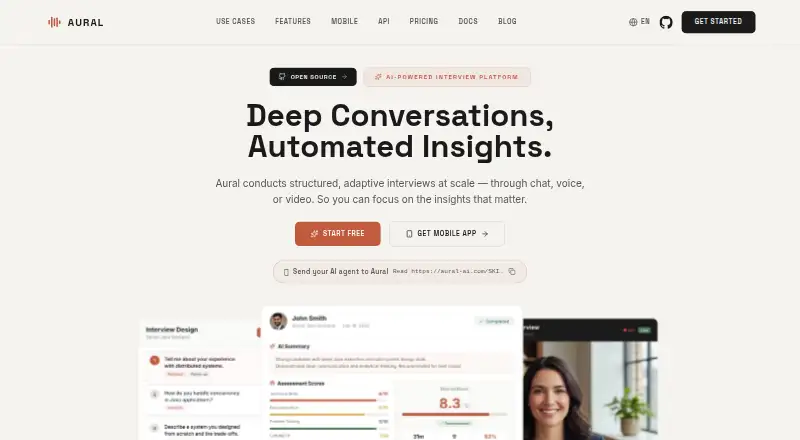
Aural is a platform for structured, adaptive interviews conducted by chat, voice, or video.
What Aural is
Aural is a platform for structured, adaptive interviews conducted by chat, voice, or video. Its AI interviewer changes the depth, tone, and direction of follow-up questions in response to participant answers. Sessions can be live or asynchronous and recorded; they are automatically transcribed and summarized, with structured data export in XLSX or PDF. Interview templates support open-ended, multiple-choice, rating-scale, coding, and whiteboard questions. Aural supports English, Chinese, Spanish, French, German, and other interview languages. It provides a REST API with Bearer-token authentication and an OpenAPI specification. The software is open source under the MIT license and can be self-hosted, with support for pluggable LLMs including OpenAI, Kimi, MiniMax, or compatible APIs. Aural states that data is encrypted at rest with AES-256 and in transit with TLS 1.3, and that it complies with GDPR and other global privacy regulations. The free plan includes three templates, 100 AI tokens, 30 minutes of session time, and one seat; paid plans start at $9/mo.
Good
- Chat, voice, and video interview formats
- Automatic transcription and summaries
- Exports structured data to XLSX or PDF
- Open source under the MIT license
- Self-hosting supports pluggable LLMs
Watch out
- Free plan includes only one seat
- Free plan limits sessions to 30 minutes
- Webhooks and official SDKs are not provided
Who it suits
Aural suits teams that need structured interviews, automated session summaries, and exportable results. Its open-source and self-hosting options may suit users who want to run it on their own infrastructure.
Verdict
Aural brings adaptive interviewing and structured outputs into one platform, with self-hosting available for teams that want it. Note the API limitations and the free plan’s template, token, session-time, and seat caps.
Plans and prices
From Aural's own pricing page, checked 30 Sep 2001.
| Plan | Price | What it gives you |
|---|---|---|
| Free | Free | 3 templates · 100 AI tokens · 30 min session time · 1 seat · $0/month |
| Pay As You Go | $0.08, paid once | Session time $0.08/minute · AI tokens $0.02/token · Additional seats $10/seat/mo · $0.08/minute |
| Starter | $9 a month | 10 templates · 200 AI tokens · 3 hrs session time · 1 seat · Email support · $9/month |
| Basic | $24 a month | 10 templates · 500 AI tokens · 10 hrs session time · 1 seat · Email support · $24/month |
The facts
Each one read from Aural's own pages, with the date it was checked.
What it does
- AI interviewer
- Its AI interviewer adapts follow-up depth, tone, and direction based on participant responses.checked 30 Sep 2001
- Analytics
- Sessions are automatically transcribed and summarized, with structured data export in XLSX or PDF.checked 30 Sep 2001
- API
- Aural provides a REST API with Bearer-token authentication and an OpenAPI specification.checked 30 Sep 2001
- API limitation
- Webhooks and official SDKs are not provided, and internal tRPC and voice WebSockets are not stable Developer API contracts.checked 30 Sep 2001
- Compliance
- Aural states that it complies with GDPR and other global privacy regulations.checked 30 Sep 2001
- Core product
- Aural conducts structured, adaptive interviews through chat, voice, or video.checked 30 Sep 2001
- Languages
- Aural supports interview languages including English, Chinese, Spanish, French, German, and others.checked 30 Sep 2001
- Open source
- Aural is fully open source under the MIT license and can be self-hosted on your own infrastructure.checked 30 Sep 2001
- Question types
- The platform supports open-ended, multiple-choice, rating-scale, coding, and whiteboard questions.checked 30 Sep 2001
- Security
- Aural states that data is encrypted at rest with AES-256 and in transit with TLS 1.3.checked 30 Sep 2001
- Self-hosting
- The self-hosted version supports pluggable LLMs including OpenAI, Kimi, MiniMax, or compatible APIs.checked 30 Sep 2001
- Support
- General questions and technical support are handled at support[at]aural-ai.com.checked 30 Sep 2001
The company
- Headquarters
- Hong Kongchecked 28 Sep 2001
The full review of Aural
Overview
Aural is software for conducting structured interviews through chat, voice, or video. Its AI interviewer adjusts how deeply it follows up, along with its tone and direction, in response to participant answers. Teams can run interviews live or asynchronously and record sessions.
After each session, Aural automatically transcribes and summarizes the interview. Structured data can be exported as XLSX or PDF. The platform is fully open source under the MIT license, with an option to self-host it on your own infrastructure as well as hosted use. Aural is headquartered in Hong Kong.
Key features
Adaptive interviews and question formats
The interviewer changes its follow-up approach based on what participants say, rather than relying only on a fixed sequence. Aural supports open-ended, multiple-choice, rating-scale, coding, and whiteboard questions, giving interview builders several ways to collect responses.
Interviews can be conducted by chat, voice, or video, either live or asynchronously. Recording is supported, and interview templates are available. Supported interview languages include English, Chinese, Spanish, and French, German, among others.
Transcripts, summaries, and exports
Automatic transcription and summarization turn each session into reviewable material. Teams can also export structured data in XLSX or PDF format.
API and self-hosting
Aural provides a REST API that uses Bearer-token authentication and has an OpenAPI specification. It does not provide webhooks or official SDKs. Its internal tRPC and voice WebSockets are not stable Developer API contracts, so they should not be treated as supported integration surfaces.
Self-hosting allows organizations to run Aural on their own infrastructure and use pluggable LLMs, including OpenAI, Kimi, MiniMax, or compatible APIs. Aural states that data is encrypted at rest with AES-256 and in transit with TLS 1.3, and that it complies with GDPR and other global privacy regulations. General and technical support is available at support[at]aural-ai.com.
Pricing
Aural has a free plan and paid options. The Free plan is $0/month and includes 3 templates, 100 AI tokens, 30 minutes of session time, and 1 seat.
| Plan | Price | Included |
|---|---|---|
| Pay As You Go | $0.08/minute | Session time costs $0.08/minute, AI tokens cost $0.02/token, and additional seats cost $10/seat/mo. |
| Starter | $9/month | 10 templates, 200 AI tokens, 3 hours of session time, 1 seat, and email support. |
| Basic | $24/month | 10 templates, 500 AI tokens, 10 hours of session time, 1 seat, and email support. |
The usage-based option separates session-time and token charges; additional seats are priced separately. Starter and Basic include the same number of templates and one seat, with different token and session-time allowances.
Platforms
Aural is available on Android, iOS, and the web. It also offers an API and a self-hosted option.
Who it's for
Aural may suit teams that need structured interviews across different response formats and want transcripts, summaries, or exportable data from sessions. Its live and asynchronous modes support different interview workflows, while self-hosting and pluggable LLMs offer an option for teams that want to operate the software on their own infrastructure. The lack of webhooks and official SDKs is a constraint for integrations that depend on those tools.
Pros and cons
Pros
- Supports chat, voice, and video interviews, including live and asynchronous sessions.
- Offers multiple question formats, automatic transcripts and summaries, and XLSX or PDF exports.
- Open source under the MIT license, with self-hosting and pluggable LLM options.
- Provides a REST API with Bearer-token authentication and an OpenAPI specification.
Cons
- Webhooks and official SDKs are not provided.
- Internal tRPC and voice WebSockets are not stable Developer API contracts.
- The listed plans include 1 seat each; additional seats are priced separately on Pay As You Go.
Alternatives
For a broader view of this category, see Video Interviewing Software. Other options to consider include Hyring, EasyHire.me, Willo, Jobma, Interviewer.AI, Spark Hire, Vesume, and interviewstream.
Verdict
Aural brings adaptive interviewing, varied question types, and automatic session outputs together, with both hosted and self-hosted paths. Its open-source license and REST API are notable for teams considering customization or integrations, though the API limitations matter for workflows that require webhooks or official SDKs. The free plan offers a way to start, while paid plans set different session-time and token allowances.
Getting started
- Visit https://www.aural-ai.com/.
- Choose the web, Android, or iOS platform, or review the self-hosted option.
- Select the Free plan, Pay As You Go, Starter, or Basic plan.
- Create an interview template using the available question types.
- Run a live or asynchronous interview and export structured results as XLSX or PDF.
Limits worth knowing
The Free plan includes 3 templates, 100 AI tokens, 30 min session time, and 1 seat. Starter is $9/month and includes 10 templates, 200 AI tokens, 3 hrs session time, and 1 seat; Basic is $24/month and includes 10 templates, 500 AI tokens, 10 hrs session time, and 1 seat.
Questions
Is Aural free?
Yes. Its Free plan is billed at $0/month and includes 3 templates, 100 AI tokens, 30 min session time, and 1 seat.
What do paid plans cost?
Pay As You Go is billed at $0.08/minute, with AI tokens at $0.02/token and additional seats at $10/seat/mo. Starter is $9/month and Basic is $24/month.
Which platforms does Aural support?
Aural is available on Android, iOS, and the web, and it can also be self-hosted. The platform list also includes an API.
Is Aural open source?
Yes. Aural is open source under the MIT license and can be self-hosted on your own infrastructure.
Does Aural provide an API?
Yes. It provides a REST API with Bearer-token authentication and an OpenAPI specification. It does not provide webhooks or official SDKs.
What support is available?
Starter and Basic include email support. General questions and technical support are handled at support[at]aural-ai.com.
Alternatives to Aural
- 1
Talview
AndroidiOSWebAPI7.2 - 2

Hyring
Free planWebWindows7.0From $79 a month - 3

Interviewer.AI
AndroidiOSWebAPI7.0From $199 a month - 4

KitaHQ
WebAPIExtension7.0From $8.25 a month - 5

One Way Interview
AndroidiOSWeb7.0From $1.17 a month - 6

IntervueBox
Free planWebAPI6.9From $99 a month