
AudioPod AI
AudioPod AI is an in-browser audio workstation for making podcasts, audiobooks, music, voiceovers, transcripts, and edited audio.
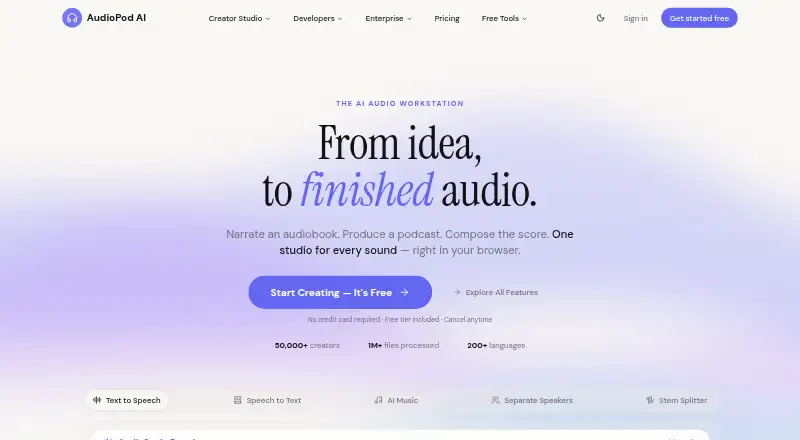
What AudioPod AI is
AudioPod AI is an in-browser audio workstation for making podcasts, audiobooks, music, voiceovers, transcripts, and edited audio. Audiobook Studio accepts PDF or EPUB manuscripts, organizes chapters, narrates with cloned or studio voices in more than 200 languages, and masters output to ACX specifications. Podcast Studio turns supplied PDFs, articles, or notes into editable episodes with one to four AI hosts; its description says output is grounded only in those sources. Other tools include text-to-speech, voice cloning, prompt-based music generation, stem separation, speaker-labeled transcription, and noise reduction. Developers can connect through a REST API, Python and JavaScript SDKs, or an MCP server. Listed agent clients include Claude, GPT, Codex, Cursor, Continue, Cline, OpenClaw, and Hermes. AudioPod says it encrypts data in transit and at rest and does not use customer audio in generic training without explicit opt-in. The free Basic plan provides 1,000 credits per month and a 30-minute file limit. An iOS app for narrating children's books is in development, with early TestFlight access offered through a waitlist.
Good
- Free Basic plan includes 1,000 monthly credits.
- Audiobook Studio accepts PDF and EPUB manuscripts.
- Podcast Studio supports one to four AI hosts.
- Includes APIs, SDKs, and an MCP server.
- Data encryption is described for transit and storage.
Watch out
- Basic files are limited to 30 minutes.
- Creator costs $20/mo.
- The iOS app is still in development.
Who it suits
AudioPod AI suits podcasters, audiobook authors, musicians, educators, marketers, developers, YouTubers, and accessibility users. Its API and agent connections may also suit developers building audio workflows.
Verdict
AudioPod AI brings podcast, audiobook, and other audio tools into an in-browser workstation, with a free entry plan and developer interfaces. Check the plan-specific file limits and credit allowances against the intended workload.
Plans and prices
From AudioPod AI's own pricing page, checked 14 Oct 2026.
| Plan | Price | What it gives you |
|---|---|---|
| Basic | Free | 5,000 credits/month · ~15 min TTS · ~5 min music · ~22 min transcription · 3 custom voice models · 30 min/file · 500 MB uploads |
| Creator | $20 a month | 200,000 credits/month · ~600 min TTS · ~15 hr transcription · ~200 min music · unlimited custom voice models · 2 hr/file · 2048 MB uploads · monthly |
| Pro | $50 a month | 600,000 credits/month · ~1,800 min TTS · ~45 hr transcription · ~600 min music · detailed stem presets · 5 hr/file · 4096 MB uploads · monthly |
| Studio | $100 a month | 1,250,000 credits/month · ~3,750 min TTS · ~95 hr transcription · ~1,260 min music · dedicated support · 10 hr/file · 5115 MB uploads · monthly |
| Pay-as-you-go | $17,500, paid once | commercial use included · use after subscription credits · no monthly commitment · credits never expire |
| Enterprise | Priced on request | unlimited credits · unlimited TTS · unlimited transcription · unlimited music generation · full API access · 16 audiobook requests at once · volume pricing and tailored contracts |
The facts
Each one read from AudioPod AI's own pages, with the date it was checked.
What it does
- Agent compatibility
- The AudioPod for Agents page lists Claude, GPT, Codex, Cursor, Continue, Cline, OpenClaw and Hermes as supported agent clients.checked 4 Oct 2026
- AI music generator
- The music tool creates royalty-free songs, rap, instrumentals and samples from text prompts.checked 14 Oct 2026
- API and SDKs
- The developer platform documents REST access plus Python and Node.js SDKs, cURL, a CLI and an MCP server.checked 14 Oct 2026
- API pricing
- Developer documentation lists stem separation at $0.10/min, transcription at $0.01/min, TTS or voice cloning at $0.05 per 1,000 characters, and music generation at $0.04/min.checked 14 Oct 2026
- Audiobook creator
- The audiobook tool converts PDFs, ebooks or text into narrated books using more than 500 voices and 200+ languages, with ACX-spec export.checked 14 Oct 2026
- Audiobooks
- Audiobook Studio accepts PDF or EPUB manuscripts, splits chapters, narrates in cloned or studio voices across 200+ languages and masters output to ACX specifications.checked 4 Oct 2026
- Audio features
- The studio includes text-to-speech and voice cloning, prompt-based music generation, stem separation, transcription with speaker labels and noise reduction.checked 4 Oct 2026
- Compliance
- The trust page lists GDPR-aligned data handling, a standard DPA on request and a pen-test summary on request under NDA; it says SOC 2 Type II is in progress with an audit window scheduled for 2026.checked 4 Oct 2026
- Documentation depth
- The docs provide a five-minute quick start, installation commands, code examples and service-specific API coverage for audiobooks, stems, cloning, transcription, music, denoising and speaker separation.checked 14 Oct 2026
- Integrations
- Live integration surfaces are REST API, MCP server and webhooks; Zapier, Make, Pipedream and n8n directory listings are described as in progress.checked 14 Oct 2026
- Intended users
- AudioPod says it serves podcasters, audiobook authors, musicians and DJs, educators, marketers, developers, YouTubers and accessibility users.checked 4 Oct 2026
- Limit: performance
- G2 reviewers reported that some features take a long time to process or run slowly.checked 14 Oct 2026
- Limit: usability
- One G2 reviewer found some tool interfaces confusing and said learning where features are located takes time.checked 14 Oct 2026
- MCP support
- AudioPod exposes a Streamable HTTP MCP endpoint with setup commands for Claude Code, Codex CLI, Cursor, Continue, Cline and other MCP clients.checked 14 Oct 2026
- Media converter
- The media converter changes audio and video formats and provides quality controls plus clipping and trimming.checked 14 Oct 2026
- Model training
- AudioPod says it does not use customer audio in a generic training set without explicit opt-in.checked 4 Oct 2026
- Noise reduction
- Noise Reduction removes background noise, echo and other artifacts with Balanced, Studio and Ultra quality modes.checked 14 Oct 2026
- Notable news
- The May 6, 2026 changelog entry announced public API v1, Python and Node SDK quickstarts, MCP installation snippets and an agent-focused developer landing page.checked 14 Oct 2026
Where it runs
- Browser DAW
- The browser DAW offers a multitrack timeline, effects, direct stem import, crossfades and trimming without installation.checked 14 Oct 2026
- Mobile app
- AudioPod Mobile is described as an iOS app in development for parents to narrate children's books in a cloned voice, with early TestFlight access offered through a waitlist.checked 4 Oct 2026
The company
- Company legal name
- The terms identify the provider as AudioPod, Inc.checked 14 Oct 2026
- Company profile
- LinkedIn lists AudioPod AI as privately held, founded in 2024, headquartered in Bangalore and employing 2–10 people.checked 14 Oct 2026
Money
- Limit: free credits
- A G2 reviewer wanted a larger free allowance.checked 14 Oct 2026
- Limit: free-offer complaints
- Both Trustpilot reviews rated AudioPod one star and alleged that the service advertises free access but requires signup, phone details or subscription payment.checked 14 Oct 2026
The full review of AudioPod AI
AudioPod AI is a browser-based workstation for creating and editing podcasts, audiobooks and other audio. It is best suited to creators who want several production tools together, and developers who need API or agent access. Its range is a strong draw, but monthly credits and per-file limits make the right plan depend on the workload.
Overview
AudioPod brings text-based production and audio editing into one service. Audiobook Studio converts PDF or EPUB manuscripts into chaptered narration and masters output to ACX specifications; Podcast Studio builds editable episodes from PDFs, articles or notes. For podcast creators, grounding episodes in supplied sources is a useful constraint, while the one-to-four-host range accommodates different formats.
Beyond those studios, the toolset covers text-to-speech, voice cloning, prompt-based music generation, stem separation, transcription with speaker labels and noise reduction. A transcript editor and caption export extend its usefulness for turning recorded speech into publishable text and captions. The breadth is appealing for mixed workloads, though the credit system means frequent use across several tools can make a free allowance go quickly.
Key features
Audio production
Audiobook Studio accepts PDF and EPUB manuscripts, splits them into chapters, and narrates in cloned or studio voices across 200+ languages. ACX mastering makes it relevant to authors preparing audiobook output for that specification. Podcast Studio instead starts from source material and produces an editable episode with one to four AI hosts. Neither workflow removes the need to review generated narration or edit an episode to suit its intended audience.
Editing and developer access
Transcription includes speaker labels, with a transcript editor and caption export for follow-up work. Stem separation and noise reduction add practical editing options, while detailed stem presets are reserved for Pro. Developers get a REST API, Python and JavaScript SDKs, and an MCP server; AudioPod names Claude, GPT, Codex, Cursor, Continue, Cline, OpenClaw and Hermes as supported agent clients. This makes it a more relevant choice for teams embedding audio workflows than for buyers seeking only a standalone audiobook reader.
Data and support
AudioPod says it encrypts data in transit with TLS and at rest with AES-256, isolates object storage by customer account, and does not put customer audio into a generic training set without explicit opt-in. Its trust commitments include GDPR-aligned handling and a standard DPA and pen-test summary available on request under NDA; SOC 2 Type II is in progress, with an audit window scheduled for 2026. Human support is offered, with priority support on Pro and Studio and dedicated support on Studio.
Pricing
Basic is free and includes 1,000 credits per month, approximately three minutes of text-to-speech or one minute of music, and a 30-minute, 500 MB per-file/upload limit. That is enough to explore the tools, but not a generous allowance for regular production. Pay-as-you-go costs $1, paid once for 7,500 credits; credits do not expire, commercial use is included, and they are used after subscription credits. It avoids a monthly commitment, though it does not replace the need to check file limits for the applicable plan.
Creator costs $20 a month, billed $20/mo. It provides 200,000 credits monthly, about 600 minutes of TTS or 15 hours of transcription, unlimited custom voice models, and a 2-hour/2048 MB file limit. It is the sensible entry point for recurring creator work, but the file ceiling can rule it out for longer recordings or manuscripts.
Pro costs $50 a month, billed $50/mo, for 600,000 credits, about 1,800 minutes of TTS or 45 hours of transcription, detailed stem presets, priority support and a 5-hour/4096 MB limit. Choose it when larger projects, deeper stem controls or faster support justify the step up. Studio costs $100 a month, billed $100/mo, and raises the allowance to 1,250,000 credits, about 3,750 minutes of TTS or 95 hours of transcription, dedicated support and a 10-hour/5115 MB limit. That larger ceiling suits substantial production needs, but is unnecessary for occasional short-form work.
Enterprise has custom pricing, unlimited credits, TTS and transcription, plus custom integrations and SLA guarantees; it fits organizations whose volume or service requirements exceed the self-serve plans. All paid monthly tiers are credit-based, so stated audio durations are approximate usage equivalents rather than separate unlimited entitlements.
Platforms
The product is available on web and through an API. AudioPod Mobile is an iOS app in development for parents who want to narrate children's books in a cloned voice; early TestFlight access is offered through a waitlist, so it should not be treated as a finished mobile option.
Who it's for
AudioPod is aimed at podcasters, audiobook authors, musicians and DJs, educators, marketers, developers, YouTubers and accessibility users. Its strongest case is for people who can make use of multiple audio tools or combine a browser studio with programmatic access. Someone needing only a narrow, low-volume narration tool may find the broader credit-based setup harder to justify.
Pros and cons
- Pros: Audiobook and podcast workflows start from common source documents, with chapter splitting, editable episodes and ACX mastering addressing distinct production needs.
- Pros: Speech, music, transcription and editing tools share one workstation, reducing the need to assemble a workflow around a single-purpose tool.
- Pros: REST API, two SDKs and an MCP server serve developers and agent-based workflows; credit packs do not expire and include commercial use.
- Cons: The free plan's 1,000 credits translate to only about three minutes of TTS or one minute of music, so meaningful recurring use calls for a paid plan or credit packs.
- Cons: File limits range from 30 minutes on Basic to 10 hours on Studio, so long projects can force an upgrade regardless of the monthly credit balance.
- Cons: SOC 2 Type II remains in progress, which may matter to organizations that require completed certification.
Alternatives
For audiobook-focused work, compare Audibloom, whose free plan offers five minutes monthly with six starter voices and watermarked MP3, and Bindery by Infinite Library, which lets users try without an account and provides 800 AI credits after signing in, with watermarked proofs. Musely Audiobook Generator offers a free tier with five text generations a day and 25 multimedia credits per 30 days. StoryVox starts with 10 credits, described as about 10,000 words. These are worth considering when audiobook generation, rather than AudioPod's broader production and developer tooling, is the priority.
AudioBookByMe offers one free audiobook conversion per month, 66 voices in eight languages and a watermarked MP3 download, with a free voice-clone trial. Narrated Novels provides a free starter tier with 5,000 characters monthly and 20+ premium voices, plus API access. AuthorVoices sells a one-time book pass. Choose among them when their audiobook-specific free or one-time options better match a single-book project.
For podcast creation, see the AI Podcast Generators category; for audiobook tools, the AI Audiobook Generators category. Castory advertises free use and displays 0 / 5,000. For voice conversion or transcription specifically, browse AI Voice Conversion Software and Podcast Transcription Software. These category pages are useful when comparing options by task rather than choosing a multi-tool workstation.
Verdict
AudioPod AI is a strong fit for creators who want podcast, audiobook and editing capabilities in one browser workspace, or developers who need audio functions through APIs and agent clients. Its breadth and substantial paid transcription allowances are the main reasons to choose it. Look elsewhere if a small, predictable narration task makes its credit system and plan-dependent file ceilings more complexity than you need.
Getting started
- Open the AudioPod website.
- Choose the free Basic plan or a paid plan starting at $20/mo.
- Use the browser-based workstation for audio projects.
- For developer integrations, connect through the REST API, Python or JavaScript SDK, or MCP server.
- For early access to AudioPod Mobile, join the TestFlight waitlist.
Limits worth knowing
Basic includes 1,000 credits per month, about three minutes of text-to-speech and one minute of music, and limits files to 30 minutes and uploads to 500 MB. The cheapest paid plan, Creator at $20 a month, includes 200,000 monthly credits, about 600 minutes of text-to-speech and about 15 hours of transcription, with a two-hour file limit and 2048 MB uploads.
Questions
Is AudioPod AI free?
Yes. Its Basic plan costs nothing and includes 1,000 credits per month.
How much do paid plans cost?
Creator is $20 a month, Pro is $50 a month and Studio is $100 a month. Pay-as-you-go costs $1.00 USD once; Enterprise pricing is custom.
Which platforms does AudioPod support?
The listed platforms are API, iOS and web. AudioPod Mobile is described as an iOS app in development, with early TestFlight access through a waitlist.
Can AudioPod create audiobooks and podcasts?
Audiobook Studio accepts PDF or EPUB manuscripts and produces narrated, chapter-split audio. Podcast Studio converts PDFs, articles or notes into editable episodes with one to four AI hosts.
What integrations are available?
AudioPod offers a REST API, Python and JavaScript SDKs, and an MCP server. Its listed agent clients include Claude, GPT, Codex, Cursor, Continue, Cline, OpenClaw and Hermes.
What does the free plan limit?
Basic includes 1,000 credits monthly, about three minutes of text-to-speech and about one minute of music. Files are limited to 30 minutes and uploads to 500 MB.
Alternatives to AudioPod AI
- 1

BookFoundry
AndroidiOSWebAPI7.6$14.99 one-time - 2

ElevenLabs
Free planWebAPI7.6From $6 a month - 3
Vox9
Free planAndroidiOSWeb7.3Free plan - 4
Narrated Novels
Free planWebAPI7.2From $29 a month - 5

AuthorVoices
Web6.9From $49 a month - 6
Musely Audiobook Generator
Free planWeb6.7From $4.99 a month