
APIContext
APIContext is a monitoring platform for checking service reliability and whether live API behavior follows its contract.
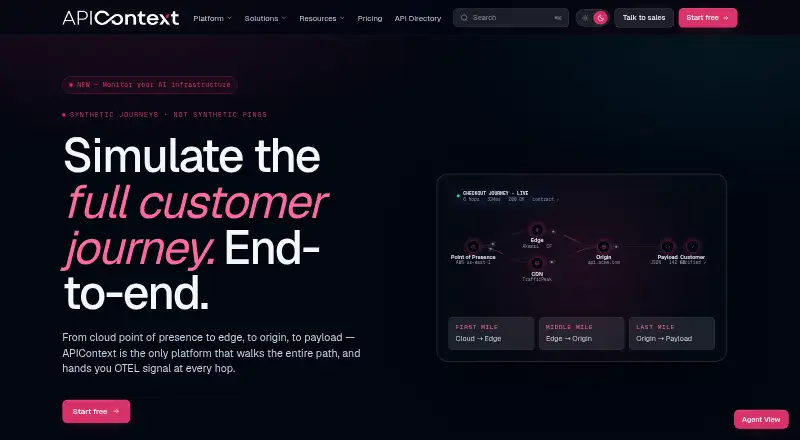
What APIContext is
APIContext is a monitoring platform for checking service reliability and whether live API behavior follows its contract. It makes authenticated calls on a schedule and turns the results into monitoring signals. Its listed coverage includes REST and GraphQL APIs, browser-based web journeys, MCP servers, AI workflows, and third-party services, with checks from 125+ global locations. For contract checks, it compares API behavior with OpenAPI specifications and standards such as FAPI, and can alert when an endpoint diverges. It supports OpenTelemetry-compatible traces, metrics, logs, and events, routed through webhooks and APIs. Listed destinations include Datadog, Dynatrace, Splunk, Grafana, PagerDuty, Slack, ServiceNow, and OpsGenie. Security checks use real calls to validate OAuth, FAPI, JWT, mTLS, scopes, tokens, and protected-resource behavior. A free plan allows 10,000 monthly API, MCP, and HTTP tests, but excludes simulated browser journeys.
Good
- Checks REST and GraphQL APIs, MCP servers, and AI workflows.
- Compares behavior with OpenAPI and FAPI standards.
- Supports OpenTelemetry-compatible traces, metrics, logs, and events.
- Provides security checks using real calls.
- Offers a free tier and a 14-day trial.
Watch out
- Free tier excludes simulated browser journeys.
- Free tier is limited to 10,000 tests monthly.
Who it suits
API and platform teams that need scheduled reliability checks, contract validation, or security checks across APIs and related services may find it suitable. Its free tier is limited to API, MCP, and HTTP tests, while browser journeys are excluded.
Verdict
APIContext combines scheduled monitoring with contract conformance and security checks. Its free tier has a clear test limit and omits simulated browser journeys; paid plans start at $29/mo billed annually.
Plans and prices
From APIContext's own pricing page, checked 30 Sep 2026.
| Plan | Price | What it gives you |
|---|---|---|
| Free tier | Free | 10,000 tests/month · API, MCP, and HTTP tests only · no simulated browser journeys · Forever; no card required, no expiry |
| Starter | $29 a month | 1 project · 5 collaborators · 30,000 synthetic API calls/month · 3 endpoints · 5-minute uptime checks · 3 months data retention · 14 regions · email support · Billed annually · $348/yr |
| Team | $99 a month | Unlimited projects · 20 collaborators · 100,000 synthetic API calls/month · 10 endpoints · 5-minute uptime checks · 6 months data retention · OAS and Postman imports · Billed annually · $1188/yr |
| Pro | $499 a month | Unlimited projects and collaborators · 500,000 synthetic API calls/month · 40 endpoints · 3-minute uptime checks · 12 months data retention · FAPI, FDX, and FHIR conformance · OTEL export · APM forwarding · 4-hour support response · Billed annually · $5988/yr |
| Enterprise | Priced on request | 1,000,000 synthetic API calls/month · 100 endpoints · 60-second checks · 36 months data retention · SSO available as paid add-on · mTLS · FIPS 140 HSM · IP allowlisting · dedicated CSM · 99.99% SLA · Contact APIContext |
The facts
Each one read from APIContext's own pages, with the date it was checked.
Where it runs
- CLI platforms
- The APIContext CLI documentation provides downloads for Windows, macOS, and Linux.checked 30 Sep 2026
What it does
- Compliance
- The pricing page describes SOC 2 controls as self-attested and lists GDPR plus DPA and EU, UK, and US data residency.checked 30 Sep 2026
- Conformance
- The platform checks API behavior against OpenAPI specifications and standards including FAPI, and can alert when an endpoint drifts from its contract.checked 30 Sep 2026
- Coverage
- APIContext says it monitors REST and GraphQL APIs, browser-based web journeys, MCP servers, AI workflows, and third-party services from 125+ global locations.checked 30 Sep 2026
- Integrations
- The product overview lists Datadog, Dynatrace, Splunk, Grafana, PagerDuty, Slack, ServiceNow, and OpsGenie as signal or alert destinations.checked 30 Sep 2026
- Product
- APIContext describes itself as a monitoring platform combining outside-in reliability testing with runtime conformance validation.checked 30 Sep 2026
- Security checks
- APIContext says it validates production OAuth, FAPI, JWT, mTLS, scopes, tokens, and protected-resource behavior using real calls.checked 30 Sep 2026
- Security handling
- The security page says APIContext supports encrypted key and certificate handling and generates audit traces for assessors, stakeholders, and regulators.checked 30 Sep 2026
- Support
- The pricing page lists email support for Starter, a 4-hour response for Pro, and a 1-hour response SLA for Enterprise.checked 30 Sep 2026
- Synthetic monitoring
- The service makes real, authenticated calls on a continuous schedule and turns results into monitoring signals.checked 30 Sep 2026
- Telemetry
- APIContext supports OpenTelemetry-compatible traces, metrics, logs, and events, and says teams can route signals through webhooks and APIs.checked 30 Sep 2026
Money
- Free-tier limit
- The free tier is limited to 10,000 monthly tests for API, MCP, and HTTP checks and excludes simulated browser journeys.checked 30 Sep 2026
The company
- Headquarters
- An APIContext press release announcing the company’s formation identifies Seattle, Washington as its location.checked 30 Sep 2026
The full review of APIContext
Overview
APIContext is a monitoring platform for teams responsible for production APIs, authenticated services, and API contracts. It is best suited to teams that need scheduled checks alongside conformance and security validation. Its breadth is compelling, but the useful free tier has a firm monthly ceiling and excludes browser journeys.
Key features
APIContext makes real, authenticated calls on a schedule and converts their results into monitoring signals. It covers REST and GraphQL APIs, MCP servers, AI workflows, browser-based journeys, and third-party services across 125+ global locations. That makes it a stronger fit for teams monitoring dependencies and service behavior together than a narrow uptime checker; the free tier, however, does not include simulated browser journeys.
Contract checks compare API behavior with OpenAPI specifications and standards including FAPI, with alerts for endpoint drift. Security checks validate production OAuth, FAPI, JWT, mTLS, scopes, tokens, and protected-resource behavior through real calls. These checks are particularly relevant where API identity and conformance carry operational weight, rather than for teams seeking only basic availability alerts.
OpenTelemetry-compatible traces, metrics, logs, and events can be routed through webhooks and APIs. Listed destinations include Datadog, Dynatrace, Splunk, Grafana, PagerDuty, Slack, ServiceNow, and OpsGenie, giving teams several ways to fit signals into existing observability and incident workflows. Encrypted key and certificate handling and audit traces for assessors, stakeholders, and regulators support security review processes. SOC 2 controls are self-attested; GDPR, a DPA, and EU, UK, and US data residency are also described.
Pricing
The Free tier costs nothing, billed Forever, with no card required and no expiry. Its 10,000 monthly tests cover API, MCP, and HTTP checks, but not simulated browser journeys. It is a sensible way to begin monitoring a limited scope, not a substitute for broader production coverage.
Starter costs $29 a month, billed annually at $348/yr. It includes 1 project, 5 collaborators, 30,000 synthetic API calls per month, 3 endpoints, 5-minute uptime checks, 3 months of data retention, 14 regions, and email support. This suits a small team with a few endpoints, though the project and endpoint caps leave little room for a growing estate.
Team costs $99 a month, billed annually at $1188/yr. It raises capacity to unlimited projects, 20 collaborators, 100,000 monthly synthetic API calls, and 10 endpoints, with 5-minute checks, 6 months of retention, and OAS and Postman imports. It is the more natural step for teams sharing work across projects, but still caps collaborators and endpoints.
Pro costs $499 a month, billed annually at $5988/yr. It adds unlimited collaborators, 500,000 monthly calls, 40 endpoints, 3-minute checks, 12 months of retention, FAPI, FDX, and FHIR conformance, OTEL export, APM forwarding, and a 4-hour support response. It is aimed at larger or more regulated API programs; the substantial annual commitment only makes sense if the added throughput, conformance, and integrations matter.
Enterprise has custom pricing and includes 1,000,000 monthly calls, 100 endpoints, 60-second checks, 36 months of retention, mTLS, FIPS 140 HSM, IP allowlisting, a dedicated CSM, and a 99.99% SLA. SSO is a paid add-on, and support has a 1-hour response SLA. Its higher limits and service commitments are for organizations with stringent scale or operational requirements, rather than teams that can work within Pro's caps. The 14-day trial offers a short evaluation window before a paid commitment.
Platforms
APIContext supports Linux, macOS, web, and Windows. Its CLI downloads are provided for Windows, macOS, and Linux, which gives teams on those systems a command-line option alongside the web product.
Who it's for
APIContext fits teams that need to monitor authenticated production APIs while checking contract drift, security behavior, or AI and MCP services. It is less compelling for small projects that need only simple uptime checks, or for teams whose core need is browser journeys but that want to stay on the free tier.
Pros and cons
- Pro: Authenticated scheduled checks, contract conformance, and production security validation address reliability and API behavior in one platform.
- Pro: Coverage across APIs, MCP, AI workflows, browser journeys, and third-party services supports monitoring beyond a team's own endpoints.
- Pro: OpenTelemetry-compatible signals and named alert destinations can connect monitoring with observability and incident response workflows.
- Con: Free monitoring stops at 10,000 tests per month and excludes simulated browser journeys, limiting its value for broad evaluation.
- Con: Paid plans impose endpoint and collaborator caps until higher tiers, while Pro's annual price is a substantial commitment.
- Con: Enterprise SSO costs extra, despite the tier's security and service commitments.
Alternatives
For teams comparing API-focused monitoring options, start with the API Monitoring Tools category. Choose Site24x7 API Monitoring instead if uptime monitoring for up to 50 resources and instant downtime email alerts on its free plan better match the need. Dotcom-Monitor is another freemium option, with a free plan for up to 25 targets, checks as frequent as every 5 minutes, and two monitoring locations.
Postman is the alternative to consider when an API client, specs, mock servers, and collection-running tools matter more than APIContext's scheduled production and security checks. Tallwatch offers a free plan with 10 monitors, 60-second checks from three regions, and email and Slack alerts, making it worth considering for teams prioritizing those monitoring limits. UptimeRobot is a freemium option for hobby and non-profit projects, with 50 monitors and a 5-minute interval on its free plan.
Watchlog offers a free plan with one monitoring agent, one API check, and 10,000 custom events per month, so it is an alternative for teams whose monitoring scope fits those limits. HostTracker has a free plan with two monitors and 30-minute checks, plus a separate 30-day free trial. ObserveOne API Monitoring offers a free plan with 10 AI verifications a month, one saved check, one user, and a 30-day history.
Verdict
Choose APIContext if your team needs scheduled, authenticated API monitoring with contract and security validation, particularly across complex or regulated services. Its combination of checks and signal routing is the strongest reason to choose it; look elsewhere if you need only basic uptime monitoring, need browser journeys on a free tier, or cannot justify annual paid-plan limits and costs.
Getting started
- Visit https://apicontext.com/.
- Choose the free tier or a paid plan; a 14-day trial is listed.
- Use APIContext on the web or on Linux, macOS, or Windows.
- For CLI use, download the CLI for Windows, macOS, or Linux.
Limits worth knowing
The free tier is limited to 10,000 monthly API, MCP, and HTTP tests and does not include simulated browser journeys. Starter costs $29.00 per month billed annually and includes one project, five collaborators, 30,000 monthly synthetic API calls, three endpoints, and five-minute uptime checks.
Questions
Is APIContext free?
Yes. The free tier costs $0.00 per free, is billed forever, requires no card, and has no expiry. It allows 10,000 monthly tests for API, MCP, and HTTP checks.
How much do paid plans cost?
Starter costs $29.00 per month billed annually, or $348 per year. Team is $99.00 per month billed annually, and Pro is $499.00 per month billed annually; Enterprise pricing is by contact.
Is there a free trial?
A 14-day trial is listed.
Which platforms does APIContext support?
The listed platforms are Linux, macOS, web, and Windows. CLI downloads are provided for Windows, macOS, and Linux.
What integrations are listed?
Signal or alert destinations include Datadog, Dynatrace, Splunk, Grafana, PagerDuty, Slack, ServiceNow, and OpsGenie. Teams can also route signals through webhooks and APIs.
Where does APIContext have offices?
Its offices are in London, Edinburgh, Seattle, and Portland.
Alternatives to APIContext
- 1

Dotcom-Monitor
Free planAndroidiOSWebAPI8.3From $13.33 a month - 2
Loadster Synthetic Monitoring
Free planWebAPIExtensionLinux7.8From $29 a month - 3

UptimeRobot
Free planAndroidiOS7.8From $9 a month - 4
Tallwatch
Free planWebAPILinuxmacOS7.7From $14.99 a month - 5

Postman
Free planWebExtensionLinuxmacOS7.6From $9 a month - 6
Sentinel
Free planWebAPIExtensionmacOS7.5From $14 a month