
Apache Flink
Apache Flink is a framework and distributed processing engine for stateful computations over bounded and unbounded data streams.
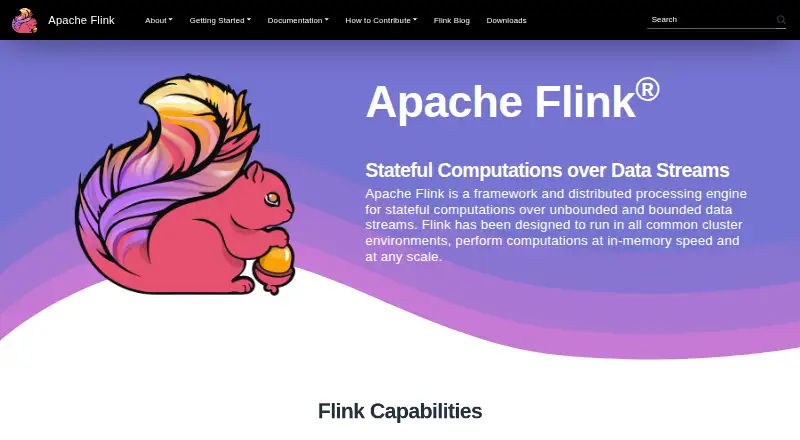
What Apache Flink is
Apache Flink is a framework and distributed processing engine for stateful computations over bounded and unbounded data streams. It supports event-driven applications, stream and batch analytics, and data pipelines and ETL. The project lists exactly-once state consistency, event-time processing, and handling for late data among its capabilities. Its APIs include SQL for stream and batch data, the DataStream API, and ProcessFunction for time and state. Operational capabilities include flexible deployment, high availability, savepoints, scale-out architecture, support for very large state, and incremental checkpoints. The project also lists low latency, high throughput, and in-memory computing. Flink is designed for common cluster environments; for Kubernetes, the site identifies the Kubernetes Operator as the standard deployment mechanism. Separately released connectors include AWS, Cassandra, Elasticsearch, Google Cloud PubSub, HBase, Hive, JDBC, Kafka, MongoDB, OpenSearch, Prometheus, Pulsar, and RabbitMQ. Flink is self-hosted and free under Apache License v2. Security configuration requires attention: SSL/TLS and REST API and SQL Gateway authentication are disabled by default.
Good
- Supports stateful processing of bounded and unbounded streams.
- Offers SQL, DataStream, and ProcessFunction APIs.
- Lists event-time processing and late-data handling.
- Includes savepoints and incremental checkpoints.
- Free under Apache License v2.
Watch out
- SSL/TLS and API authentication are disabled by default.
- Submitted code runs with available operating-system permissions.
- Flink is not a sandbox.
- Mailing-list posting requires subscription.
Who it suits
It suits developers and data teams building stateful stream or batch processing applications, pipelines, or ETL. Teams deploying it in shared or production environments should account for its security configuration requirements.
Verdict
Flink provides APIs and operational capabilities for stream and batch workloads, with a free self-hosted option. Its security boundary and default-disabled authentication settings warrant careful configuration before shared or production use.
Plans and prices
From Apache Flink's own pricing page, checked 30 Sep 2026.
| Plan | Price | What it gives you |
|---|---|---|
| Apache Flink | Free | Open source under Apache License v2 |
The facts
Each one read from Apache Flink's own pages, with the date it was checked.
What it does
- APIs
- Its listed layered APIs include SQL on stream and batch data, the DataStream API, and ProcessFunction for time and state.checked 30 Sep 2026
- Community support
- The project lists its user mailing list as a support channel and also points users to Slack and Stack Overflow.checked 30 Sep 2026
- Correctness
- The site lists exactly-once state consistency, event-time processing, and sophisticated late-data handling as capabilities.checked 30 Sep 2026
- Deployment options
- Flink is designed to run in common cluster environments, and the site identifies the Kubernetes Operator as the standard deployment mechanism for Flink on Kubernetes.checked 30 Sep 2026
- Integrations
- Separately released connectors listed on the downloads page include AWS, Cassandra, Elasticsearch, Google Cloud PubSub, HBase, Hive, JDBC, Kafka, MongoDB, OpenSearch, Prometheus, Pulsar, and RabbitMQ.checked 30 Sep 2026
- Known vulnerabilities
- The project does not maintain its own CVE list and directs users to the Apache Security database for Flink CVEs.checked 30 Sep 2026
- License and maintainer
- The site states that its content is under Apache License v2 and identifies the Apache Software Foundation as the trademark holder.checked 30 Sep 2026
- Operations
- The site lists flexible deployment, high-availability setup, savepoints, scale-out architecture, support for very large state, and incremental checkpoints.checked 30 Sep 2026
- Performance
- The site lists low latency, high throughput, and in-memory computing as performance capabilities.checked 30 Sep 2026
- Security boundary
- Flink trusts the cluster operator and authenticated job submitters; submitted code runs with the operating system permissions available to it, so Flink is not a sandbox.checked 30 Sep 2026
- Security configuration
- SSL/TLS, REST API authentication, and SQL Gateway authentication are disabled by default and must be configured for production or shared deployments.checked 30 Sep 2026
- Support limitation
- A user needs to subscribe to a mailing list before posting, and Jira requires an ASF JIRA account to log issues.checked 30 Sep 2026
- Use cases
- Flink supports event-driven applications, stream and batch analytics, and data pipelines and ETL.checked 30 Sep 2026
- What it does
- Apache Flink is a framework and distributed processing engine for stateful computations over unbounded and bounded data streams.checked 30 Sep 2026
The full review of Apache Flink
Overview
Apache Flink is a self-hosted engine for processing data streams and bounded datasets while preserving application state. It is best suited to engineering teams building event-driven services, analytics, or data pipelines that need control over deployment and operations. Its breadth across stream and batch work is compelling, but the security model puts real responsibility on the cluster operator.
Key features
Flink offers SQL for stream and batch data, alongside the DataStream API and ProcessFunction for work involving time and state. Java, Python, and Scala support gives teams language choices within the same framework. Exactly-once state consistency, event-time processing, and late-data handling help address the practical problem of events arriving late or out of order.
Its operational toolkit includes flexible deployment, high availability, savepoints, scale-out, support for very large state, and incremental checkpoints. These are useful foundations for evolving workloads and recovery, though they do not remove the need to run and manage the underlying infrastructure. Flink identifies low latency, high throughput, and in-memory computing as performance capabilities; actual results still depend on deployment and workload choices.
Separately released connectors span AWS, Cassandra, Elasticsearch, Google Cloud PubSub, HBase, Hive, JDBC, Kafka, MongoDB, OpenSearch, Prometheus, Pulsar, and RabbitMQ. This range can help connect existing data systems, but connector availability does not make Flink a managed integration service.
Pricing
Apache Flink is free and open source under Apache License v2, with no free trial because there is no paid plan to trial. The free plan is the software itself; teams should still account for the infrastructure and operational work required by a self-hosted deployment. There are no paid tiers or seat-based plan distinctions described.
Platforms
Flink is an API-based, Linux and self-hosted product designed for common cluster environments. For Kubernetes, the project identifies its Kubernetes Operator as the standard deployment mechanism. That flexibility suits teams with infrastructure expertise, while organizations seeking a turnkey hosted service should consider a managed option instead.
Who it's for
Flink fits teams that need stateful stream processing alongside batch analytics or ETL, and can operate distributed infrastructure. Its APIs, time handling, and operational features make it a serious choice for workloads where event correctness and scale matter. It is less suitable for users looking for a desktop application, a managed service included with the software, or an isolated execution environment for untrusted jobs.
The security boundary deserves particular attention in shared or production clusters. Flink trusts the cluster operator and authenticated job submitters; submitted code runs with the operating-system permissions available to it, so Flink is not a sandbox. SSL/TLS, REST API authentication, and SQL Gateway authentication are disabled by default and need configuration before production or shared use.
The project directs users to its user mailing list, Slack, and Stack Overflow. Posting to the mailing list requires subscribing first, and filing Jira issues requires an ASF JIRA account. For vulnerability information, Flink points users to the Apache Security database rather than maintaining its own CVE list.
Pros and cons
- Pros: Stream and batch APIs, SQL, and support for Java, Python, and Scala let teams address several processing patterns in one framework.
- Pros: Exactly-once state consistency, event-time processing, and late-data handling address important correctness demands in event-driven workloads.
- Pros: Flexible deployment, high availability, savepoints, scale-out, and incremental checkpoints give operators tools for managing stateful systems.
- Cons: Self-hosting means the team must supply and operate its cluster rather than relying on an included managed environment.
- Cons: Job code is not sandboxed and runs with available operating-system permissions, making trust boundaries essential.
- Cons: Several security controls are disabled by default, so shared and production deployments require deliberate configuration.
Alternatives
Materialize is worth considering if a managed web option or a self-managed free plan capped at 24GiB memory and 48GiB disk better matches the deployment. Feldera offers an open-source single-node, single-container edition with full SQL support, all connectors, and datasets larger than memory for teams that prefer that footprint.
Ververica Platform may suit teams considering its free Community Edition or Cloud option, with the caveat that a free license may be required and license terms may restrict use. Apache Beam is another free, open-source programming model; execution costs depend on the runner and infrastructure selected.
RisingWave is an alternative for teams considering a paid product with a self-managed Apache 2.0 open-source version without feature gates, license fees, or usage restrictions. Amazon Managed Service for Apache Flink is the option to consider when managed Flink is preferable; its usage-based charges depend on duration, KPU count, running storage, and optional durable backups.
Confluent Cloud may fit readers seeking a serverless managed option with autoscaling Kafka resources and more than 80 fully managed connectors. Timeplus offers a free, open-source streaming SQL engine as another option.
Browse the Streaming Analytics Software and Stream Processing Software directories for more options.
Verdict
Choose Apache Flink if your team needs a capable, free framework for stateful stream and batch processing and has the expertise to operate its own clusters. Its strongest case is the combination of correctness features, multiple APIs, and operational controls. Look elsewhere if you need managed hosting or a sandboxed job boundary; in production, securing its default configuration is part of adopting it.
Alternatives to Apache Flink
- 1

Apache Beam
Free planOpen sourceWebAPILinuxmacOS7.7Free plan - 2
Apache Druid
Free planWebAPILinuxmacOS7.2Free plan - 3

Confluent Cloud
Free planWebAPILinux7.1From $385 a month - 4
Timeplus
Free planWebAPILinuxmacOS7.1From $199 a month - 5

Materialize
Free planWebAPILinuxSelf-hosted7.0From $1.50 a year - 6

RisingWave
WebAPILinuxmacOS6.7$0.23 usage-based